

Last Updated: November 7, 2026
Quick Summary
Precision cut steel tubing is steel tube sawn to a specified length with squared ends and a tight length tolerance, so pieces fit without re-cutting or grinding. Cut accurately, parts seat without shims and welds close with predictable gaps. Specifying both length and squareness reduces rework during assembly.
- Precision-cut pieces arrive square at a known length, ready for the jig.
- Our 3" x 4" and 1-1/2" x 2" rectangle tubing is cut to approximately ±1/8" on length.
- Out-of-square ends open gaps the weld must bridge, causing burn-through or inconsistent penetration.
- Burrs snag fixtures and keep parts from sitting flush, adding deburring time to every end.
- Specify both length and squareness for critical joints, and plan a dry fit before welding.
Table of Contents
- What Precision Cut Steel Tubing Actually Means
- How Cut Accuracy Affects Fit, Welds and Assembly Time
- Steel Tubing Sizes and Wall Thickness Basics
- Steel Tubing Cut to Length: Tolerances and Ordering Tips
- Steel Tubing Applications Where Precision Pays Off
- How to Choose Steel Tubing for Your Project
- Getting Your Precision Cut Tubing Ordered and Delivered
- Frequently Asked Questions
What Precision Cut Steel Tubing Actually Means
Precision cut steel tubing is rectangular, square or round steel tube sawn to a specified length, with the ends squared and held to a tight length tolerance.
Cutting stock yourself with a hacksaw, cutoff wheel or grinder can leave ends out of square and rough with burrs, and those imperfections carry straight into fit-up and welding.
Our current catalog includes 1-1/2" x 2" 11ga rectangle tubing, 3" x 4" rectangle tubing in 11ga and 3/16" wall, and 1" x 2" x 3/16" rectangle tubing manufactured to A500 Grade B and A513 standards.
How Cut Accuracy Affects Fit, Welds and Assembly Time
Cut accuracy determines how much time you spend before the first weld.
Square ends matter as much as length. A tube whose end sits at a slight angle creates a gap the weld must bridge, inviting burn-through on thin wall and inconsistent penetration on heavier wall.
Burrs are the other hidden cost. A rough cut leaves sharp edges that snag on fixtures and keep parts from sitting flush.
Here is how the cost of inaccurate cuts typically shows up on a job:
| Problem | Where it appears | Typical fix | Time impact |
|---|---|---|---|
| Length off by a few eighths | Frame or rack assembly | Re-cut, shim or regrind | Adds rework on every affected joint |
| Out-of-square ends | Butt and miter joints | Grind or re-square | Slows fit-up and weld prep |
| Burrs on the tube edge | Fixtures and mating parts | Hand deburr | Minutes per end, multiplied by piece count |
| Inconsistent gaps | Welding | Extra filler or re-tacking | Affects weld quality and rework |
Steel Tubing Sizes and Wall Thickness Basics
Rectangle and square tubing is described by outside dimensions and wall thickness. A 2 x 2 tube with a thin wall and one with a heavy wall look nearly identical but weigh and carry load very differently.
Thinner walls are lighter and cheaper per foot, working well for frames, supports and trailer components where load is distributed. For full dimensional reference, see our 2 1/2 x 2 1/2 Square Tubing: Wall Thickness and Weight Guide and our Steel Tubing Sizes and Specs Buying Guide.
When you compare sizes, check three things: the outside dimensions, the wall thickness, and the material grade. Our 1" x 2" x 3/16" tubing, for example, is listed at 3.05 lb/ft and manufactured to A500 Grade B / A513 specifications.
Steel Tubing Cut to Length: Tolerances and Ordering Tips
A tolerance is only useful if you know what it controls. Cut-to-length tubing has two independent tolerances: length tolerance (how close the finished piece is to the ordered dimension) and squareness tolerance (how far the cut end deviates from 90 degrees to the tube axis).
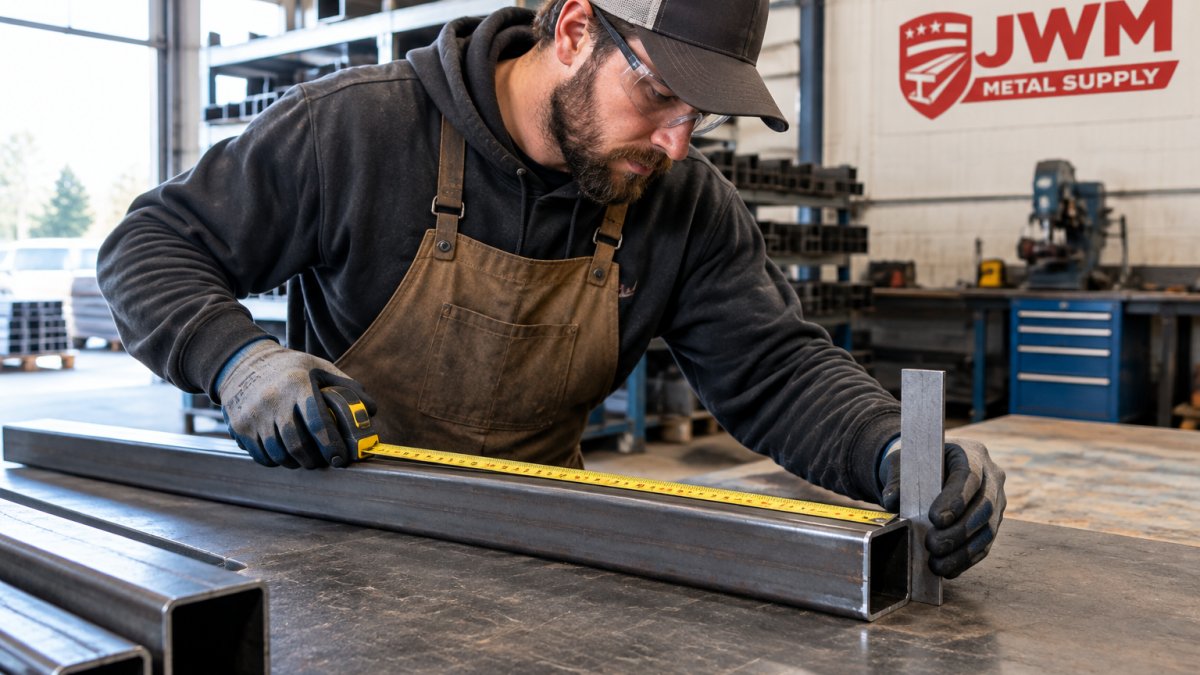
A length tolerance around ±1/8" is the figure listed for our 3" x 4" and 1-1/2" x 2" rectangle tubing. Our 3" x 4" and 1-1/2" x 2" rectangle tubing listings are cut to approximately ±1/8" on length.
What Actually Drives Achievable Accuracy
Four variables set the practical floor on how tight a cut can hold:
- Blade condition and type. A dull blade deflects in the cut, causing length drift on long runs, a rougher edge and a wider kerf, so the same saw setting yields a different finished length than a fresh blade.
- Wall thickness and tube geometry. Thin walls (11ga, 0.125") flex more under clamping and cutting force than 3/16" wall, so thin-wall pieces vary more on the same saw. Square and rectangle tube also behave differently from round tube because the blade exits a flat face rather than a curve.
- Feed rate and clamping. Pushing the saw faster than the material wants produces a burr on the exit side and can pull the tube in the vise. Consistent clamping pressure and a matched feed rate separate a repeatable cut from a one-off good cut.
- Stock straightness. A tube with a bow or twist will not sit flat in the saw, and the resulting cut is square to the vise, not the tube. No saw setting fixes crooked stock.
How to Specify Tolerance by Joint Type
Match the tolerance you ask for to how the part actually joins:
| Joint type | What matters most | Practical tolerance guidance |
|---|---|---|
| Butt joint, welded | Squareness and consistent length | ±1/8" length is usually adequate; squareness controls gap |
| Mitered corner | Squareness of the cut face | Specify square ends; a few degrees of error opens the miter |
| Bolted or clamped assembly | Length and hole-to-end distance | Tighter length tolerance, since there is no weld gap to absorb error |
| Machine base or mounting surface | Flatness of the assembled face | Dry-fit before welding; build in a trim allowance |
How Cut Length and Squareness Are Inspected
A supplier holding a tolerance should be able to tell you how it is checked. Common inspection methods include:
- Length is checked with a tape or steel rule against a stop, or a caliper for short pieces. On production runs, a length stop is set once and spot-checked against a reference piece.
- Squareness is checked with a machinist's or combination square held against the tube side and cut face; a feeler gauge or visual gap shows how far off the end is. For tighter work, a dial indicator on a surface plate gives a number rather than a judgment call.
- Burr is checked by running a gloved finger along the edge or by visual inspection under light; a burr that catches a glove will interfere with fit-up.
If your project is regulated or safety-critical, ask your supplier what inspection record ships with the order.
What to Include When You Place an Order
When you order cut tubing, give the supplier the details that decide whether the piece is right the first time:
- Exact outside dimensions (for example, 1-1/2" x 2" or 3" x 4")
- Wall thickness in gauge or fraction form (11ga, 0.125", 3/16")
- Material grade if your project has a specification, such as A500 Grade B
- Finished length in inches, with the quantity of each length
- Tolerance for length and, if the joint is critical, a note that ends must be square
- Finish (raw steel is most common for welding projects)
- Shipping address and timeline, so you can plan the job around delivery
Writing these down before you order cuts the back-and-forth. A single mismatched dimension can hold up a whole build.
Watch out: if you specify a tolerance tighter than the cutting setup can hold, the schedule can slip. Confirm the achievable tolerance before you commit the drawing.
Steel Tubing Applications Where Precision Pays Off
Precision cut tubing is useful wherever pieces must assemble quickly, though the reason precision matters changes by application.
Trailer Frames and Crossmembers
Repeated lengths must square up across the frame, and crossmembers need consistent length so the deck sits flat. The dominant requirement is length repeatability across dozens of pieces, because a frame out of square by a fraction of an inch per crossmember compounds into a visible twist. Squareness matters at the rail-to-crossmember joint, where a gap forces the welder to bridge it. Burr control is secondary, but a heavy burr still interferes with clamping.
Equipment Frames and Machine Bases
Mounting holes and sub-assemblies depend on exact spacing, so length tolerance and squareness both tighten. A machine base that must sit flat against a mounting surface cannot absorb error with a weld gap the way a trailer frame can. This is where a dry fit before welding earns its keep and a trim allowance is worth building in.
Farm and Ranch Repairs
Gate frames, feeders and equipment supports are usually one-off or low-volume, so fit-up speed matters more than repeatability across a long run. A square, clean end lets a repair go together in the field without a grinder. Burr control matters because these parts get handled.
Furniture and Shop Fixtures
Clean, square joints show in the finished piece, so squareness and edge quality are the visible requirements. A burr or out-of-square end that would be hidden under a weld on a trailer frame is on display here, making this the application where specifying square ends and a clean cut edge is worth the conversation with the supplier.
Automotive Fabrication
Roll cages, brackets and custom supports combine tight length tolerance with squareness at mitered joints. A roll cage is a safety structure, so joint fit and weld quality matter beyond cosmetics, and brackets that bolt to a chassis need hole-to-end distances that hold. This is where inspection documentation and traceability start to matter.
How to Read the Comparison
The pattern is that volume drives the value of repeatability, and joint type drives the value of squareness. High-volume, welded assemblies get the most from consistent length; low-volume, visible or bolted assemblies get the most from square, clean ends. Regulated or safety-critical work adds inspection and documentation on top of both.
In each case, a tube cut square and to length can reduce grinding and fitting time during assembly. The first step is knowing which tolerance your application actually depends on.
How to Choose Steel Tubing for Your Project
Start with the load and the environment.
Step 1: Define the load. Light supports and enclosures can use thinner walls such as 11ga.
Step 2: Match the material to the job. A500 Grade B and A513 steels are common choices for structural and general fabrication.
Step 3: Choose the cut. Specify finished lengths and a square end.
Step 4: Plan the finish. Raw steel is what most welding projects use.
Step 5: Check the timeline. Our standard orders ship in 1 to 5 business days. If your deadline is tight, confirm the lead time before you commit to a build schedule.
Getting Your Precision Cut Tubing Ordered and Delivered
Ordering cut tubing is quick once you have the dimensions, wall thickness, grade and finished lengths written down. You can shop our cut-to-length rectangle tubing and see the available lengths for each size before you check out.

If you are still deciding where to buy, our guide to buying square tubing cut to length covers what to check when comparing suppliers, and our custom cut steel tubing ordering guide walks through the process from quote to delivery.
Precision cut tubing removes the step where raw stock gets measured, sawn and cleaned by hand.
Frequently Asked Questions
Why is precision cut steel tubing worth paying for?
Precision cut tubing arrives at a consistent length with square, clean ends, so parts fit together without extra grinding or shimming. Tight, repeatable cuts help parts fit together with less adjustment before welding. Ordering pieces cut to length also means you are not wasting time measuring, marking and sawing each piece yourself.
How accurate is cut-to-length steel tubing?
Accuracy depends on the supplier and the cutting method. For example, JWM Metal Supply's 3" x 4" x 11ga and 1" x 2" x 3/16" rectangle tubing lists a length tolerance of approximately ±1/8", with saw-cut ends. That tolerance is typical for many fabrication jobs, but if your assembly requires tighter fit, measure your pieces against the actual part before welding and plan for a small allowance in your design. Always confirm tolerance details before ordering.
What type of steel tubing is the strongest?
Strength depends more on the steel grade and wall thickness than on shape alone. A500 Grade B carbon steel is a common structural choice for rectangular tubing, and heavier wall thickness, such as 3/16" (0.188") compared with 11ga (0.125"), increases load capacity. For load-bearing frames, trailers or equipment supports, check the grade and wall thickness against the loads your project will see, and consult an engineer for critical structures.
What information should I provide when ordering cut-to-length steel tubing?
Provide the profile (round, square or rectangle), outside dimensions, wall thickness, material grade if it matters for your project, the exact cut length in inches and the quantity needed. Note whether you need square ends and whether you are ordering a single piece or several. Accurate specifications at the time of order reduce the chance of receiving the wrong size or length and help you avoid rework during fabrication.
