

Quick Summary
To select steel tubing for farm equipment repair, first measure the damaged part's outside dimensions, wall thickness and length, then match its shape to the load it carries. Check how the original failed before copying it, and choose a wall at least as thick as the original, moving up one gauge if the part failed from repeated stress.
- Measure outside dimensions at two or three points, since dents and wear can change the size.
- Confirm wall thickness with a caliper or the stamped gauge, and record the decimal reading.
- Use square or rectangular tubing for bending loads and round tubing for twisting loads.
- Never choose a wall thinner than the original; moving up one gauge helps after repeated stress.
- Plan protection against moisture, fertilizer and abrasion before choosing the coating for the joint.
Table of Contents
- Start by Measuring the Damaged Part
- Choosing Round or Square Steel Tubing for the Load
- Selecting Steel Tubing Sizes and Wall Thickness
- Picking a Steel Tube Grade for Welding
- Accounting for Corrosion and Field Conditions
- Ordering Your Cut-to-Length Tubing From JWM Metal Supply
- Frequently Asked Questions
Start by Measuring the Damaged Part
The fastest way to a good replacement is to measure the part you are fixing. A tube that looks close is often off by enough to ruin a fit. Start with the outside dimensions, the wall thickness and the length.
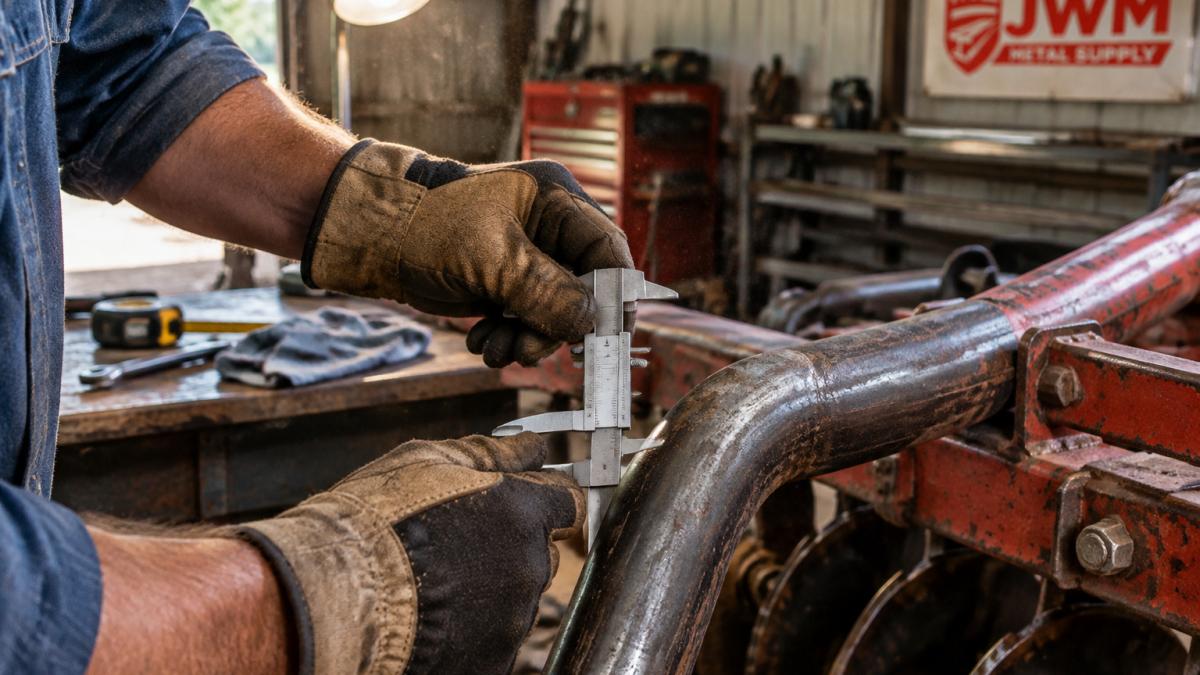
Use a set of calipers or a tape measure for the outside width and height. Measure at the flat sides of a square tube or across the diameter of a round one. Take readings at two or three points along the damaged section, since dents and wear can hide a different size at each end.
Measuring Outside Dimensions and Wall Thickness
Wall thickness is a number people often get wrong. Measure the edge of the cut end with a caliper, or check the gauge stamped on the old tube if it is still legible. Steel gauge numbers can be confusing, so write down the decimal reading too. An 11ga wall is about 0.120 to 0.125 inches, which is very different from a 3/16 inch wall at 0.188 inches.
Note the shape as well. Round, square and rectangular tubing each fit different brackets and mounting points, and a mismatch in shape is harder to fix than a small error in size.
Checking Length and Cut Tolerance
Measure the length the replacement needs to be, then add nothing. Cut-to-length stock is usually cut square, but the tolerance on a saw cut is typically about plus or minus 1/8 inch. For a tight fit, leave the piece a little long and trim it during test fitting.

Keep the damaged piece as a template. Set it next to the new tube and check that the ends and holes line up before you weld anything.
Choosing Round or Square Steel Tubing for the Load
The shape of the original part usually tells you what it was designed to do, but for a repair you also need to understand why that shape was chosen so you can decide whether an equivalent replacement is safe. Square and rectangular tubing is common on frames, implement arms and mounting brackets because the flat faces make it easy to bolt and weld and because the walls resist bending in the direction of the load.
Ask what the tube has to carry and in which direction. A frame member that takes bending loads from a heavy implement usually benefits from square or rectangular shape, which puts material where the bending stress is highest. A piece that turns or rotates is often better as round tubing because a round section resists torsion evenly around its axis.
Inspecting the Failed Member Before You Match It
Before you copy the original shape, look at how it failed. A tube that bent in the middle points to a bending overload; a tube that twisted or cracked at a weld points to torsion or a stress concentration. Check for cracks at weld toes, elongation around bolt holes, and fretting or wear at contact points. If the failure is at a weld rather than in the tube itself, matching the shape and wall may not fix the root cause, and the repair may need a gusset, a doubler or an engineering review.
Measure the original outside dimensions and wall thickness at an undamaged section, not at the bent or worn area, because deformation changes the reading. Compare the measured wall to the nominal size; a part that has worn thin at a rub point may need a thicker wall or a wear pad rather than a like-for-like replacement.
When to Match the Original and When to Reconsider
For a one-off repair, copying the original shape, size and wall is the safest path because the surrounding structure was built around it. Changing shape can change how the part flexes, how it sits against other components and how you weld it. Reconsider the design only when the original part failed repeatedly in the same spot, when the load has clearly changed (a larger implement, added weight, a different hitch), or when the replacement material is not equivalent. In those cases, a qualified engineer or the equipment manufacturer should review the design rather than a shop improvising a stronger-looking part.
Watch out: A tube that is stronger in one direction can be weaker in another, so a shape change made to fix a bending failure can create a torsion or fatigue problem elsewhere in the assembly.
Selecting Steel Tubing Sizes and Wall Thickness
Once you know the shape, pick the size and wall thickness. A common mistake is choosing a size that fits the hole pattern but has too thin a wall for the job. The fit can look right while the part fails under load.
Matching Wall Thickness to the Repair Load
Thicker walls resist bending and denting better, but they also add weight and cost. For most farm repairs, the original wall thickness is a good starting point. If the part failed from repeated stress, moving up one gauge (a thinner-to-thicker step, such as 16ga to 14ga) can help. Do not go thinner than the original.
For a larger frame member, our 3 x 4 x 3/16 rectangle tubing and 2 x 4 x 11ga rectangle tubing are available cut to length.

Watch out: Do not assume a thicker wall is always better. A heavier tube can overload the existing mounts and welds, so match the wall to what the surrounding structure was built for.
The article's key sizing and wall-thickness points are summarised below.
| Item | Value | Note |
|---|---|---|
| Original wall thickness | Starting point | Do not go thinner than original |
| Moving up one gauge | 16ga to 14ga | Can help after repeated stress |
| Rectangle option | 3 x 4 x 3/16 | For larger frame members |
| Rectangle option | 2 x 4 x 11ga | Available cut to length |
| Main sizing risk | Too thin a wall | Fit can look right but fail under load |
Picking a Steel Tube Grade for Welding
Most farm repairs use carbon steel tubing. The grade you choose affects how easily it welds and how it holds up under load. Common structural tubing is produced to ASTM A500, which specifies the mechanical properties and tolerances engineers rely on (A500/A500M Standard Specification for Cold-Formed Welded and Seamless Carbon Steel...). Our rectangle tubing is listed as A500 Grade B carbon steel in its product details.

For welding, carbon steel tubing in this family is generally straightforward to join with standard processes. Clean the mill scale and oil from the weld area, match your filler metal to the base steel, and preheat only if the wall is thick or the shop is cold. Keep heat input moderate, because excess heat can weaken the metal next to the weld, an area called the heat-affected zone.
Accounting for Corrosion and Field Conditions
Farm equipment lives outdoors, in rain, mud, fertilizer, manure and road salt, and each of those conditions attacks steel differently. A repair that ignores the operating environment will often fail at the coating before it fails at the weld. Plan the protection at the same time you choose the tube, because the coating choice affects how you prepare and weld the joint.
Matching Protection to the Operating Condition
Moisture and soil exposure are the baseline: raw carbon steel will rust if left bare, so at minimum clean the tube, apply a primer and a topcoat, and touch up any coating burned off during welding.
Galvanized tubing is a common choice for outdoor structures because the zinc coating protects the steel even where the surface is scratched, but the coating must be handled correctly during repair. Welding over galvanized steel requires removing the zinc from the weld zone first and providing good ventilation, because zinc fumes are hazardous. Paint and primer are easier to weld around but offer less scratch protection, so they suit parts that are painted after fabrication and inspected regularly.
Coating Damage, Maintenance and Hidden Corrosion
Most coating failures start at edges, weld toes, bolt holes and rub points, so inspect those areas first. A coating that is chipped or burned back lets moisture under the film, and the steel can corrode beneath intact-looking paint. After a repair, recoat the weld and any bare metal before the part goes back into service, and schedule a recheck after the first season to catch coating breakdown early.
Corrosion can also hide inside a closed tube or at a welded joint, where you cannot see it. If the original part failed by thinning from the inside, matching the outside dimensions will not restore the lost wall, and the replacement should account for that loss.
Watch out: Do not weld over an unknown coating without checking what it is; some coatings release hazardous fumes and some must be removed before welding.
Ordering Your Cut-to-Length Tubing From JWM Metal Supply
With your measurements, shape, size and grade chosen, you are ready to order. JWM Metal Supply sells American-made carbon steel tubing cut to the exact length you enter, with no minimum order quantity, so a single repair piece is as easy to buy as a stack of stock.
Before you order, double-check these items:
- Outside width, height and shape from your measurements
- Wall thickness in gauge and decimal inches
- Required length, plus a little extra if you plan to trim during fitting
- Finish: our tubing ships raw, so plan your own paint or coating
Standard orders ship in 1 to 5 business days, and nationwide shipping is available. Material certifications are available if your repair needs documented specifications. Browse the full catalog and place your order at JWM Metal Supply to get the right tube cut to fit your repair.
Frequently Asked Questions
Is round or square steel tubing stronger?
For most farm equipment repairs, the answer depends on the direction of the load. Square and rectangular tubing have flat faces that handle bending in the planes of their sides and make bolting and welding to frames simpler. Round tubing distributes stress evenly around its circumference and resists torsion well, which is why it is common in axles and drive components. Match the shape to how the original part was loaded, and when in doubt, use the same shape and wall thickness as the part you are replacing.
How do I measure steel tubing for a replacement part?
Measure the outside width and height of the tube with a caliper, not a tape, so you capture the true outside dimension. Measure wall thickness at a cut end or with an ultrasonic gauge, and convert gauge numbers to inches before ordering, since a 11-gauge wall is about 0.120 inch to 0.125 inch depending on the standard. Record the length you need, then add a small allowance for the weld preparation you plan to do.
What should I check before welding replacement steel tubing?
Confirm the grade and wall thickness match or exceed the original, clean mill scale, oil and paint from the weld zone, and make sure the fit-up is tight. Check that the tube is straight and square at the cut end. Thin walls can burn through quickly, so set your amperage and travel speed for the wall thickness you are actually welding rather than a generic setting.
What are the different grades of steel tubes?
Structural hollow sections are commonly produced to ASTM A500 Grade B and Grade C, which differ mainly in minimum yield and tensile strength. Grade B is the common choice for general fabrication and farm frames. The rectangular tube sold by JWM Metal Supply is raw, unpainted carbon steel with a saw-cut end. Verify the grade on your order or certification before relying on it for a load-bearing repair.
