

Last Updated: November 5, 2026
Quick Summary
Securing steel plate starts with a clean deck, sound anchor points, and dunnage or blocking so the plate cannot slide forward. Rig front, middle, and rear tie-downs in pairs, tension them evenly in a crisscross order, and protect every sharp edge where a strap crosses the plate.
- Sweep the deck free of gravel, ice, and oil, since grit or grease kills friction.
- Center the plate over the trailer axles, not over the tail, to prevent sway.
- Tighten in a crisscross order so the plate does not walk sideways as tension builds.
- A 2-inch ratchet strap rated at 3,333 lb working load is practical to re-tension at a fuel stop.
- Stop and re-check the load in the first 10 to 25 miles as straps settle and stretch.
Table of Contents
- Start With Load Prep and a Securement Plan
- How to Secure Steel Plate on a Flatbed: Step by Step
- Straps vs Chains for Steel Plate: Which Holds Better
- Working Load Limit and Tie-Down Count Math
- Edge Protectors for Tie-Down Straps: Stop the Cut
- Cross-Chains, X-Chains, and Stopping Side Shift
- Cargo Securement Checklist and Re-Tensioning Schedule
- Order Cut-to-Length Plate and Tie-Down Gear in One Stop
- Frequently Asked Questions
Start With Load Prep and a Securement Plan
Securing steel plate starts before you touch a strap. A clean deck, sound anchor points, and a written plan for where each tie-down goes decide whether the load stays put at highway speed.
Steel plate is dense, flat, and slick, with no chocks, handles, or grab points. That makes it one of the harder loads to secure well, and it is why securing steel plate deserves a plan rather than a quick guess.
Clean the Deck and Check Anchor Points
Sweep the trailer deck free of gravel, ice, and oil. Friction between plate and deck does real work, and grit or grease kills it.
Then inspect every anchor point:
- Look for cracks, bends, or rust-thinned steel
- Confirm each D-ring or E-track rail is bolted or welded per its rating
- Reject any anchor that moves under hand pressure
A weak anchor fails first. Replace it before the plate goes on.
Block and Dunnage the Plate Before Tensioning
Dunnage is scrap lumber or rubber matting placed under and around the load. It raises the plate off a slick deck and gives straps and chains a shoulder to pull against.
- Lay 4x4 or 2x4 dunnage across the deck so the plate sits on wood, not bare steel
- Place blocking against the front edge so the plate cannot slide forward under braking
- Keep blocking low enough that it does not interfere with strap routing
Blocking against forward movement matters most. Hard braking pushes a heavy plate forward with force that multiplies with speed and weight.
How to Secure Steel Plate on a Flatbed: Step by Step
The short version: position the plate, anchor front, middle, and rear, then tension evenly and check it twice. Most failures come from skipping the middle tie-down or over-tightening one strap while the rest sit loose.
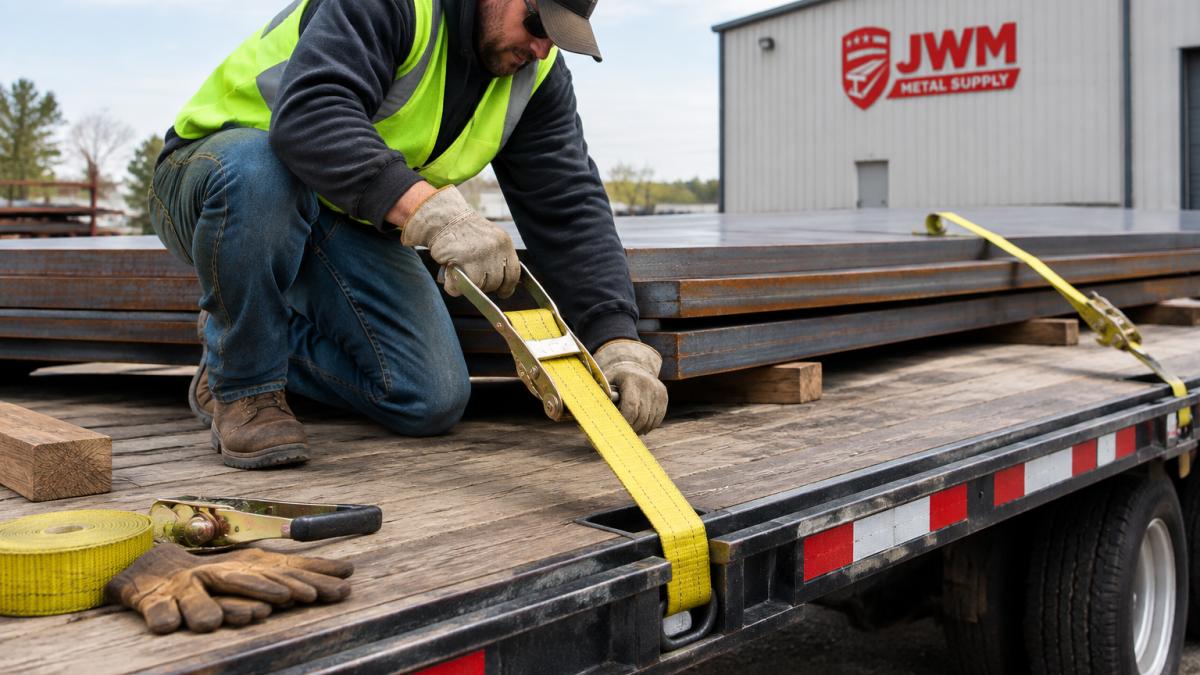
Step 1: Position the Load and Set Anchor Points
Center the plate over the trailer axles, not over the tail. Too much weight behind the rear axle lightens the tongue and makes the trailer sway.
Set anchor points in pairs, directly across from each other on both sides of the deck. If your trailer has no built-in anchors, bolt-on E-track rails give you adjustable attachment points along the full deck length. Our E-track rail and hook kit and 8-pack E-track kit provide adjustable tie-down points for trailer decks.


Step 2: Run Front, Middle, and Rear Tie-Downs
Run tie-downs in three groups:
- Front: two straps angled forward and outward from the plate's front corners
- Middle: two straps straight down or slightly outward over the plate's center
- Rear: two straps angled rearward and outward from the back corners
Angling straps outward as well as forward or back resists side shift, not just fore-and-aft movement. For heavy plate, a heavy-duty ratchet strap set does the pulling. Our VEVOR retractable ratchet tie-down straps automatically retract excess webbing to keep it tangle-free.

Step 3: Tension Evenly and Verify the Load
Tighten in a crisscross order, like lug nuts. Snug one strap, then its opposite, then move to the next pair. This keeps the plate from walking sideways as tension builds.
Then verify:
- Press down hard on each corner. Any movement means a loose strap
- Check that webbing is not twisted or rubbing a sharp edge
- Confirm every ratchet handle is fully locked down
Straps vs Chains for Steel Plate: Which Holds Better
Chains win for heavier plate and sharp edges. Straps win for lighter plate, convenience, and protecting the finish.
Chains generally resist abrasion and cut-through better than webbing.
Straps are lighter, faster to rig, and gentler on machined surfaces. A 2-inch ratchet strap rated at 3,333 lb working load is practical to re-tension at a fuel stop.
| Factor | Straps | Chains |
|---|---|---|
| Best for | Lighter plate, finished surfaces | Heavier plate, rough edges |
| Edge damage risk | High without protectors | Low |
| Setup speed | Fast | Slower |
| Weight | Light | Heavy |
| Cost | Lower | Higher |
| Re-tensioning | More frequent | Less frequent |
| Binder release risk | Ratchet, low | Load binder, needs full seat |
A practical rule of thumb: if the plate is light enough that four 2-inch straps clear the aggregate WLL requirement with margin, straps are fine as long as every edge is protected.
Watch out: a load binder that is not fully seated can pop open under vibration, and a chain that looks tight at the dock can go slack after the first hard brake. For a deeper comparison before you buy, our guide to heavy-cargo tie-down systems breaks down the trade-offs.
Working Load Limit and Tie-Down Count Math
Working load limit, or WLL, is the maximum load a tie-down is rated to hold in service. It is always well below break strength, and it is the number stamped on the strap, chain, or binder.
Here is how to work the math for a plate load in plain terms:
- Weigh the plate. A 4x8 sheet of 1/4-inch plate weighs roughly 326 pounds; two stacked sheets are about 652 pounds. Without a scale ticket, calculate from the plate's dimensions and published weight per square foot.
- Add up the WLL of every tie-down. A 2-inch ratchet strap rated at 3,333 lb WLL contributes 3,333 lb. A Grade 70 5/16-inch chain with a load binder contributes roughly 4,700 lb. Read the stamp, not the marketing copy.
- Compare the aggregate to the load weight. The aggregate must be at least half the load weight under the federal minimum, and most practitioners aim well above that for flat, slick steel.
- Count the minimum tie-downs. Check the current federal minimum tie-down counts for your load length and weight before you haul. Blocking that genuinely prevents forward movement can reduce the count, but only if it is rated for the load.
- Add a margin for friction loss. Steel on steel has very low friction, and a wet or oily deck makes it worse. When friction is low, the tie-downs carry more of the fore-and-aft load, so add tie-downs rather than relying on the deck.
A worked example: a 4x8 sheet of 1/4-inch plate at roughly 326 pounds with four 2-inch straps at 3,333 lb WLL each gives an aggregate far above half the load weight.
Watch out: never use a tie-down at its break strength.
Edge Protectors for Tie-Down Straps: Stop the Cut
Edge protectors are sleeves, pads, or corner guards placed between webbing and a sharp plate edge. They spread the load and stop the edge from cutting the strap. A cut strap is a failed strap, and it usually fails at speed.
Common options include:
- Heavy rubber corner guards
- Sections of split hose slipped over the edge
- Commercial webbing sleeves
- Folded scrap carpet or conveyor belt
Place a protector at every point where a strap crosses a plate edge. Then check them again after tensioning, because straps shift as they settle.
Cross-Chains, X-Chains, and Stopping Side Shift
A cross-chain runs diagonally from one side of the trailer to the opposite side of the load. An X-chain is two cross-chains forming an X over the load. Both fight lateral movement, the sideways slide that straight-down straps do not stop.
Use cross-chains when:
- The plate is wide and heavy
- The deck is slick or the plate sits on steel
- You expect turns, crowned roads, or crosswinds
- The load has no blocking against side shift
Run the X over the top of the plate, anchored to opposite corners. Tension both legs evenly so the X pulls the plate down and inward at the same time.
Cargo Securement Checklist and Re-Tensioning Schedule
A checklist beats memory every time. Run through it before you pull out, and again at every stop.
- Deck clean, dry, and free of debris
- Dunnage and blocking in place
- Every anchor point inspected and sound
- Front, middle, and rear tie-downs rigged
Re-tensioning schedule:
- First 10 to 25 miles: stop and re-check. Straps settle and stretch
- Every fuel stop or two hours: walk the load, press-test corners
- After any hard braking or rough road: stop and inspect
- Before unloading: check for shifted straps or worn webbing
Watch out: webbing that has been rubbing a sharp edge can look fine on top and be cut halfway through underneath. Slide your gloved hand along the full length of every strap at each stop.
Order Cut-to-Length Plate and Tie-Down Gear in One Stop
You can buy the plate and the gear that holds it in the same place. Pairing the plate with the right tie-down gear also means protecting its surface from rubbing and scuffs, with Superior Fit Sleeves helping keep contact points covered.
Here is what we stock that pairs with this guide:
- Retractable ratchet tie-down straps with steel S-hooks and weather-resistant webbing
- 2-inch heavy-duty tie-down straps rated at 3,333 lb working load
- E-track rail kits in 6-pack and 8-pack configurations for adjustable anchor points
- Cut-to-size steel plate in square and rectangle shapes, shipped nationwide
Material certifications are available if you need documented specs for a load-bearing job. Most orders ship in 1 to 5 business days.
Getting the plate size right is half the securement battle.
Frequently Asked Questions
How many tie-downs are needed to secure a steel plate load?
Count by aggregate working load limit, not by habit. Add the WLL of every tie-down you plan to use and confirm the total meets the current federal minimum for your load, then add a tie-down for margin. A 2-inch ratchet strap rated at 3,333 lbs WLL means two of them cover a 6,000 lb plate on paper, but four straps placed front, middle, and rear resist shifting far better. Always check the current FMCSA cargo securement rules for your trailer and load.
Should you use straps or chains to secure steel plate?
Straps are generally more convenient and gentler on plate surfaces; chains are generally better at resisting abrasion on loads that rub hard against the tie-down. For most flatbed hauls of cut plate, 2-inch polyester ratchet straps with edge protectors handle the job. If the plate has sharp, unmachined edges or the route is long and rough, use Grade 70 chain with binders and still add edge protection. Never mix the two systems on the same anchor point.
How do you prevent tie-downs from slipping on steel plate?
Three things stop slip: edge protectors at every contact point, dunnage or blocking under and beside the plate so it cannot walk, and even tension across all tie-downs. A slick mill finish gives webbing almost nothing to bite, so route straps over protected corners and pull them to matching tension rather than cranking one tight and leaving the rest loose. Re-check tension after the first few miles, when the load settles.
How often should you check tie-downs during transport?
Inspect early in the trip, then at regular intervals and after any hard brake, pothole, or weather change. Stop and re-tension if a strap is slack, frayed, or has shifted off its edge protector. Keep a written cargo securement checklist in the cab and initial each stop so the inspection is documented rather than assumed.
Securing steel plate well comes down to preparation, even tension, and a habit of checking the load again after the first few miles. If you want plate cut to your exact deck dimensions and the straps and E-track to hold it, JWM Metal Supply has you covered with American-made steel, no minimum order, and fast free shipping. Get started with JWM Metal Supply and haul your next load with confidence.
