

Last Updated: October 14, 2026
How to Buy Custom Cut Steel Tubing: What to Know First
Ordering steel tubing online comes down to three numbers and one decision: outside dimensions, wall thickness, and length, then pick the shape that matches how the part carries load.

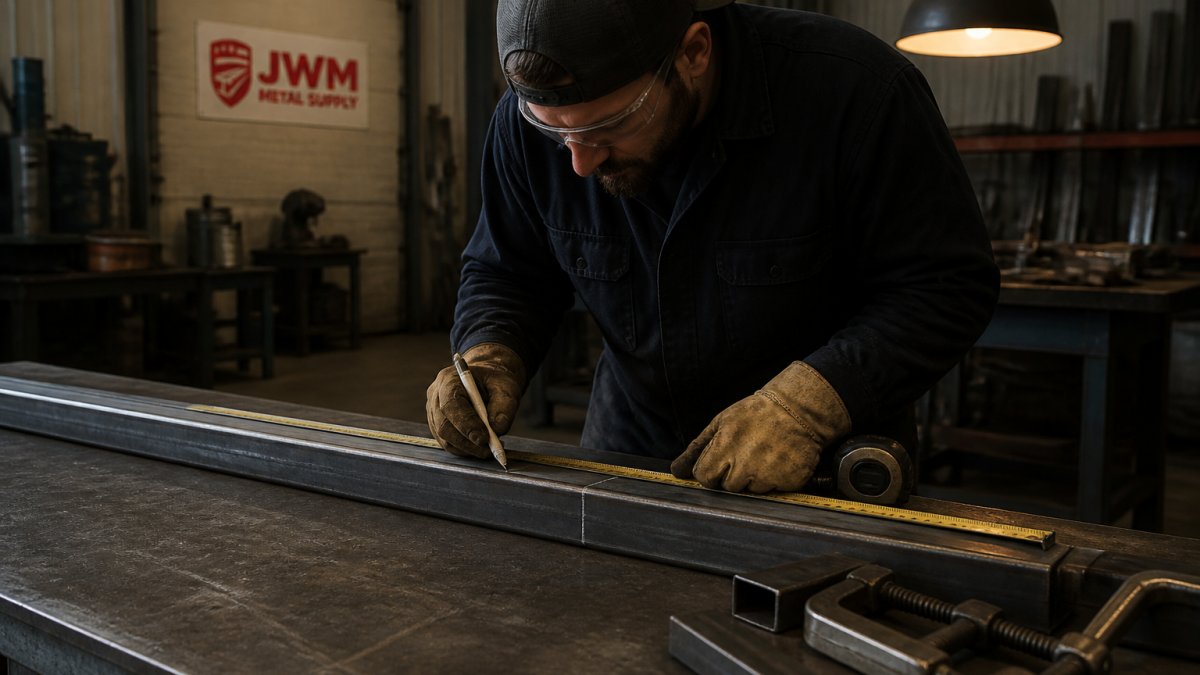
At JWM Metal Supply, we cut every order to the length you specify, ship in 1-5 business days, and set no minimum order.
Most first-time buyers overthink the grade and underthink the cut list, which is what actually determines whether your order arrives usable.
- Outside dimensions set how the tube fits your joint
- Wall thickness sets how much load it carries
- Length sets whether you can build without re-cutting
Get those three right and the rest is paperwork.
Steel Tubing Dimensions: Outside Diameter, Wall Thickness, and Gauge
Steel tubing dimensions are written as outside dimension by outside dimension by wall thickness, so a 2" x 2" 16ga square tube measures two inches across, two inches tall, and 0.065" through the wall.
Wall thickness shows up two ways: gauge or decimal inch. A 16 gauge wall is 0.065", a 14 gauge wall is 0.083", and an 11 gauge wall is 0.125".
Reading a Tubing Spec Without Guessing
A full spec answers four questions: shape, outside size, wall, and material grade. A line like "2" x 2" 14ga (0.083") A500 Grade B square tube" covers all four.
The American Society for Testing and Materials standards overview explains how A500 covers cold-formed welded carbon steel structural tubing, which is the grade most fabrication and trailer work calls for.
Weight matters too: a 1" x 2" tube with a 3/16" wall runs about 3.05 lb per foot, so know your total weight before you commit to a shipping method.
Square Steel Tubing: Where It Works Best
Square steel tubing is the default for anything with a flat joint. Four flat faces mean clean welds, easy clamping, and no rotation when you fit a corner, for a frame, gate, or cart, it is usually the fastest path.
Our 2" x 2" 16ga (0.065") Carbon Steel Square Tube suits lighter frames, workbenches, and bracing where weight matters. Step up to the 2" x 2" 14ga (0.083") Carbon Steel Square Tube when the part takes a real load or sees vibration.

Square tube also stacks and stores well, so shops keep common sizes on hand.
Rectangular Steel Tubing: When a Wider Profile Wins
Rectangular steel tubing wins when the load bends in one direction. A 1" x 2" or 3" x 4" profile puts more material where bending stress is highest, giving stiffness without the weight of a bigger square tube, think trailer tongues, equipment frames, and long spans.
Our 3" x 4" x 11ga (0.125") Rectangle Steel Tubing handles trailer builds, equipment frames, and farm repairs where the span is long and the load is real. For tighter fabrication and automotive work, the 1" x 2" x 3/16" (0.188") Rectangle Steel Tubing gives you a heavy wall in a compact footprint, with smooth saw-cut ends ready to weld.

Round Tubing and Other Shapes at a Glance
Round tube resists torsion better than any other shape, which is why it shows up in roll cages and pivoting parts. The trade-off is joint fit: round-to-flat connections take more work.
Shape |
Best For |
Joint Fit |
Torsion Resistance |
|---|---|---|---|
Square |
Frames, gates, carts |
Easiest |
Moderate |
Rectangular |
Long spans, trailer tongues |
Easy |
Moderate |
Round |
Roll cages, pivots |
Hardest |
Highest |
Pick the shape that matches the dominant load, not the one that looks best in a photo.
Steel Tube vs. Pipe: Which One Your Project Needs
Steel tube and steel pipe are not interchangeable, and mixing them up is the most common ordering mistake we see.
Pipe comes in standard schedules with wall tied to pressure rating; tube comes in gauge or decimal wall with grade tied to strength.
The Occupational Safety and Health Administration guidance on welding and cutting is worth a read before any structural welding, since ventilation and fire watch rules apply to shop work.
How to Measure and Order Custom Cut Steel Tubing Step by Step
The ordering process is short if you prepare first.
3" x 4" x 11ga (0.125") Rectangle Steel Tubing — Select Length →
- List every part with its finished length in inches, measured from the same reference point on every piece.
- Add cut allowance for blade kerf and cleanup on each piece. Kerf is the width of material the blade removes, so ten parts at 24" each consume more than 240" of stock once you account for it.
- Pick shape and outside size that fits your joints.
- Choose wall thickness for the load and weight you can accept.
- Confirm material grade against your drawing or engineer's call.
- Enter each length on the product page and set the quantity.
- Review the total and submit. Cuts are made to your listed lengths.
Measure Finished Length, Not Stock Length
The most common ordering error is listing the stock length you think you need rather than the finished length of the part, the distance from one cut end to the other after any miter, notch, or cleanup.
Measure with the tube flat on a bench, not held in the air, a tape pulled across a sagging length reads short. Mark with soapstone or a paint marker, not a pencil.
Build a Cut List That Survives the Shop
A cut list is a table, not a paragraph. Give each row a part name, shape, outside dimensions, wall, grade, finished length, and quantity. Group identical parts so the saw operator sets up once, and keep parts that share a shape and wall but differ in length on separate rows.
Total the linear feet before you order, the same order in a heavier wall can change both the freight class and how the bundle is handled.
What You'll Need Before You Order
Have your cut list, a tape measure, and your joint dimensions in front of you. Know whether your drawing calls for A500 Grade B or another grade, and whether you need mill test reports for a load-bearing application.
If the job requires documentation, gather the project name, purchase order number, and any specification the cert must reference up front to avoid a second round of paperwork.
Cut Length Tolerances, Cutting Methods, and What Affects Price
Cut length tolerance is the range your finished piece can land in and still be correct. Our standard saw-cut tolerance is approximately ±1/8", fine for most frames and repairs, but plan for that range if a part bolts into an existing assembly with no adjustment.
How Cut Accuracy Actually Works
Three things move a cut off its target length: measurement (where the tape hooks and whether the tube sits flat), kerf (the material the blade turns into chips, which a cut list must allow for), and the saw's setup and blade condition.
A ±1/8" band is generous enough to absorb all three on a typical saw cut. If your part needs to land tighter than that, say so before the order is cut, because a tighter band usually means a different setup and a slower feed, not a different saw.
Cutting Methods and What Each One Leaves Behind
Abrasive sawing is the workhorse for carbon steel tube: fast, handles most walls, and leaves a slightly rougher end with burr you knock off before welding.
For round and rectangular profiles, the end shape matters as much as the length. A square cut sits flat against a mating face; a cut off square by a degree or two leaves a gap the welder must fill.
What Drives the Price of a Custom Cut Order
Price drivers, in order of impact:
- Wall thickness and size: more steel per foot, more cost
- Number of cuts: each additional cut adds processing time and blade wear
- Total length ordered: longer orders spread the setup across more pieces
- Grade and certification: mill test reports add handling and paperwork
What to Have Ready for an Accurate Quote
A quote is only as good as the details behind it. Have these ready:
- The shape, outside dimensions, and wall for each line item
- The grade, and whether a mill test report is required
- The finished length and quantity for every part
- The end condition, if it matters for fit-up
- The delivery ZIP code and whether a forklift or dock is available at the receiving end
Common Mistakes to Avoid When Buying Custom Cut Steel Tubing
The expensive mistakes happen before the order. Here are the ones we see most.
- Confusing pipe and tube sizing. The outside dimension will not match your drawing.
- Forgetting kerf. Ten parts at 24" each need more than 240" of stock.
- Choosing wall by habit. Thicker is not always better; it adds weight and cost.
- Skipping the grade check. A500 Grade B is not the same as a generic mild steel callout.
- Ordering exact lengths with no tolerance room. Design for ±1/8" or specify tighter needs up front.
We cut every order in-house from American-made carbon steel and ship in 1-5 business days. If you are unsure which wall or shape fits, send us the drawing and we will tell you what we would order.
Getting the shape, wall, and length right the first time separates a smooth build from a week of rework. JWM Metal Supply cuts American-made carbon steel tubing to your exact specifications, with no minimum order, free shipping, and material certifications available on request. Order the 2" x 2" 14ga square tube for frames and bracing, or the 3" x 4" 11ga rectangle tube for trailer and equipment work.
Frequently Asked Questions
How do I measure steel tubing for a custom cut?
Measure the finished length you need, then add a small allowance for your weld prep or finishing work. Use a tape measure or steel rule on a flat surface and mark the cut line with a soapstone or marker. Write down the outside dimensions and wall thickness separately from the length so the supplier knows exactly which tubing you want. At JWM Metal Supply, every piece is saw cut to your ordered length with a tolerance of about +/- 1/8 inch.
What information do I need to order steel tubing cut to length?
You need four things: the shape (round, square, or rectangular), the outside dimensions, the wall thickness or gauge, and the exact length you want. For example, 2 inch x 2 inch 14 gauge square tube cut to 48 inches. Material grade matters too, such as A500 Grade B carbon steel. Include the quantity and whether you need mill test reports. With those details, a supplier can quote and cut your order without back-and-forth questions.
What is the difference between steel tubing and steel pipe?
Steel tubing is sized by its outside dimensions and wall thickness, and it comes in square, rectangular, and round profiles for structural and fabrication work. Steel pipe is sized by nominal pipe size with a schedule for wall thickness, and it is made mainly for carrying fluids or gas. If you are building a trailer, frame, or repair project, tubing is usually the right choice. Pipe is better when the job is moving liquid or gas under pressure.
How much extra length should I allow when ordering cut steel tubing?
Add roughly 1/8 to 1/4 inch per cut end if you plan to trim, square, or bevel the piece before welding. For a part that must fit exactly, order to the finished size and rely on the supplier's tolerance, which is typically about +/- 1/8 inch. If your project has several pieces that meet at angles, cut one test piece first and check the fit before ordering the rest of the run.