

Last Updated: October 21, 2026
Understanding Your Custom Metal Parts Options
Finding the right source for custom metal parts can feel overwhelming, but the process is simpler than most people think.
At JWM Metal Supply, we help customers navigate this decision every day. Whether you're a DIY enthusiast or a contractor, the right supplier saves you time and money; the wrong one can derail your timeline.
This guide covers how to order custom metal parts, what to expect from suppliers, and how to avoid common pitfalls.
Local Fabricators vs. Online Metal Suppliers
Local fabricators and online metal suppliers each have distinct advantages. Neither is universally "better", it depends on your specific needs.
Local fabricators offer hands-on consultation: walk in with sketches, get immediate feedback, and tackle complex, one-of-a-kind builds. The trade-off is higher per-unit costs and steep minimums for small jobs.
Online metal suppliers like JWM Metal Supply work differently. Specify material, dimensions, and tolerances, and receive a quote within hours. No minimums, fast free shipping, and instant comparison. You lose in-person consultation but gain speed and pricing transparency.
When to Choose Each Route
Choose a local fabricator when:
- Your project requires custom assembly, welding, or complex secondary operations
- You need ongoing consultation and design iteration
- Lead times are flexible (2-4 weeks acceptable)
- Your budget can absorb premium pricing
Choose an online metal supplier when:
- You need standard materials cut to your exact specifications
- You have detailed drawings or CAD files ready
- You want competitive pricing and transparent quotes
- You need fast turnaround (1-5 business days)
- You're ordering small quantities with no minimum requirements
The reality: many projects use both. You might order precision-cut material from an online supplier, then take it to a local shop for assembly and finishing.
How to Order Custom Steel Parts: Step-by-Step
Ordering custom steel parts follows a predictable process. The key is preparation. The more specific you are upfront, the faster and more accurate your quote.
Gather Your Project Specifications
Before contacting any supplier, write down exactly what you need.
Start with the material. A36 (mild carbon steel) is the most common choice for fabrication, welding, and general-purpose work: affordable, easy to machine, and welds cleanly.
Next, dimensions. Be precise and measure twice. For flat plate or bar stock, you need thickness, width, and length.
Then, quantity. Online suppliers like JWM Metal Supply have no minimums, so a single piece costs the same per-unit as ten.
Finally, tolerances and finish. Do you need ±1/16" accuracy or is ±1/8" acceptable? Raw mill finish, or deburred, painted, or polished?
Prepare Your Files and Drawings
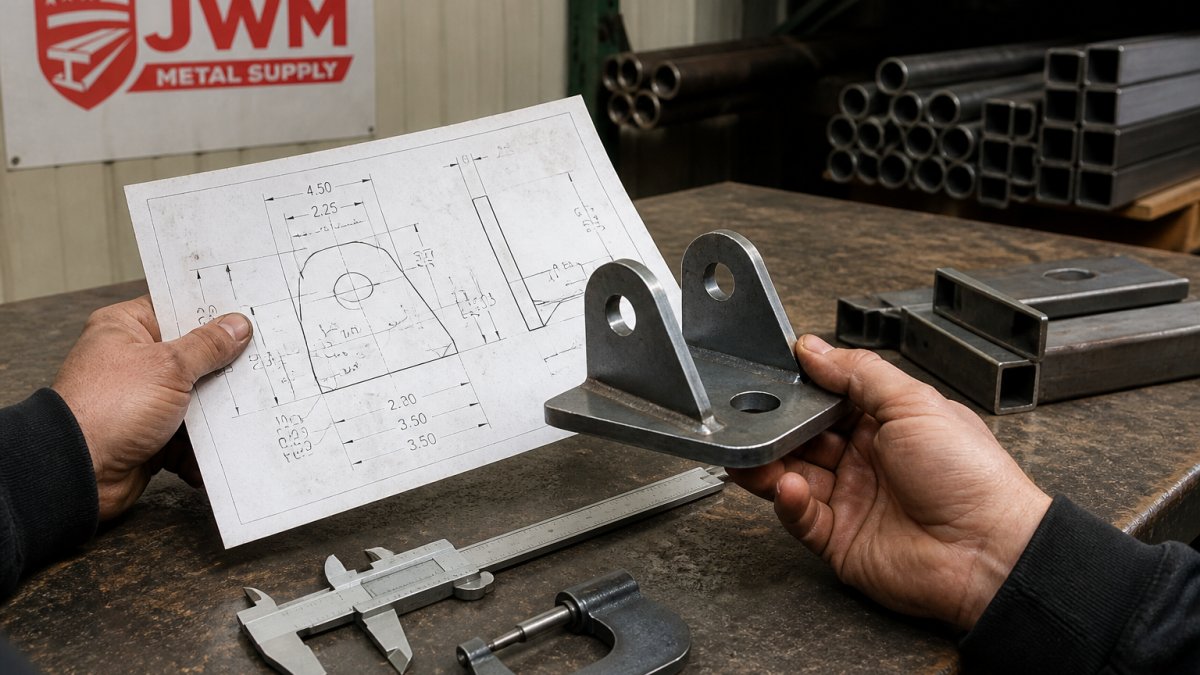
If you have CAD files or detailed drawings, have them ready. Many suppliers accept PDF, DWG, or STEP files. Include dimensions, material grade, and any special requirements.

You don't need perfect engineering drawings. A sketch or labeled photo with measurements works. What matters is clarity: a supplier should be able to quote without asking clarifying questions.
Request Quotes and Compare
Contact multiple suppliers and get at least two quotes. Compare not just price, but:
- Lead time. JWM Metal Supply typically ships in 1-5 business days; some suppliers quote 2-3 weeks.
- Shipping costs. JWM Metal Supply includes free shipping nationwide.
- Material certifications. Confirm the supplier provides ASTM certs if your project requires them.
- Edge condition. Plasma-cut (clean, weld-ready) or saw-cut (rougher)? This affects finishing labor.
- Minimum orders. JWM Metal Supply has no minimums.
Don't pick the cheapest quote automatically. A supplier offering faster lead time and included shipping at a slightly higher price often saves you money overall.
Comparison Factor |
Why It Matters |
What to Ask |
|---|---|---|
Lead time |
Affects your project schedule |
"How many days to ship?" |
Shipping |
Hidden cost that adds up |
"Is shipping included?" |
Material certs |
Required for load-bearing or certified work |
"Do you provide ASTM certs?" |
Edge finish |
Affects your finishing labor |
"Are edges plasma-cut or saw-cut?" |
Minimum order |
Affects small projects |
"Any minimums or setup fees?" |
Custom Steel Parts Cut to Size: Grades and Materials
The material you choose determines whether your part performs. Most projects use common grades. Understanding the differences prevents expensive mistakes.
Common Steel Grades for Custom Work
A36 carbon steel is the workhorse: affordable, welds easily, machines cleanly, and handles most structural and fabrication applications. Tensile strength around 58,000 PSI. If unsure, A36 is the safe default. JWM Metal Supply's flat plate and angle iron are A36.
A500 Grade B is structural tubing with slightly higher strength than A36, used for frames, trailers, and racks. A513 is a similar tubing grade, often used interchangeably.
Higher-strength grades (like 4140 or 300M) cost more and require specialized equipment. Use them only if your application genuinely demands it.
Choosing the Right Material for Your Application
Ask yourself: What is this part doing?
If it's structural or load-bearing, you need to know the expected load. Most structural projects use A36 or A500 Grade B, which are proven, affordable, and widely available. If your load is unusually high, consult a structural engineer. Don't guess.
If it's a bracket, mounting plate, or support, A36 works fine.
If it's a decorative or light-duty part not under stress, A36 is overkill; thinner gauges work.
If it's something that needs to resist rust, bare steel will rust. Your options: hot-dip galvanize, paint, powder coat, or use a naturally corrosion-resistant grade. Galvanizing is often cheaper than premium grades.
Steel Plate Sizes and Grades: What You Need to Know
When you order steel plate, you're choosing thickness and grade. These two factors define the part's strength and cost.
Standard Plate Dimensions and Thicknesses
Steel plate comes in standard thicknesses: 1/16", 3/16", and 1/4". The thicker the plate, the heavier, stronger, and more expensive.
For most DIY and light fabrication work, 1/16" to 1/4" plate covers your needs. A 1/4" plate is strong enough for serious structural work.
Common widths are 5", 6", 8", 10", 12". You specify the length you need, and the supplier cuts it to order.
Tolerance matters. Plate thickness is nominally what you order, but actual thickness varies slightly. A "1/4" plate might measure 0.249" to 0.251". For most projects, this variation doesn't matter.
1/4" Thick × 5" Wide A36 Steel Flat Plate – Select Length (5"–30") →
Grade Selection for Load-Bearing Applications
For anything load-bearing, the grade determines how much stress the material can handle.
A36 has a yield strength of around 36,000 PSI and tensile strength around 58,000 PSI: it bends permanently past 36,000 PSI and breaks past 58,000 PSI.
A500 Grade B (common in tubing) has higher yield strength, around 46,000 PSI.
If you're uncertain whether A36 is strong enough, don't guess. Calculate the load or consult an engineer. Undersizing material is dangerous. Oversizing wastes money but is safe.
For load-bearing work, also confirm the supplier provides material certifications. A cert documents that the steel meets ASTM standards.
Steel Shipping and Delivery: Timelines and Costs
Shipping is often the hidden cost that surprises buyers. Understanding lead times and shipping options prevents delays.
Lead Times and Rush Orders
Standard lead time for custom-cut steel is typically 1-5 business days. JWM Metal Supply ships most orders within this window, cutting material to order in-house before packaging and shipping.
Rush orders are possible but come with caveats. Some suppliers offer 24-hour turnaround at a premium; others can't accommodate rush orders at all. Ask upfront and communicate tight deadlines when requesting a quote.
Weekends and holidays affect timing. An order placed Friday might not ship until Monday. Plan accordingly.
Shipping Options and Packaging
Standard shipping is typically ground delivery via UPS, FedEx, or a freight carrier.
Free shipping is increasingly common. JWM Metal Supply includes free shipping on all orders, nationwide, a significant advantage since shipping steel can cost $25-$100+ depending on weight and distance.
Packaging matters. Steel edges are sharp, so good suppliers wrap sharp edges, secure the bundle, and use sturdy boxes. Poor packaging results in damaged goods and returns.
Delivery location affects cost. A business address is cheaper than residential. If ordering for a job site, have it delivered there.
Quality Assurance and Material Certifications
You're paying for material that meets specific standards. Confirming quality prevents problems downstream.
ASTM certifications document that steel meets published standards. ASTM A36, for example, specifies chemical composition, strength properties, and testing requirements.
For most projects, you don't need certs.
Ask the supplier: "Can you provide ASTM certs?" Most reputable suppliers can, sometimes for a small charge.
Inspect upon arrival. Open the package immediately and check material, dimensions, and quantity for shipping damage.
Test if necessary. For critical applications, you can have material tested independently by a lab, standard for aerospace, automotive, and high-stress applications.
Common Mistakes to Avoid When Ordering Custom Parts
Learning from others' mistakes saves time and money.
Vague specifications. "I need steel plate" is not specific enough. Write down material grade, thickness, width, length, quantity, and edge finish. A 30-second specification email beats three rounds of clarification.
Underestimating lead time. Ask lead times upfront and build buffer time into your schedule.
Ignoring shipping costs. Always compare total cost delivered, not sticker price.
Choosing the cheapest option automatically. The lowest price often reflects slower lead times, lower quality, or hidden fees. Compare the full package.
Ordering without confirming material certs. Confirm the supplier can provide certs before ordering.
Not measuring twice. Measure, write it down, measure again, then order.
Assuming all A36 is the same.
Finding the right source for custom metal parts comes down to matching your needs to the right supplier. You'll have precision-cut American steel ready in days, not weeks, with material certifications available if you need them. Shop Now and see how fast we can deliver your custom parts.
Frequently Asked Questions
What information do I need to provide when ordering custom metal parts?
Provide exact dimensions (length, width, height, thickness), material grade (such as A36 carbon steel), quantity needed, finish type (raw or coated), and any special tolerances. Include CAD files, technical drawings, or detailed sketches if available. Specify whether you need certifications, edge conditions (sharp or deburred), and your desired delivery date. The more detail you supply upfront, the faster and more accurate your quote will be.
How long does it typically take to receive custom steel parts?
Most fabricators ship custom parts in 1–5 business days, depending on complexity and current workload. Simple cuts on standard materials like A36 steel plate or angle iron are fastest. Rush orders may be available for an additional fee. Always confirm lead times when requesting a quote, especially if you have a tight project deadline. Online suppliers often provide faster turnaround than traditional local shops due to streamlined workflows.
Can I order custom metal parts in small quantities, or do I need a minimum order?
Many online metal suppliers, including JWM Metal Supply, accept orders of any size with no minimum quantity requirement. This makes them ideal for hobbyists, DIY projects, and one-off repairs. Local fabricators may impose minimums or charge higher per-unit prices for small runs. If you're doing a single project that requires just one or two custom parts, online suppliers with no-minimum policies offer better value and flexibility.
How do I know if a supplier's material certifications are legitimate?
Ask for Mill Certificates of Conformance (COCs) or ASTM test reports that verify the material grade, chemistry, and mechanical properties. Reputable suppliers source from certified mills and can provide documentation proving the steel meets ASTM standards. For load-bearing or safety-critical applications, always request certifications before ordering. American-made suppliers are typically more transparent about sourcing and can trace material back to the mill.