

Last Updated: October 20, 2026
What Is 1/4 Steel Plate?
1/4 steel plate is hot-rolled carbon steel with a nominal thickness of 0.250 inches (6.35 mm), sold as flat stock in rectangles, squares, circles, gussets or cut shapes.
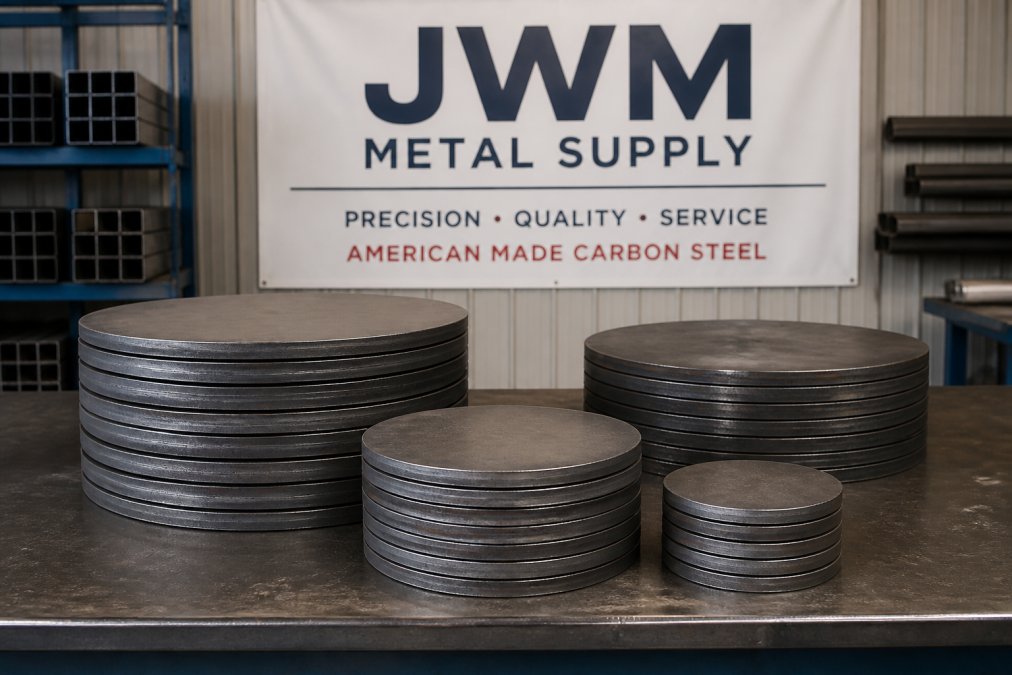
A36 Steel Plate, 1/4" thick steel pate circles
The exact phrase matters less than what it delivers. A 1/4-inch steel plate is roughly four times the mass of 16-gauge sheet, which is why it stops flexing under a bolted joint. Most hardware-store "steel plate" is thinner than buyers expect, so confirm the nominal thickness before you assume you have 1/4-inch material in hand.
How Thick Is 1/4 Steel Plate, Exactly?
A 1/4 steel plate measures 0.250 inches nominal, which converts to 6.35 mm. That number is a target, not a guarantee.
Mill tolerances allow slight variation across a plate, and the allowance widens as plate gets thicker. For most fabrication work the difference is irrelevant. For precision fits, shimming, or a machined surface, measure the actual thickness with a micrometer before you cut.
1/4-Inch Steel Plate Weight per Square Foot
A 1/4-inch steel plate weighs about 10.2 pounds per square foot. That figure comes from steel's density: at 0.2836 pounds per cubic inch, a one-foot square of 0.250-inch plate works out to roughly 10.2 pounds.
The calculation, step by step
You can reproduce that number for any size piece without a chart:
- Convert thickness to feet: 0.250 in ÷ 12 = 0.02083 ft
- Multiply by area in square feet to get cubic feet
- Multiply cubic feet by 490 lb/ft³ (the nominal density of carbon steel)
For a 12" x 12" piece: 1.0 ft² × 0.02083 ft × 490 lb/ft³ ≈ 10.2 lb. The same math works for any rectangle, just swap in your dimensions.
Dimensional weight chart
Plate Size |
Square Feet |
Approx. Weight |
|---|---|---|
6" x 12" |
0.5 |
5.1 lb |
12" x 12" |
1.0 |
10.2 lb |
12" x 24" |
2.0 |
20.4 lb |
15" x 27" |
2.8 |
28.7 lb |
18" x 24" |
3.0 |
30.6 lb |
24" x 24" |
4.0 |
40.8 lb |
24" x 48" |
8.0 |
81.6 lb |
48" x 48" |
16.0 |
163.2 lb |
48" x 96" |
32.0 |
326.4 lb |
Quick conversions for mixed units
- Pounds per square inch: 10.2 lb ÷ 144 in² ≈ 0.071 lb/in²
- Kilograms per square foot: 10.2 lb × 0.4536 ≈ 4.63 kg/ft²
- Kilograms per square meter: 4.63 kg/ft² × 10.764 ≈ 49.8 kg/m²
- Pounds per linear foot of 12"-wide strip: 10.2 lb
Estimating by the piece
Multiply square footage by 10.2 and you have a working number for shipping quotes, bench capacity, and lift planning. A 24" x 36" piece is 6 ft², so about 61 lb.
For anything you plan to move by hand, keep the piece under roughly 50 pounds or bring a second person. That ceiling lands around 4.9 ft², a 24" x 29" plate is about the largest single-person rectangle at this thickness.
A36 Steel Plate: The Default Grade and When to Pick Something Else
A36 steel plate is the standard carbon steel grade for general fabrication, and it is what most buyers mean when they order 1/4-inch plate. ASTM A36 specifies a minimum yield strength of 36,000 psi and a tensile range of 58,000 to 80,000 psi, per ASTM International's A36 specification overview.
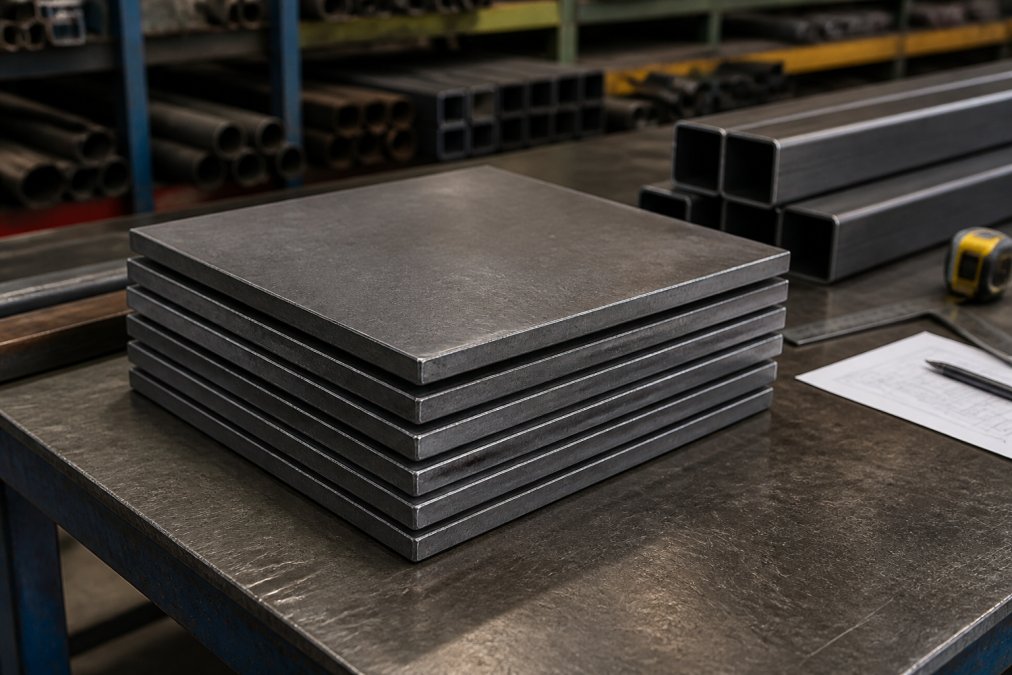
1/4" Thick square steel plates
Pick A36 when the part is structural but not highly stressed: brackets, gussets, mounting plates, repairs. Step up to a higher-strength grade only when a design calls for it, and let the engineer's number drive that decision rather than habit.
Two practical notes from the shop floor. First, A36 is a performance spec, not a chemistry recipe, so two plates from different mills can machine slightly differently.
Ask for the mill certification before the plate ships, not after. Traceability is far easier to secure up front than to reconstruct once the material is on your bench.
Common Uses: From Base Plates to Trailer Repairs
Base plates, mounting plates, gussets, brackets, trailer frame patches, welding table tops, and farm equipment repairs all run on 1/4-inch plate.
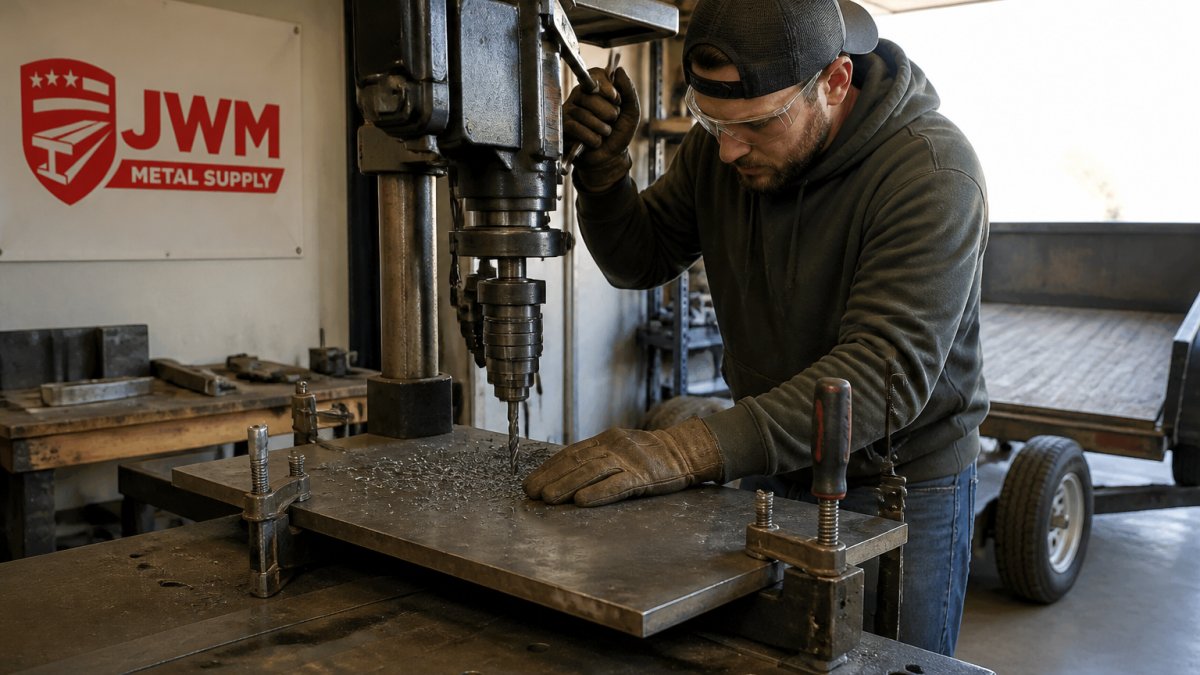
Trailer work is the most common request we see. A 1/4-inch patch plate bridges rusted frame sections without the flex you get from thinner sheet. Mounting plates for pumps, winches, and hitches benefit from the same rigidity.
Welding 1/4-Inch Steel: Settings, Prep, and Distortion Control
Welding 1/4-inch steel is a comfortable range for most processes: MIG, stick, and TIG all handle it with the right settings. The American Welding Society's welding handbook resources cover procedure qualification in detail, but the shop-level basics are straightforward.
- MIG: short-circuit transfer in the 180-220 amp range with 0.035-inch wire works for most joints
- Stick: 1/8-inch 7018 at roughly 110-130 amps suits fillet welds
- Prep: grind mill scale back at least an inch from the joint, and bevel butt joints on thicker sections
- Distortion: tack in a cross pattern, alternate weld direction, and let the part cool between passes
Fit-up matters more than dial settings. A tight gap and clean faying surface do more for weld quality than chasing the perfect amperage. On long seams, backstep the weld to keep heat input even.
Steel Plate Cut to Size: What to Specify When You Order
Steel plate cut to size means the supplier cuts your exact dimensions from stock rather than shipping a standard mill size. Ordering cut-to-size saves you saw time and scrap, and it is how most small-shop buyers purchase 1/4-inch plate.
15" x 27" Steel Rectangle Plate -- 1/4" Thick-A36 Hot Rolled →
Specify these five things and you will get what you expect:
- Thickness: 1/4 inch (0.250") nominal
- Grade: A36 hot rolled, or state the required spec
- Dimensions: exact length and width, with a note on whether tolerance matters
- Shape: rectangle, square, or a cut profile with a drawing
At JWM Metal Supply, we cut from American-made stock on a CNC plasma table, hold a ±1/16-inch tolerance on cut sizes, and ship in 1-5 business days with no minimum order. Our 15" x 27" A36 hot-rolled plate is a ready-made option for bench and repair work, and our 1/4" x 5" flat plate cut to length covers bracket and trailer jobs where you want a narrow strip.
One caution on custom cutting: the more complex the profile, the more the cut time drives the quote. Simple rectangles stay cheapest.
What Drives the Price of 1/4 Steel Plate
Price per piece on a 1/4 steel plate comes down to five variables: total weight, grade, cut complexity, quantity, and freight. Understanding how each one moves the number is the difference between a fair quote and an expensive one.
1. Weight is the biggest lever
Steel is sold by the pound at the mill level, so a larger plate costs more even when the per-pound rate is identical. A 12" x 12" piece at 10.2 lb and a 24" x 48" piece at 81.6 lb carry the same per-pound rate but an eight-fold difference in total. When you compare quotes, compare them per pound, not per piece, a supplier quoting a larger plate at a lower per-piece rate may simply be quoting a smaller plate.
2. Grade moves the number next
A36 is the value option for general fabrication. Certified material, plate that ships with a mill test report tying the heat to a specific chemistry and mechanical result, carries a premium because the documentation and traceability add cost. Higher-strength grades cost more still. If a job does not require certification, say so at order time; you should not pay for paperwork you will not use.
3. Cut complexity adds labor and machine time
A plain rectangle is the cheapest cut because the machine makes four straight passes. A profiled shape with curves, holes, or tight corners adds programming time, cut path length, and fixturing. As a rule of thumb, simple rectangles and squares stay closest to the base per-pound rate, while complex profiles can add a meaningful percentage on top. If your design allows a rectangle plus a separate bracket, that is often cheaper than one profiled piece.
4. Quantity changes the per-piece rate
Setup cost, programming, fixturing, and machine start, is spread across the order. One plate carries the full setup; ten plates carry one-tenth each. Small-shop buyers often find that ordering two or three pieces of a common size costs only slightly more per piece than ordering one.
5. Freight is where small buyers get surprised
Flat steel is heavy and bulky, and carriers price on both actual weight and dimensional weight. A single 24" x 48" plate at 81.6 lb may ship at a higher dimensional weight because of its footprint. Ask for the shipping weight and the freight class before you commit, and compare all-in delivered cost rather than piece price alone.
How to compare quotes
Ask every supplier for the same five data points so the quotes are apples to apples:
- Per-pound rate and the calculated weight of your piece
- Grade and certification, A36 commercial vs. A36 with mill certs
- Cut tolerance stated in inches (for example, ±1/16")
- Lead time in business days
- All-in delivered cost, including freight and any rush or certification surcharges
Watch for surcharges on rush orders and certification requests, and ask for an all-in quote before you commit. A Federal Trade Commission consumer guidance on online purchase protections is worth a read if you are buying from a new supplier for the first time.
The cheapest per-pound rate is not always the cheapest plate. Weight, grade, cut complexity, quantity, and freight interact, and the only fair comparison is all-in delivered cost for the exact same specification.
Frequently Asked Questions
How much does 1/4-inch steel plate weigh per square foot?
A 1/4-inch carbon steel plate weighs about 10.2 pounds per square foot. For a full 4-foot by 8-foot sheet, that works out to roughly 326 pounds, which is why most garage projects use smaller cut pieces rather than full sheets. To estimate any size, multiply the length by the width in feet, multiply that by 10.2, and you have your shipping weight. Always add a little margin for packaging and pallet weight when planning freight or pickup.
What is the actual thickness of 1/4-inch steel plate?
The nominal thickness is 0.250 inches, or about 6.35 mm. Actual mill thickness can land slightly above or below that figure within standard manufacturing tolerances, so treat 1/4-inch as a nominal callout, not a precision-machined dimension. If your project depends on an exact thickness, such as a machined pocket or a tight bearing fit, measure the plate with calipers before you cut and confirm the tolerance requirement with your supplier when ordering.
What size welder do I need to weld 1/4-inch steel?
For welding 1/4-inch steel, most hobbyists get solid results with a 180-amp to 220-amp MIG machine running 0.035-inch wire, or a stick welder in the 140-amp to 180-amp range with 3/32-inch electrodes. Smaller 110-volt machines can join 1/4-inch plate with multiple passes and proper joint prep, but a bevel and a slight root gap help you achieve full penetration. Match your machine to the joint, not just the thickness, and practice on scrap first.
Can 1/4-inch steel plate be cut and drilled with common shop tools?
Yes. A 1/4-inch plate is thick enough to be rigid but still workable with a decent angle grinder, a portable band saw, a circular saw with a metal-cutting blade, or a plasma cutter. For drilling, use cobalt or carbide-tipped bits at low speed with cutting fluid, and start with a pilot hole. Avoid work-hardening the steel by pressing too hard and spinning too fast. Clamp the plate securely, deburr every cut edge, and wear eye and hand protection.
Buying 1/4-inch plate should not require a purchase order and a week of waiting. JWM Metal Supply cuts American-made A36 carbon steel to your exact length, ships free with no minimum order, and gets material out the door in 1-5 business days. Order a single plate for a garage project or set up recurring supply for your shop, and get the same precision cut either way. Shop now and have your 1/4 steel plate on the bench this week.