

Table of Contents
- What Drives the Cost of Steel for DIY Welding Projects
- Steel Plate Cut to Size: Pricing by Length and Thickness
- Steel Tubing for Welding Projects: What Square and Rectangular Stock Costs
- How to Calculate Steel Weight Before You Order
- Steel Shipping Costs and Hidden Fees to Watch
- New, Surplus, and Scrap Steel: Cost Tradeoffs for Small Projects
- Building a Realistic Bill of Materials for a DIY Welding Project
- Verdict: Where the Steel Cost Savings Actually Come From
- Frequently Asked Questions
Last Updated: October 18, 2026
What Drives the Cost of Steel for DIY Welding Projects
The cost of steel for DIY welding projects is set by three variables: shape, grade, and thickness. Change any one of them and the price moves. A structural tube grade costs more than basic mild steel.
Mild steel (A36 carbon steel) is the default for home welding: it welds cleanly, drills easily, and costs less than alloy grades. For most garage projects, it's all you need.
Shape, Grade, and Thickness: The Three Price Levers
Shape determines how much processing the mill performs. Flat bar and plate are simple rolled products. Square tubing requires forming and welding a seam, which adds cost.

Grade separates commodity steel from structural steel. A36 is general-purpose. A500 Grade B tubing carries structural ratings and costs more per foot.
Thickness drives weight, and weight drives price. Doubling thickness roughly doubles material cost for the same footprint.
| Lever | Cheaper Choice | Costlier Choice | Why It Matters |
|---|---|---|---|
| Shape | Flat bar | Square tubing | Forming adds labor |
| Grade | A36 mild steel | A500 structural tube | Certification and testing |
| Thickness | 1/8" | 1/4" | Weight scales with price |
Steel Plate Cut to Size: Pricing by Length and Thickness
Steel plate cut to size means ordering exact dimensions instead of a full mill sheet, eliminating waste and cutting labor on your end, but plate is quoted by the piece while the underlying cost tracks weight.

Most suppliers price plate off a per-pound base plus a cut charge. That's why two pieces of the same weight carry different stickers: one is stock off the rack, the other a custom cut that ties up a saw or plasma table.
Normalizing Plate Price to a Per-Pound Basis
To compare plate against every other shape here, convert each quote to dollars per pound: divide the piece price by the calculated weight.
That number looks high next to commodity steel, and it should: small cut-to-size pieces spread a fixed cut and handling charge over very few pounds. Order a larger footprint, the 15" x 27" plate at $100.79, and the math changes:
Same alloy, less than half the per-pound cost. The per-pound price of plate falls as the piece gets bigger because fixed cut charges spread across more weight. If you need several small plates, ordering one larger plate and cutting it yourself is often cheaper, provided you have the saw or plasma capacity.
What Moves the Plate Number
| Factor | Effect on Price | Practical Takeaway |
|---|---|---|
| Thickness | Weight scales linearly | 1/4" costs about twice 1/8" for the same footprint |
| Footprint | Fixed cut charge spreads thinner | Bigger pieces carry a lower per-pound rate |
| Cut type | Plasma or saw time per piece | Fewer, simpler cuts reduce the charge |
| Quantity | Setup amortized | Batch your cut list into one order |
For brackets, mounting plates, and trailer repairs, A36 is a practical choice, it welds well with MIG, TIG, or stick and machines easily. Just remember the sticker on a small cut piece is the steel plus the cut, and at small sizes the cut is what you're really paying for.
Steel Tubing for Welding Projects: What Square and Rectangular Stock Costs
Steel tubing for welding projects costs more per pound than flat products because of forming, but delivers rigidity plate can't match at the same weight.
Square tube shines in frames, racks, and trailer work, the box profile resists twisting better than angle or channel.

Wall thickness is the cost driver here. Sixteen gauge suits light frames and shop fixtures. Heavier walls cost more and demand more welder amperage.
Angle iron sits between flat bar and tube on price and rigidity.
How to Calculate Steel Weight Before You Order
Weight estimation is the best cost-control habit in DIY welding: steel sells by weight, so knowing your pounds before checkout tells you your price before the cart does.
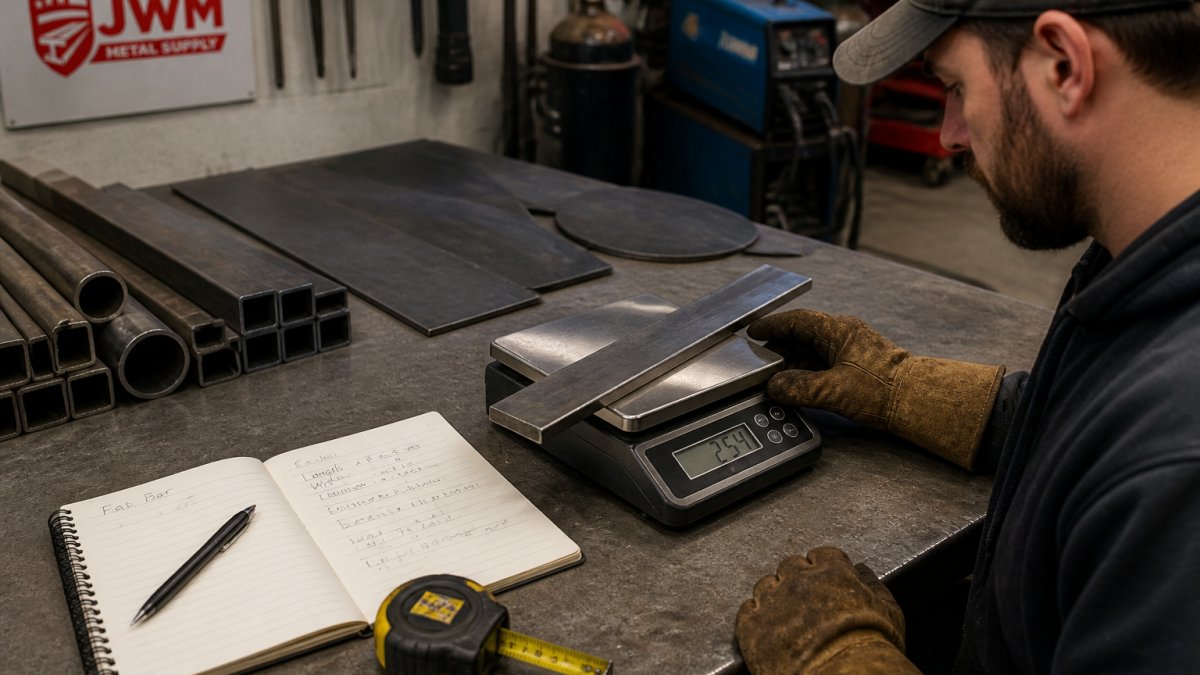
The formula for flat stock: length x width x thickness x 0.2836 = weight in pounds (dimensions in inches).
For tubing, calculate the wall's cross-sectional area, multiply by length, then by density, or check the supplier's weight-per-foot tables first.
- List every piece with dimensions
- Convert all dimensions to inches
- Apply the density formula per piece
That checklist doubles as your ordering worksheet. Run it once and you'll never guess at a steel bill again.
Steel Shipping Costs and Hidden Fees to Watch
Steel shipping costs vary wildly by supplier, and they're where budgets quietly break. Some vendors quote a low material price, then add freight, cut charges, and handling at checkout.
Watch for these line items:
- Cut fees charged per piece or per cut
- Minimum order surcharges that punish small buyers
- Oversize freight for long lengths
JWM Metal Supply ships free with no minimum order, so a single cut piece costs the listed price and nothing more.
1/4" Thick × 5" Wide A36 Steel Flat Plate – Select Length (5"–30") →
Ask for the full landed cost before you commit. Material price plus freight plus cutting equals your real number.
New, Surplus, and Scrap Steel: Cost Tradeoffs for Small Projects
New steel gives you known grade, consistent dimensions, and clean edges. You pay for that certainty.
Surplus steel, leftover from larger jobs, can undercut new stock substantially. The tradeoff is unpredictability: odd sizes, unknown grade, and surface condition you'll need to grind before welding.
Scrap yards offer the lowest entry point, often priced by the pound with no cut-to-length service. You'll spend hours hunting, cutting, and cleaning.
| Source | Upfront Cost | Certainty | Best For |
|---|---|---|---|
| New cut-to-length | Highest | Grade and size guaranteed | Load-bearing and precision work |
| Surplus | Moderate | Variable grade and finish | Practice and non-critical builds |
| Scrap | Lowest | Unknown alloy | Jigs, fixtures, shop furniture |
Building a Realistic Bill of Materials for a DIY Welding Project
A bill of materials turns a vague idea into a priced shopping list. Most DIY budgets stop at the steel line and get blindsided by cutting, delivery, consumables, and waste. Here's a complete total, line by line.
Project: 30" x 48" welding table frame
| Line | Item | Spec | Qty | Unit Price | Extended |
|---|---|---|---|---|---|
| 1 | Legs | 1/2" x 1/2" square tube, 16ga, 30" | 4 | $30.12 | $120.48 |
| 2 | Frame rails | 1" x 1" x 3/16" angle, 48" | 2 | $26.24 | $52.48 |
| 3 | Cross braces | 1/8" x 1/2" flat bar | 4 | $21.43 | $85.72 |
| 4 | Top plate | 1/4" A36 plate, cut to size | 1 | $100.79 | $100.79 |
| Steel subtotal | $359.47 |
That subtotal is the number most budgets stop at. Here is what actually lands on the card.
Step 1: Add Waste and Offcuts
Cut lists never come out perfect: 10-15% waste on tube and angle is common, since blade kerf, square-up cuts, and mis-measured pieces all consume stock. On a $359.47 subtotal, 12% waste adds about $43.14, bringing material to roughly $402.61.
Step 2: Add Cutting Charges
If you order cut-to-length, each piece may carry a per-cut or per-piece charge. Ask for it before checkout and multiply by your piece count, eleven cut pieces on this build, a charge that can quietly add a meaningful percentage to the steel line. Cut everything yourself from stock lengths and this line drops to blades and discs.
Step 3: Add Delivery or Pickup
Freight on long tube and angle is where budgets break: oversize lengths often trigger a surcharge, and small orders can hit a minimum. Confirm the landed cost, material plus cut plus freight, before you commit; local pickup turns that line into fuel and time instead.
Step 4: Add Consumables
Consumables are the most-forgotten line in DIY welding budgets. For a frame this size, plan for:
- MIG wire or stick electrodes
- Shielding gas (if MIG)
- Grinding and cut-off discs
Consumables commonly run 10-20% of the steel bill on a small frame, and they're consumed whether or not the project goes well.
Step 5: Total It
| Cost Line | Amount |
|---|---|
| Steel subtotal | $359.47 |
| Waste and offcuts (12%) | $43.14 |
| Cutting charges | Ask supplier, varies by piece count |
| Delivery or pickup | Ask supplier, varies by length and order size |
| Consumables (est. 15%) | $53.92 |
| Realistic all-in estimate | about $456.53 plus cutting and delivery |
The gap between the $359.47 steel subtotal and the ~$456.53 all-in figure is the point: a realistic bill of materials lists every piece by spec, quantity, and price, then adds waste, cutting, delivery, and consumables, so nothing arrives short, nothing sits unused, and the budget you set is the budget you spend.
Verdict: Where the Steel Cost Savings Actually Come From
Savings don't come from buying the cheapest steel. They come from buying the right steel in the right quantity, cut to size.
Three moves do the heavy lifting. First, select the lightest section that safely does the job.
JWM Metal Supply cuts American-made carbon steel to your exact specifications with no minimum order and free shipping, ready to ship in 1-5 business days.
Frequently Asked Questions
How do I estimate the steel needed for a DIY welding project?
Sketch the project and list every piece by shape, thickness, and length. For a simple cart, that might be four legs of 1/2" square tubing, two 24" flat bar crossmembers, and one 1/4" plate shelf. Add 10 to 15 percent for waste and test cuts. Then use weight math (volume times 0.284 lb per cubic inch for carbon steel) to convert your list into pounds, which is the unit most suppliers and cost calculators work in. A written list also makes quote requests faster and more accurate.
Is buying steel plate cut to size worth it for a small project?
For most DIY welders, yes. A cut-to-size plate arrives square and weld-ready, so you skip the angle grinder session, the consumed cutoff wheels, and the risk of a crooked edge that throws off your fit-up. On a $37.27 piece of 5" A36 flat plate, the cutting is already included in the price. The tradeoff is that custom-cut items are usually non-returnable, so measure twice and confirm tolerances (often plus or minus 1/16" on plasma-cut plate) before you order.
What affects the cost of steel for a welding project?
Five things move the number most: shape and thickness (heavy angle costs more per pound than thin flat bar), grade (A36 mild steel is the budget standard for DIY work), quantity (small orders carry a higher per-pound price because handling is fixed), cutting (custom cuts add labor unless bundled into the listed price), and shipping (free shipping changes the math versus freight surcharges). Sales tax and any certification requests round out the total. Comparing quotes on all five, not just the sticker price, is how you find the real cheapest option.
How should I account for steel shipping costs when buying online?
Ask two questions before checkout: is shipping included, and is there a minimum order? Some suppliers advertise low per-piece prices but add freight, crating, or liftgate fees that can exceed the material cost on small orders. Others, including JWM Metal Supply, ship free with no minimum order, which makes a single 20" piece of flat bar a viable purchase. For large plate, confirm whether the carrier delivers to a residence or requires a dock, since residential delivery can carry a surcharge.
Where can I get cheap steel for welding practice?
Scrap yards and fabrication shop offcuts are the cheapest source for practice metal, often sold by the pound at a fraction of retail. The catch is inconsistent grade and unknown history, which is fine for running beads but risky for anything load-bearing. For practice pieces you want repeatable, buy small cut-to-length mild steel: a 1/8" x 1/2" flat bar starts at $21.43 and gives you clean, known A36 material. Many welders keep a mix: scrap for technique drills, new stock for finished parts.
Steel prices punish guesswork. Order the wrong thickness or length and you eat the cost. JWM Metal Supply removes that risk with cut-to-exact-length A36 plate, square tubing, angle iron, and flat bar, all American-made and shipped free with no minimum order. Material certifications back every load-bearing application, and most orders ship in 1-5 business days. Get started with JWM Metal Supply and build your next project from a bill of materials you can actually trust.