

Table of Contents
- Why Order American Made Steel Plate Online
- What You'll Need Before You Order
- Step 1: Choose Your Steel Grade and Thickness
- Step 2: Select the Best Steel for DIY Trailer Builds
- Step 3: How to Calculate Steel Weight for Trailers and Other Projects
- Step 4: Verify American-Made Certification and Material Specs
- Step 5: Understand Pricing, Shipping, and Lead Times
- Common Mistakes to Avoid When You Order Steel Plate Online
- Frequently Asked Questions
Last Updated: September 27, 2026
Why Order American Made Steel Plate Online
Ordering steel plate online is the fastest way to get mill-certified material delivered to your shop, but only if you know what to specify before you click buy. This guide from JWM Metal Supply walks through the exact steps to order american made steel plate online without overpaying, waiting weeks, or ending up with the wrong grade.
What You'll Need Before You Order
Before you open a product page, gather three things: finished dimensions, the load the plate will carry, and your welding or machining method. Buyers who skip this step usually order twice.
Project Dimensions and Load Requirements
Measure your finished part, not your raw stock, and add cutting allowance if you plan to trim after delivery. For load-bearing applications, note whether the plate is structural, a base plate, a mounting plate, or a gusset, since each role changes the thickness tolerance you can accept. A common mistake is ordering the exact finished size and forgetting that plasma-cut edges consume material.
Step 1: Choose Your Steel Grade and Thickness
A36 is the workhorse for structural steel, brackets, and trailer work because it welds easily and costs less.
Grade Selection by Project Type
| Project | Recommended Grade | Why |
|---|---|---|
| Trailer frame, brackets, general fab | A36 hot rolled | Cheapest weldable structural plate, forgiving on fit-up |
| Structural beam reinforcement, high-load base plates | A572 Grade 50 | Higher yield strength lets you use thinner plate for the same capacity |
| Machined spacers, fixtures, shafts | 1018 cold rolled | Tight thickness tolerance, smooth finish, consistent machinability |
| Wear plates, gears, heat-treated tooling | 1045 | Responds to heat treatment, higher hardness after quench and temper |
| Corrosive environment, food or marine exposure | 304 or 316 stainless | Chromium oxide layer resists rust without coating |
A36 is a structural carbon steel and welds with standard MIG, stick, or TIG. It has a yield strength of 36,000 psi minimum.
A Carbon Steel Plate Thickness Guide for Common Projects
| Thickness | Typical Use | Weldability | Weight Feel |
|---|---|---|---|
| 1/8" | Light brackets, guards | Excellent | Easy to handle |
| 3/16" | Trailer sides, gussets | Excellent | Moderate |
| 1/4" | Trailer frames, base plates | Excellent | Heavy |
| 3/8" | Heavy structural, mounting plates | Good | Very heavy |
| 1/2" | Bracing, high-load bases | Good | Needs equipment |
For most DIY trailer builds and general fabrication, 1/4" A36 hot rolled plate hits the sweet spot: rigid enough for structural work, still manageable with standard shop tools. If the frame will see highway speeds and repeated loading, step up to 3/8" at the tongue and hitch area even if the rest of the frame is 1/4".

Step 2: Select the Best Steel for DIY Trailer Builds
For DIY trailer builds, A36 hot rolled carbon steel in 3/16" to 1/4" thickness is the best choice. It offers the strength-to-cost ratio hobbyists need, welds predictably with MIG or stick, and holds up to road vibration better than thinner sheet. Here's what matters when picking material:
- Frame rails and crossmembers: 1/4" A36 plate or structural tubing
- Gussets and corner bracing: 3/16" plate
- Mounting plates and base plate: 1/4" plate, cut to size
- Repair patches: match the parent thickness or go one step heavier
Step 3: How to Calculate Steel Weight for Trailers and Other Projects
Steel weight determines your shipping cost, your trailer's tongue weight, and whether your tow vehicle can handle the load. The formula: weight = volume × density, where carbon steel density is roughly 0.284 lb per cubic inch.

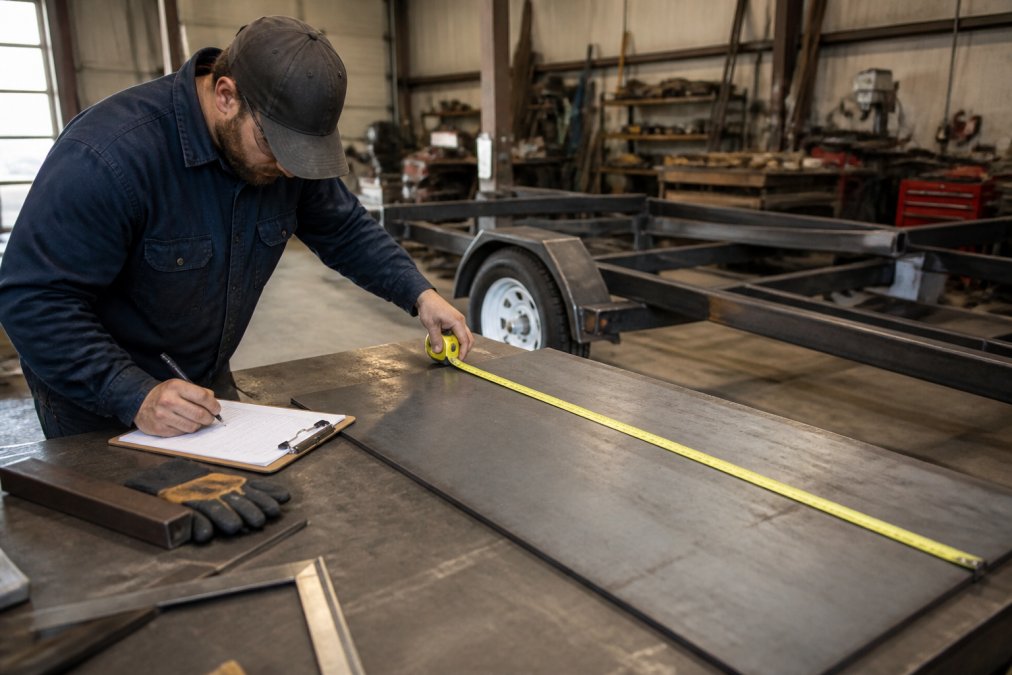
Work through it in four steps:
- Convert your plate dimensions to inches (length × width × thickness)
- Multiply to get cubic inches
- Multiply cubic inches by 0.284 for pounds
- Add up every piece to get total project weight
Step 4: Verify American-Made Certification and Material Specs
Ask for the mill test report before you buy. A mill test report (MTR) documents the alloy composition, tensile strength, yield strength, and heat number for the steel you receive. It's the only reliable proof that your plate meets ASTM standards and came from a domestic mill. Verifying these certifications ensures that the structural integrity of your material remains uncompromised, a critical consideration when selecting heavy duty steel furniture for long-term industrial applications.
15" x 27" Steel Rectangle Plate -- 1/4" →
Watch for these verification signals:
- Heat number traceable to a domestic mill
- Yield strength and tensile strength listed, not just "structural steel"
- Grade called out specifically (A36, 1018, etc.), not "commercial quality" alone
- Origin statement on the packing slip or certification document
Step 5: Understand Pricing, Shipping, and Lead Times
Online steel pricing is usually quoted per piece or per pound, with custom cuts and certifications sometimes added as line items. Ask upfront whether cutting, certification copies, or rush handling carry surcharges so your quote matches your invoice.
How Heavy Steel Actually Ships
This is where budgets get blown. Steel plate moves by two very different channels, chosen by weight and dimensions, not by your preference.
- Parcel (UPS, FedEx, USPS): For small plates and cut pieces, generally up to about 150 lb per package and within standard length limits. Tracking is automatic, delivery is to your door, and there is no liftgate or dock requirement. This is how a single 15" x 27" plate or a few cut-to-size brackets ship.
- LTL freight: Used once a shipment exceeds parcel limits or includes long pieces. Anything over roughly 8 feet in length, or over about 150 lb, moves as freight on a pallet. Freight is priced by weight, class, and distance, and often includes accessorial charges: liftgate delivery if you lack a dock, residential delivery, inside delivery, and limited-access fees for schools or military bases.
- Flatbed or dedicated truck: Used for full sheets and pallets that exceed LTL limits. This is the channel where a residential address can be a problem, because a 48-foot trailer cannot navigate most driveways.
How to Minimize Shipping Cost Without Compromising the Order
- Order the size that ships as parcel. A plate within standard parcel length limits avoids the freight minimum, often the largest line item on a small order.
- Consolidate cuts onto one plate. Six brackets nested on one 12" x 24" plate ship cheaper than six separate pieces, even at identical material cost.
- Ask about free shipping thresholds and terms. Free shipping removes the biggest hidden cost that surprises online steel buyers. Confirm terms before checkout, because freight on heavy plate can rival the material cost.
- Confirm whether you need a liftgate before the truck arrives. Without a loading dock or forklift, a liftgate is required and usually an added charge. Arranging it at order time is cheaper than a failed delivery and re-delivery fee.
- Check the delivery address type. Residential, limited-access, and inside-delivery addresses carry surcharges. If you can receive at a commercial address with a dock, do it.
Lead Time Expectations to Set
- Processing: 1-5 business days for standard cuts
- Shipping: 2-5 business days depending on distance
- Custom dimensions: confirm cut tolerance (often ±1/8") before ordering
- Rush orders: ask about availability, not every size can be expedited
For a custom size, JWM Metal Supply can cut to your exact length and width as long as the piece is shippable, which covers most plate and flat bar projects.

Common Mistakes to Avoid When You Order Steel Plate Online
| Mistake | Fix | Impact |
|---|---|---|
| Ordering finished size with no allowance | Add cut allowance for trimming | Avoids rework |
| Skipping the mill test report | Request MTR before purchase | Confirms grade and origin |
| Guessing thickness by eye | Use the thickness guide above | Prevents structural failure |
| Ignoring shipping cost until checkout | Confirm freight terms upfront | Avoids budget surprises |
| Assuming "in stock" means "ships today" | Check processing time separately | Protects your deadline |
For a custom size, JWM Metal Supply can cut to your exact length and width as long as the piece is shippable, which covers most plate and flat bar projects.
Frequently Asked Questions
What is the best metal to use to build a trailer?
A36 hot rolled carbon steel plate is the standard choice for trailer frames and structural components. It offers a yield strength of 36,000 psi, excellent weldability, and costs less. For trailer floors, 1/8-inch to 1/4-inch plate works for most light and medium-duty builds.
How do I calculate the weight of steel plate needed for my project?
Use this formula: length (inches) x width (inches) x thickness (inches) x 0.284 = weight in pounds. For example, a 15-inch by 27-inch plate at 1/4-inch thick weighs about 28.7 pounds. Always add 5-10% to your total for waste and cutting kerf. Knowing the weight upfront helps you confirm your trailer frame stays within axle and suspension ratings.
Why choose American-made steel over imported alternatives?
American-made steel comes with traceable mill test reports that document chemistry and mechanical properties. Domestic mills follow ASTM standards closely, so thickness tolerances and yield strength stay consistent from order to order. Imported steel may meet specs on paper but often lacks verifiable documentation, which matters for load-bearing trailer frames and structural repairs. You also avoid unpredictable lead times tied to overseas shipping.
What are the benefits of ordering custom-cut steel online?
Custom-cut steel arrives at your door ready to weld, drill, or bolt into place. You skip the cutting, grinding, and measuring that eats up shop time. Online suppliers like JWM Metal Supply use CNC plasma tables to hold tolerances within ±1/8 inch, so dimensions match your drawings. No minimum order means hobbyists can buy a single plate while fabrication shops order production quantities in the same checkout.