

Table of Contents
- Steel Options for DIY Trailer Builds: Quick Comparison
- A36 Structural Steel vs. A500 Grade B: Which Performs Better
- Common Steel Shapes: C-Channel, Rectangular Tube, and Angle Iron Explained
- Trailer Frame Steel Thickness Chart and Load Capacity
- Mild Steel vs. High-Strength Steel for Trailers: Cost and Performance Trade-offs
- Essential Tools for DIY Trailer Fabrication and Welding
- Corrosion Resistance, Welding Considerations, and Surface Treatment
- Conclusion
- Frequently Asked Questions
Last Updated: September 27, 2026
Steel Options for DIY Trailer Builds: Quick Comparison
Choosing the right steel for DIY trailer builds determines whether you're driving a reliable hauler or troubleshooting frame cracks years from now. Most DIY builders don't understand the trade-offs between strength, cost, and workability.
Steel for DIY trailer builds comes down to three proven options: A36 structural steel (weldable, affordable), A500 Grade B (higher strength in thinner gauge), and mild steel (cheaper but requires thicker gauge). The choice hinges on load capacity, budget, and welding skill.
Quick Picks for Steel Trailer Builds:
- Best Overall Value: A36 structural steel, excellent weldability, proven performance, widely available
- Best for High-Strength Frames: A500 Grade B, superior tensile strength in thinner gauge
- Best Budget Option: Mild steel with increased thickness, lower upfront cost, requires heavier gauge
A36 Structural Steel vs. A500 Grade B: Which Performs Better
A36 structural steel is the workhorse of DIY trailer building. It's affordable, machines cleanly, and welds without special procedures. With tensile yield strength of approximately 36,000 PSI, it handles most utility trailers under 5,000 pounds.
A500 Grade B carbon steel delivers tensile yield strength around 50,000 PSI, handling higher loads in thinner walls. It resists deflection better, keeping frames straight under stress instead of sagging over time.
A500 Grade B costs more per pound and requires more welding expertise due to higher carbon content. If you're learning to weld, A36 forgives mistakes better. For heavy-duty equipment trailers or car haulers, A500 Grade B justifies the extra effort.
A36 yields at 36,000 PSI and bends permanently beyond that point. A500 Grade B doesn't yield until 50,000 PSI, keeping frames rigid where A36 might sag a quarter-inch after 1,000 miles of rough roads.

Common Steel Shapes: C-Channel, Rectangular Tube, and Angle Iron Explained
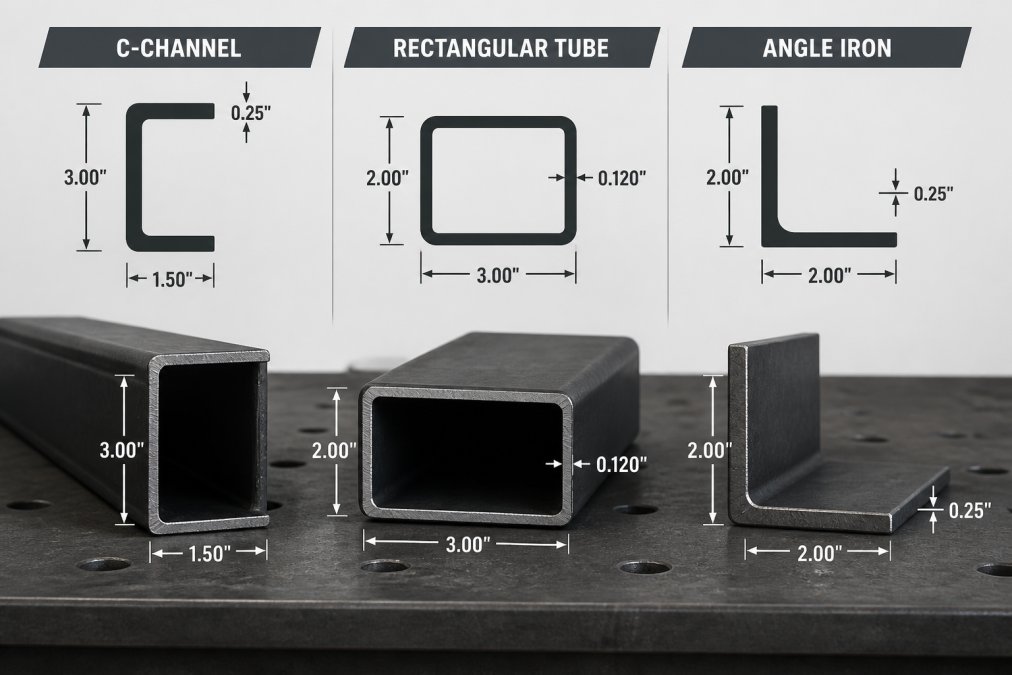
Rectangular tubing dominates modern trailer frames because the closed profile resists torsion better than open shapes and distributes loads evenly. A 3" x 4" x 1/4" rectangular tube provides excellent strength-to-weight ratio for mid-size trailers. Markings show outside dimensions (3" height × 4" width) and wall thickness (1/4"). Always verify markings match your order, dimensional errors are the most common purchasing mistake.
Angle iron (L-shaped) works best for cross-members and bracing. The 3" x 3" x 1/4" size handles lateral loads and prevents frame racking during cornering. Markings show leg size (3" × 3") and wall thickness (1/4"). Stick with equal-leg angles unless you have a specific structural reason otherwise.

C-channel appears in older designs and specialty applications. It's lighter than rectangular tube but twists more easily under load. Use it for light trailers or secondary members, not primary frame rails. Markings show nominal depth (C6 = 6" deep) and weight per foot (8.2 lbs/ft), don't confuse this with wall thickness. Selecting the appropriate steel profile remains critical when integrating specialized equipment into custom trailer designs that require both structural integrity and weight management.
Box tubing is the modern standard because the closed profile eliminates stress concentration at edges and distributes loads more evenly.
How to Read Steel Markings and Avoid Ordering Mistakes:
- Rectangular/Square Tubing: Marked as "3×4×1/4" (height × width × wall thickness in inches). Some suppliers use decimals: "3.0×4.0×0.25."
- Angle Iron: Marked as "3×3×1/4" (leg × leg × wall thickness). Unequal angles appear as "3×2×1/4" (larger leg first).
- C-Channel: Marked as "C6×8.2" (nominal depth × weight per foot). The depth is approximate; measure the actual height if precision matters.
- Flat Bar/Plate: Marked as "1/2×4" (thickness × width). Length is usually on a separate tag or invoice.
- Grade Designation: A36, A500, or mild steel should be noted on the mill certificate. Ask the supplier to confirm if it's not visible on the material itself.
Common Ordering Mistakes and How to Prevent Them:
Trailer Frame Steel Thickness Chart and Load Capacity
Thickness directly determines load capacity. A 2" x 2" square tube with 1/4" walls handles roughly 2,000 pounds per foot before deflection becomes visible. The relationship follows the cube of the thickness increase in structural calculations.

Here's a practical framework:
2" x 2" 1/4 (0.250") Carbon Steel →
Application |
Tube Size |
Wall Thickness |
Material |
Estimated Capacity |
|---|---|---|---|---|
Small utility (under 2K lbs) |
2" x 2" |
1/4" |
A36 |
2,000-2,500 lbs |
Mid-size utility (3-5K lbs) |
3" x 4" |
1/4" |
A36 |
3,500-5,000 lbs |
Equipment trailer (6-8K lbs) |
4" x 4" |
5/16" |
A500 Grade B |
6,000-8,000 lbs |
Heavy equipment (8K+ lbs) |
4" x 6" |
3/8" |
A500 Grade B |
8,000+ lbs |
Mild Steel vs. High-Strength Steel for Trailers: Cost and Performance Trade-offs
Mild steel costs 10-15% less per pound than A36 but requires thicker gauge to match performance. A 3/8" mild steel frame matches 1/4" A36 strength, adding 150-200 pounds of frame weight on a 16-foot trailer.
Real-World Sourcing Scenarios:
Scenario 1 (Scrap Yard): Mild steel.
Scenario 2 (Local Service Center): A36, pre-cut.
Scenario 3 (National Supplier): A500 Grade B.
Where to Source Each Grade:
- Mild Steel: Scrap yards, online marketplaces, local machine shops. Quality varies; best for budget-conscious builders.
- A36 Structural Steel: Local steel service centers, online suppliers
- A500 Grade B: Specialty suppliers, national distributors. Less common; requires ordering ahead.
Corrosion Resistance and Grade Choice:
Essential Tools for DIY Trailer Fabrication and Welding
A MIG welder (220V minimum) is more forgiving for beginners and produces cleaner welds on A36. A 180-amp MIG machine costs $300-500 and covers most DIY trailer work.
Corrosion Resistance, Welding Considerations, and Surface Treatment
Test your welds by bending a scrap piece in a vice. If the weld cracks before the base metal bends, adjust your technique. If the base metal bends and the weld holds, you're ready for the trailer frame.
Conclusion
Choosing the right steel for your DIY trailer build determines whether you're driving a reliable hauler or troubleshooting frame cracks five years from now. A36 structural steel covers most applications affordably. A500 Grade B handles heavy loads in thinner gauge. Rectangular tubing outperforms open shapes. 1/4" wall thickness works for trailers under 5,000 GVWR; go thicker for heavier builds.
Frequently Asked Questions
What is the best steel for DIY trailer builds?
A36 structural steel and A500 Grade B carbon steel are both excellent choices for DIY trailer builds. A36 is more affordable and easier to weld, making it ideal for hobbyists. A500 Grade B offers higher yield strength and better fatigue resistance, which is beneficial for heavy-load applications. For most DIY projects, A36 with 1/4-inch wall thickness provides a solid balance of cost, weldability, and structural integrity.
What thickness of steel is recommended for a trailer floor?
For trailer floors, 1/4-inch (0.250-inch) wall thickness is the industry standard for structural tubing and rectangular tube applications. This thickness provides adequate load-bearing capacity for most utility and cargo trailers while keeping weight reasonable. For base plates and reinforcement, 1/4-inch A36 steel plate is also recommended. Always verify your design against GVWR and axle load calculations to ensure compliance with your trailer's intended payload capacity.
Why is rectangular tubing preferred over angle iron for trailer frames?
Rectangular tubing offers superior torsion and deflection resistance compared to angle iron because it provides enclosed, load-bearing walls on all sides. This closed-box design distributes stress more evenly across the frame, reducing metal fatigue under dynamic loads. Angle iron's open L-shape is less rigid and requires additional bracing and gusset plates to achieve equivalent structural integrity. For trailer frames carrying significant payload, rectangular tubing (such as 3" × 4" × 1/4") delivers better performance with less total material weight.
Is A36 steel good for trailer frames?
Yes, A36 structural steel is excellent for trailer frames, especially for DIY and light-to-medium-duty applications. It has a tensile yield strength of 36,000 psi, good weldability with standard MIG or stick welding, and excellent machinability. A36 is more affordable than high-strength alternatives and requires no special welding procedures. However, for heavy-load trailers or applications requiring superior fatigue resistance, A500 Grade B (with 50,000 psi yield strength) may be a better choice despite higher cost.
What kind of steel is used for trailers?
Most trailers use hot-rolled carbon steel, typically A36 or A500 Grade B structural steel. A36 is the most common for DIY and utility trailers because of its cost and ease of fabrication. A500 Grade B is preferred for high-strength applications and heavy-duty commercial trailers. Mild steel angle iron and C-channel are also used for bracing and secondary structural components. Some manufacturers apply galvanized coating or paint for corrosion resistance, though raw steel is standard for DIY builds that will be finished on-site.