

Table of Contents
- What You'll Need Before You Order Precision Cut Carbon Steel
- Compare Common Carbon Steel Grades: A36, 1018, 1045, 4140
- How to Measure Steel Plate Thickness and Specify Tolerances
- Custom Laser Cut Metal Products and Shape Blanks for Fabrication
- Step-by-Step: How to Buy Precision Cut Carbon Steel Online
- Pricing, Shipping, and What Arrives in the Box
- Common Mistakes to Avoid When Ordering Steel Online
- Conclusion
- Frequently Asked Questions
Last Updated: September 27, 2026
What You'll Need Before You Order Precision Cut Carbon Steel
Buying precision cut carbon steel online starts with three numbers: the grade, the thickness, and the finished dimensions. Get those right and the rest of the order takes care of itself. Get them wrong and you'll be paying return freight on a heavy package.
At JWM Metal Supply, we cut every order to the length, width, or diameter the customer specifies, so the specification you send us is the part we cut to. That's why it pays to have your numbers ready before you click buy.
Here's what to gather first:
- Your project's required grade and thickness
- Finished dimensions in inches, measured twice
- Quantity, including a spare or two for mistakes
- Whether you need a mill finish or a specific surface finish
- Any certification requirement for load-bearing work
The American Society for Testing and Materials maintains the A36 standard that governs the most common structural carbon steel plate sold in the United States, and checking your project's spec against it takes two minutes.
Compare Common Carbon Steel Grades: A36, 1018, 1045, 4140
Grade selection is where most first-time buyers get stuck. The four-digit numbers refer to SAE/AISI chemistry designations; A36 is an ASTM structural specification instead, which is why it's named differently. The practical question isn't which grade is "best", it's which grade matches how you'll cut, weld, machine, and load the part.
| Grade | Carbon Range | Type | Typical Use | Machinability | Weldability | Heat Treat Response |
|---|---|---|---|---|---|---|
| A36 | ~0.25% max | Low carbon, structural | Base plates, trailer frames, general fabrication | Good | Excellent | Poor, not a hardenable grade |
| 1018 | ~0.18% | Low carbon, cold drawn | Shafts, pins, machined parts, fixtures | Very good | Excellent | Case harden only |
| 1045 | ~0.45% | Medium carbon | Gears, axles, tools needing heat treatment | Moderate | Fair, preheat and post-weld stress relief recommended | Good, through-hardens |
| 4140 | ~0.40% with chrome and moly | Alloy, chrome-moly | High-strength parts, stress applications, tooling | Moderate | Fair, preheat required | Excellent, deep hardening |
| 1084 / 52100 / W2 / 80CRV2 | 0.80% and up | High carbon, tool and blade grades | Knives, tooling, wear parts | Varies | Poor to fair | Excellent, designed for hardening |
How to pick between them
Start with the joining method. If the part will be welded and not heat treated, A36 or 1018 is almost always the right call.
A common pattern among fabricators is to keep A36 and 1018 on the rack for general work and order 1045 or 4140 only against a specific job, because the alloy grades cost more per pound and demand more careful handling in the shop.
How to Measure Steel Plate Thickness and Specify Tolerances
"Precision cut" is a marketing phrase until you attach a number to it. For engineering buyers, the number that matters is the dimensional tolerance, the allowable variation between the nominal dimension you order and what actually arrives. Two suppliers can both advertise "precision cut" and ship parts that differ by an order of magnitude in how close they hold to print.
What precision actually means in decimal terms
Tolerances are written in decimal inches, and the tighter the number, the more the cut costs. As a rough guide to what different processes can hold on carbon steel plate:
| Cutting Process | Typical Dimensional Tolerance | Best For |
|---|---|---|
| Saw cut | ±0.060" and up | Straight cuts on bar, rod, and plate edges |
| CNC plasma | ±0.025" to ±0.030" | Plate from roughly 3/16" to 1" and up, weld-ready edges |
| Fiber laser | ±0.005" to ±0.010" | Thin sheet and plate, fine detail, tight nests |
| Waterjet | ±0.005" to ±0.010" | Thick plate, heat-sensitive alloys, no heat-affected zone |
How to measure thickness correctly
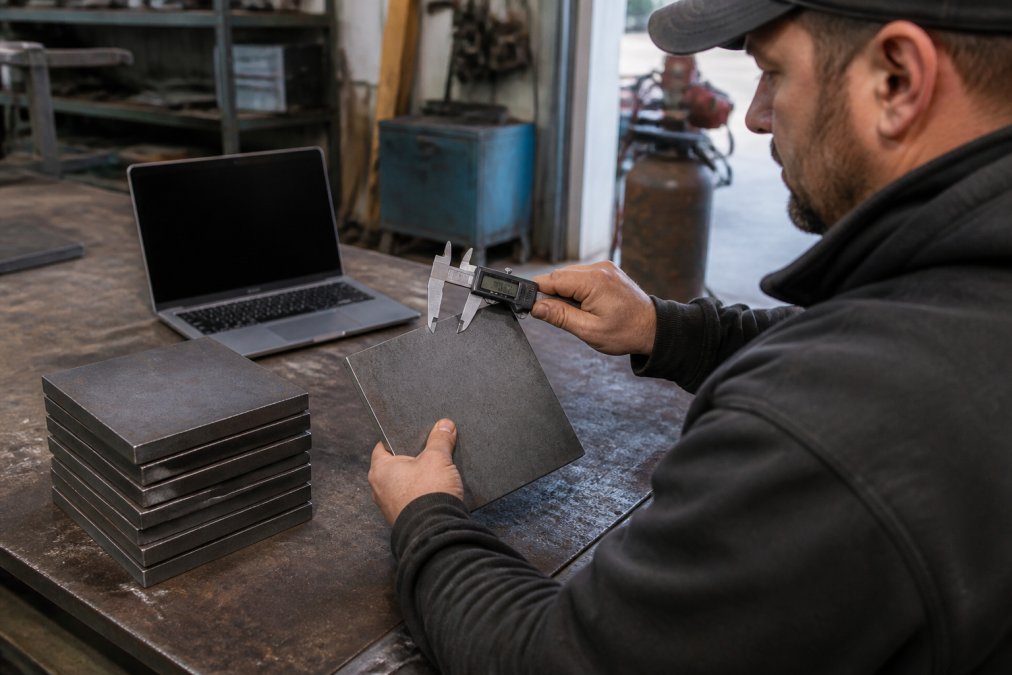
Measure thickness with a caliper or micrometer, not a tape measure. Take three readings across the plate, near each end and in the middle, and average them. Steel is sold by nominal thickness, so a "1/4 inch" plate measures 0.250" on paper and may run slightly over or under. ASTM A6, the general requirements standard for rolled structural steel plates, sets the permissible thickness variation for plate by thickness range; a supplier's cut tolerance sits on top of that mill tolerance, not instead of it.
How to write a tolerance callout on your order
A complete spec has four parts: nominal size, tolerance, material, and edge condition. Written out, it looks like this:
1/4" A36 Steel Square Plate – Select →
- Nominal size: 1/4" thick, 12" x 12"
- Tolerance: ±0.025" on all dimensions
- Material: A36 plate, mill certification required
- Edge condition: plasma cut, dross removed, weld-ready
Custom Laser Cut Metal Products and Shape Blanks for Fabrication
Custom laser cut metal products and shape blanks let you skip the layout and cutting step entirely. You send dimensions or a drawing, and the supplier cuts the profile.
Shape blanks cover most of what fabricators actually order:
- Square and rectangular plates for base plates and mounting plates
- Circle plates for fire pits, decorative work, and machine components
- Radius-corner squares for safer handling and a cleaner finished look
- Flat bar and angle iron for frames and reinforcement
Step-by-Step: How to Buy Precision Cut Carbon Steel Online
The online ordering process takes about ten minutes once you know your specs. Here's the sequence that avoids most rework.
- Write your spec first. Grade, thickness, shape, and finished dimensions, in decimal inches or fractions.
- Pick the shape and size. Square plate, circle plate, radius-corner square, flat bar, or angle iron.
- Confirm the tolerance. Check that the listed tolerance matches what your project needs.
- Enter quantity. No minimum order applies, so one piece is fine.
- Note any certification need. Request material certifications if the part is load-bearing.
- Review the quote for add-ons. Custom cuts, certifications, and rush handling should appear before you pay.
- Place the order and track it. Standard orders ship in 1 to 5 business days.
Pricing, Shipping, and What Arrives in the Box
Pricing on cut carbon steel reflects three things: the grade, the thickness, and the cut time. Thicker plate costs more per square inch, and high-carbon or alloy grades cost more than A36.
| Product | Thickness | Size Range | Price |
|---|---|---|---|
| A36 Square Plate | 1/4" | 4" x 4" to 30" x 30" | From $17.07 |
| A36 Square Plate | 3/16" | 4" x 4" to 30" x 30" | From $17.09 |
| A36 Square Plate, Radius Corners | 1/4" | 4" x 4" to 30" x 30" | From $18.35 |
| A36 Circle Plate | 1/4" | 4" to 30" diameter | From $25.90 |
Common Mistakes to Avoid When Ordering Steel Online
The most expensive mistake is ordering by nominal thickness when your project needs a tolerance. A plate that's off by a few thousandths is fine for a welding table and useless for a machined assembly. State the tolerance you need.
Conclusion
The gap between a smooth steel order and a frustrating one comes down to preparation: know your grade, measure your thickness, and specify your dimensions in writing. That's the whole game.
Frequently Asked Questions
What are the benefits of buying precision cut carbon steel online?
Ordering precision cut carbon steel online saves time and eliminates scrap. You specify exact dimensions, thickness, and grade, and the supplier cuts to tolerance before shipping. JWM Metal Supply ships American-made A36 plates with ±0.025" tolerances, no minimum order, and free shipping, so a hobbyist ordering one 4" × 4" plate gets the same precision as an industrial buyer ordering hundreds.
How do I specify tolerances when ordering custom steel online?
State your required thickness, length, width, and acceptable tolerance range in the order notes. Most suppliers default to standard mill tolerances, but precision cut suppliers like JWM Metal Supply hold ±0.025" on CNC plasma cut plates. If your project involves load-bearing welds or mating surfaces, request tighter tolerances and confirm them in writing before the order is cut.
What is the difference between mild steel and high carbon steel for fabrication?
Mild steel like A36 contains roughly 0.25% carbon, which makes it easy to weld, drill, and machine. High carbon grades such as 1084 or 52100 have more carbon and hold an edge or resist wear better, but they crack more easily during welding and usually require heat treatment. For general fabrication, trailer work, and structural plates, A36 is the practical choice.
Are there minimum order requirements for custom steel fabrication?
Not at JWM Metal Supply. The company operates with no minimum order quantity, so a single 1/4" A36 square plate at $17.07 ships the same way a bulk production run does. That matters for hobbyists and small shops who need one or two pieces for a repair rather than a full sheet. Bulk pricing is available when volume increases.
Ordering steel online works best when the specification is clear and the supplier cuts to it. JWM Metal Supply handles custom dimensions, offers material certifications, and ships free with no minimum order. Get started with JWM Metal Supply and get the exact plate your project calls for.