

Last Updated: October 9, 2026
Is American-Made Steel Stronger? What Actually Decides Strength
Is American-made steel stronger? Not automatically, and that answer surprises most buyers. Strength comes from the grade, the chemistry, and the specification the mill produced to, not the flag on the shipping label. At JWM Metal Supply, we cut and ship American-made carbon steel every day, and we will tell you plainly: the spec sheet decides, not the country of origin.
Why Country of Origin Is Not a Strength Rating
No standard body rates steel by nationality. A steel grade is a defined set of mechanical and chemical requirements, and any mill anywhere that hits those requirements produces steel of that grade. The ASTM International standards catalog lists the specifications that actually govern strength, and origin appears nowhere in them.
What origin does affect is consistency, documentation, and how quickly you can get replacement material. That distinction matters more than most buyers realize.
Steel Strength by Grade: Why the Spec Sheet Beats the Flag
Grade is the whole ballgame. A higher grade of imported steel will outperform a lower grade of domestic steel every time, because grade sets the minimum yield and tensile values the mill must meet. When you compare steel strength by grade, you are comparing apples to apples. When you compare by country, you are comparing nothing useful.
What the Numbers Actually Look Like
Take two widely used structural grades.
Now flip the comparison. An imported A992 beam and a domestic A992 beam are both required to hit 50 ksi minimum yield. If both mills test to spec, the strength is the same.
That is the entire argument in one example: the grade number on the order is the strength you get, and the country on the mill test report is a separate question.
Yield Strength vs Tensile Strength in Plain Terms
Yield strength is the stress at which steel stops springing back and starts bending permanently. Tensile strength is the point at which it actually tears apart.
Both numbers appear on the mill test report. Both are set by the specification, not the mill's address. A common mistake is shopping on tensile strength alone, then wondering why a frame flexes under load.
Elongation and Hardness: The Numbers Buyers Skip
The mill test report also carries elongation, usually expressed as a percentage over a 2-inch gauge length. A36 typically requires around 20% minimum elongation in 2 inches; A992 requires around 18% minimum.
Hardness shows up less often on structural reports but matters for wear parts, forming, and machining. It is measured on scales like Rockwell B or Brinell, and it correlates loosely with tensile strength in carbon steels.
Why Grade Beats Origin Every Time
Put the two ideas side by side:
- A domestic A36 angle and an imported A992 beam: the imported beam is stronger in yield, because A992 demands more.
- A domestic A992 beam and an imported A992 beam: strength is a tie if both meet spec.
- A domestic A36 angle and an imported A36 angle: strength is a tie if both meet spec.
In none of those three cases does the country of origin decide the winner. The grade does. That is why the first question to ask any supplier is not "where was it made" but "what grade and specification am I buying, and can you show me the test results."
ASTM Steel Specifications: The Rules Both Domestic and Imported Steel Must Meet
ASTM steel specifications define the chemistry, mechanical properties, tolerances, and test methods for a given product. A500 Grade B, for example, sets minimum yield and tensile requirements for structural tubing regardless of where it was rolled. Domestic and imported steel sold as A500 Grade B are both supposed to meet those numbers.
How Electric Arc Furnace and Blast Furnace Steel Reach the Same Spec
Two production routes dominate. The electric arc furnace (EAF) melts scrap and refines it to chemistry. The blast furnace (BF) route reduces iron ore and refines it into steel. Both routes can produce material that meets the same ASTM specification.
What most guides miss is that the route affects traceability and residual element control more than it affects the strength numbers. A well-run mill on either route hits spec.
Decision Factor |
What to Check |
Why It Matters |
|---|---|---|
Grade |
A500 Grade B or the grade your engineer specified |
Sets the minimum yield and tensile values |
Certification |
Mill test report with heat number |
Proves the material meets spec |
Traceability |
Heat number ties to the producing mill |
Lets you verify origin and chemistry |
Consistency |
Same grade, same mill, repeat orders |
Keeps the twentieth piece like the first |
Lead time |
Stock availability and cut schedule |
Keeps your project on schedule |
Steel Material Certification: How to Prove What You Bought
Steel material certification is the paperwork that ties a physical piece of steel to the heat it was poured from and the specification it was tested against. Without it, you have a claim. With it, you have proof.
Square Steel Tubing-1-1/4" x 1-1/4" x 16ga (0.065")-Select Length →
What a Mill Test Report Should Tell You
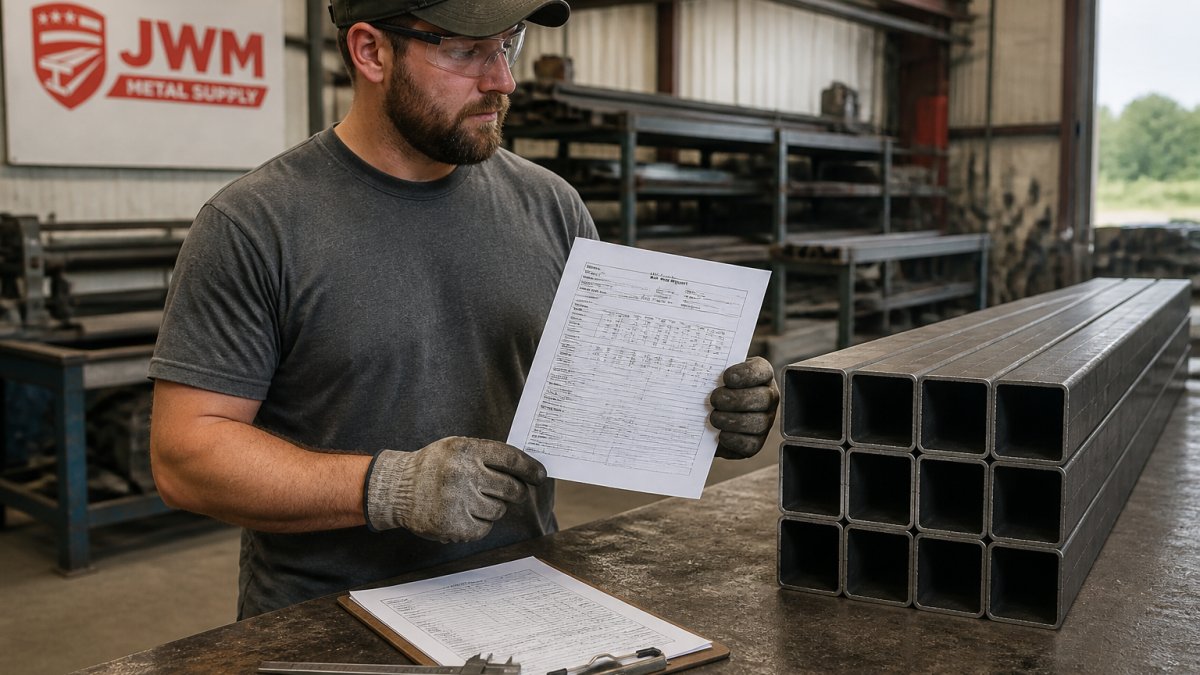
A mill test report should list the heat number, the grade and specification, the chemical composition, and the mechanical test results for yield and tensile strength. If a supplier cannot produce one on request, treat the material as unverified, no matter what the invoice says.
Steel Grade Identification: Reading Marks, Specs, and Paperwork
Steel grade identification comes down to three sources: the marks on the material, the specification referenced on your order, and the certification that follows the shipment. Match all three before you cut.
For tubing, the grade is often called out as A500 Grade B. For angle and flat bar, the spec may be a general structural or merchant bar standard.
Domestic vs Imported Steel: Where American-Made Steel Actually Wins
American-made steel wins on consistency, traceability, and supply reliability, not on raw strength. That is the honest answer, and it is the one that matters when you are welding a trailer frame or repairing equipment that has to hold up in the field.
The Comparison Nobody Publishes
Most articles on this topic talk about production trends, emissions, and trade policy. Almost none put domestic and imported steel side by side on the dimensions a buyer can actually verify. Here is that comparison, using only factors you can check on a mill test report or a purchase order:
Factor |
Domestic Steel |
Imported Steel |
|---|---|---|
Minimum yield and tensile |
Set by the grade and specification |
Set by the grade and specification |
Chemistry and residuals |
Controlled to spec; heat-by-heat documentation |
Controlled to spec; documentation varies by mill and broker |
Mill test report |
Standard practice, traceable to the producing mill |
Available, but the chain from mill to broker to you is longer |
Heat number traceability |
Direct from mill to distributor |
May pass through multiple hands before you see it |
Lead time and replenishment |
Domestic stock and cut schedules are typically shorter |
Ocean freight and port handling add variability |
Response to a quality issue |
You can reach the mill through your supplier |
Resolution depends on the importer and broker chain |
The strength row is a tie. Every other row is where origin starts to matter, not because imported steel is weaker, but because the paper trail and the supply chain behind it are longer and harder to verify.
Consistency, Traceability, and Supply Reliability
When you order the same grade from the same domestic mill repeatedly, you get predictable welding behavior, predictable forming, and a paper trail that holds up.
A common pattern in fabrication shops is that the first order of imported material tests fine and the third order from a different broker behaves differently under the welder, same nominal grade, different residual chemistry, different arc characteristics.
What to Ask Before You Buy, Regardless of Origin
A short checklist that separates a real supplier from a reseller:
- What grade and specification is this material sold as?
- Can you send the mill test report before I order?
- Does the report show a heat number that ties back to the producing mill?
- Is the material in stock, and what is the cut and ship schedule?
- If a test result comes back out of spec, what is the resolution process?
If a supplier can answer all five, origin becomes a secondary question. If they cannot answer the first two, origin does not matter, you are buying an unverified claim.
At JWM Metal Supply, every order ships with material certifications available, so you can prove what you bought. Our A500 Grade B square tubing is cut to your exact length and ready to ship in 1-3 business days, with no minimum order. For a shop that needs the twentieth piece to behave like the first, that predictability is the real advantage.
What to Ignore When Comparing Steel Strength and Price
Ignore the flag on the label and ignore any supplier who cannot produce a mill test report. Price competitiveness matters, but a cheaper piece of unverified steel is not a bargain if it fails inspection or a load test.
- Country of origin as a standalone strength claim
- Tensile strength quoted without a grade or specification
- Any price that does not come with certification on request
Conclusion: Buy the Grade, Not the Label
The real challenge is not finding strong steel. It is finding steel you can prove meets the grade your project needs, delivered when you need it. We stock American-made carbon steel, cut it to your exact length, ship it free with no minimum order, and provide material certifications on request. Shop our square steel tubing and angle iron and get material you can document, not just material you can hope for.

Frequently Asked Questions
Is American-made steel stronger than imported steel?
Not automatically. Two pieces of steel made to the same grade and specification, such as A500 Grade B, should deliver the same minimum yield and tensile strength regardless of where they were melted and rolled. Origin changes how consistently that spec is met and how easy it is to trace, not the published numbers. Ask for the grade, the ASTM spec, and the mill test report before you compare anything.
Does steel grade matter more than country of origin?
Yes. Grade and specification set the mechanical properties you can count on, including yield strength, tensile strength, and elongation. A domestic A36 angle and an imported A36 angle are both required to hit the same minimums. Country of origin affects process control, documentation, and supply reliability, which matter for repeat fabrication work but do not raise the strength ceiling of the material itself.
How can you verify the grade of a piece of steel?
Start with the mill test report or material certification supplied with the order, which lists the heat number, chemistry, and mechanical test results. Match that heat number to any marks on the material. For critical load-bearing work, a portable hardness tester or a third-party lab can confirm the alloy. Buying from a supplier that provides certifications with every order removes most of the guesswork.
What documents should you request when buying steel?
Request a mill test report or certificate of compliance that names the grade, the ASTM specification, the heat number, and the mechanical properties. If the steel is going into a trailer, rack, or structural repair, keep that paperwork with the job file. Suppliers that stock American-made material and issue certifications on request make this step simple, and it protects you if a customer or inspector asks where the steel came from.