

Last Updated: October 9, 2026
What Is 1x2 Rectangle Steel Tubing?
1x2 rectangle steel tubing is hollow structural tubing with an outside dimension of approximately 1 inch by 2 inches, formed from carbon steel strip and welded along a longitudinal seam. Its rectangular profile gives fabricators a flat surface that is easy to weld, drill, bolt, and attach to other components.
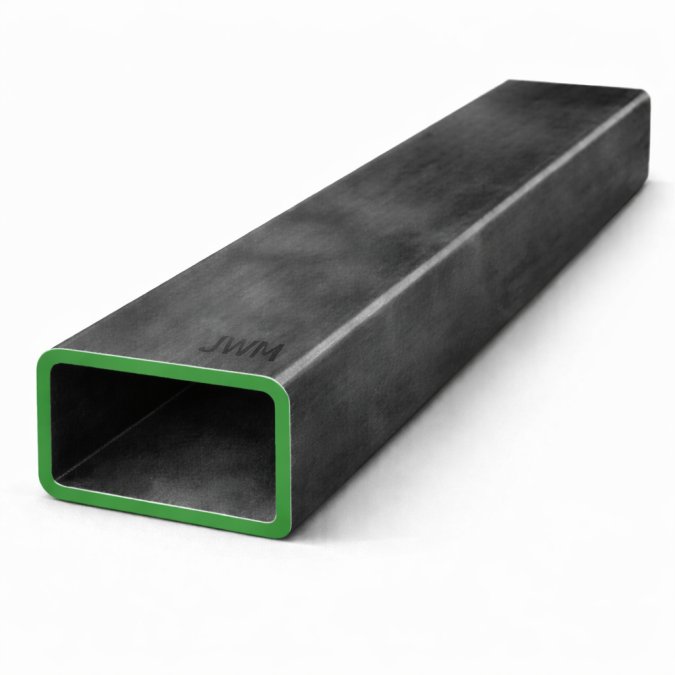
At JWM Metal Supply, we stock this size in several wall thicknesses and cut every piece to the length you specify, so you order the steel your project needs rather than a full mill length you have to store or scrap.
The rectangular shape matters more than most buyers realize. A hollow section resists bending in two directions at once, and the 2-inch face carries stiffness that the 1-inch face cannot match. That single fact drives most of the design decisions that follow.
Actual vs. Nominal Outside Dimensions
Nominal dimensions describe the size a mill intends to produce; actual dimensions are what a tape measure reads. For 1x2 tubing, the outside dimensions are the nominal 1 inch by 2 inches, and the wall thickness is measured inward from that face.
Wall thickness is where the real variation lives. A tube sold as 16 gauge typically runs 0.065 inch of wall, and the manufacturing tolerance on wall thickness and corner radius means two pieces from different heats can feel slightly different when you clamp them together.
If your assembly depends on a tight fit, measure the actual outside dimension of your material before you cut the mating parts. This is the step most home-shop builders skip, and it is the reason a frame that looked square on paper comes out racked.
Hollow Tube vs. Solid Rectangular Bar
Hollow tubing and solid rectangular bar share the same footprint but behave very differently. Solid bar is heavier, stiffer in absolute terms, and far more expensive per foot in this size; tubing trades some of that stiffness for a much better strength-to-weight ratio.
For a trailer frame, a gate, or a rack, tubing almost always wins because you are fighting weight as much as load. For a pivot pin, a machined spacer, or a part that gets drilled and tapped repeatedly, solid bar is the honest choice.
1x2 Rectangular Steel Tube Wall Thickness Options
Wall thickness is the single biggest decision you make when ordering 1x2 rectangular steel tube. It sets the weight, the weldability, the load the tube can carry, and the price you pay.
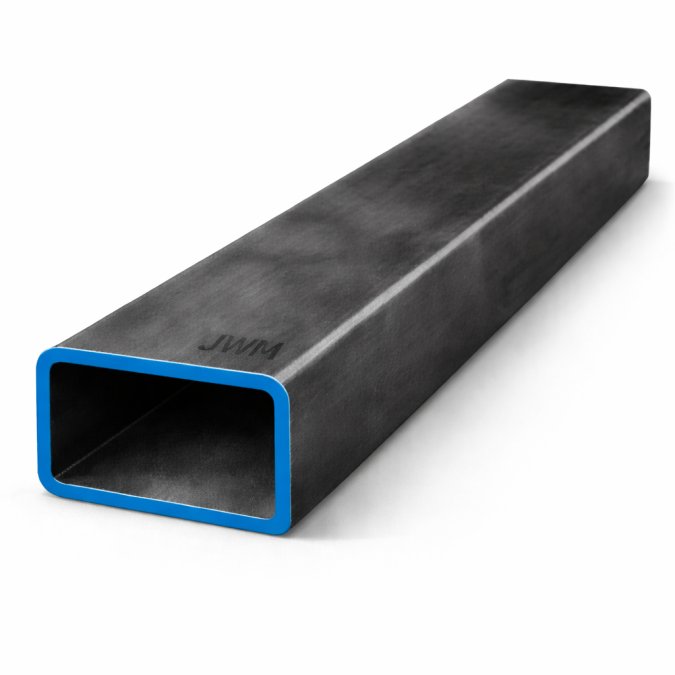
We stock four wall thicknesses in this size, and each one has a clear best use:
Wall Thickness |
Weight Per Foot |
Best For |
Trade-Off |
|---|---|---|---|
16ga (0.065") |
1.3 lb/ft |
Light racks, sign frames, guards |
Dents easily; thin for load-bearing |
1.6 lb/ft |
Gates, shelving, furniture frames |
Middle ground on weight and stiffness |
|
11ga |
2.25 lb/ft |
Trailer frames, equipment supports |
Heavier; harder to bend by hand |
3/16" (0.188") |
3.05 lb/ft |
Structural supports, machine frames |
Heaviest; costs the most per foot |
The pattern is simple: every step up in wall thickness adds weight and stiffness, and every step down saves weight and money at the cost of durability. There is no universally correct answer here, only the answer that fits your load and your budget. Selecting the appropriate gauge requires balancing these metal durability factors against the specific stresses encountered in high-impact environments like off-road bumper fabrication.
How to Choose Wall Thickness for Your Project
Start with what the tube has to do, not with what looks strong. A sign frame that never sees a load does not need 3/16-inch wall, and a trailer crossmember that carries cargo should not be built from 16 gauge.
Ask three questions in order:
- What load does it carry? Static loads like shelving tolerate thinner wall than dynamic loads like trailer frames, which see road shock and vibration.
- How is it loaded? A span supported at both ends bends in the middle; a cantilever bends at the root. Longer unsupported spans need more wall, or more depth.
- How is it joined? Thin wall burns through faster under a welder. If you are new to welding, 14ga and up gives you more margin for error than 16ga.
For anything that carries people, tows behind a vehicle, or supports a structure overhead, have a qualified engineer check the design. Tubing span tables and load ratings depend on grade, wall, span, and end conditions together, and no online chart replaces that review.
1x2 Steel Tubing Weight Per Foot
Weight per foot determines shipping cost, how many pieces you can handle alone, and how much your finished structure weighs. For 1x2 steel tubing, weight per foot scales directly with wall thickness.
The four options we stock run 1.3 lb/ft at 16 gauge, 1.6 lb/ft at 14 gauge, 2.25 lb/ft at 11 gauge, and 3.05 lb/ft at 3/16-inch wall.
That gap changes how you work. One person can carry and position a 20-foot stick of 16 gauge without much trouble. The 3/16-inch wall version is a two-person job, and it will bend your sawhorses if they were not built for it.
Freight cost follows the same curve, which is why ordering cut lengths instead of full sticks often makes sense for smaller projects. You pay for the steel you use, not for the drop you cut off and store in a corner.
Rectangular Steel Tubing Strength: Grades and Load Basics
Rectangular steel tubing strength comes from three things working together: the steel grade, the wall thickness, and the shape of the section. Change any one and the load capacity changes.
We supply 1x2 tubing in A500 Grade B or A513 carbon steel, depending on what the mill run provides.
Grade sets the stress the steel can take before it yields. A500 Grade B carries a minimum yield strength of 46 ksi and a minimum tensile strength of 58 ksi.
1" x 2" 16ga Rectangle Steel Tubing – Select Length →
Here is the part most buying guides leave out: yield strength is not the same as allowable load. The shape of the tube, the length of the span, and how the ends are held determine when it bends.
Which Way to Orient 1x2 Tubing for Bending Resistance
Orient the 2-inch face vertically when the tube spans a gap and carries a downward load. Depth is what resists bending, and the 2-inch dimension gives you roughly twice the depth of the 1-inch face.
Picture a trailer crossmember or a shelf rail. Standing the tube on edge puts the tall dimension in the direction the load pushes, which is exactly where you want the material. Laying it flat gives you a wider surface to bolt to, but the tube bends sooner under the same load.
There is a real trade-off here. Flat orientation is easier to weld to a plate, easier to drill through, and gives you a broader bearing surface for bolted connections. If your load is light and your priority is a clean attachment, flat is fine. If bending is the concern, stand it up.
1x2 Steel Tubing Cut to Length: Ordering and Fabrication
Ordering 1x2 steel tubing cut to length means you specify the exact piece length you need and it arrives ready to weld, with no full-length stick to store and no waste to pay for. We cut every order in-house to your selected length.
Length tolerance on our cut-to-size tubing is ±1/8 inch. That is tight enough for most fabrication work, but if you are building a matched set, order all the pieces at once so they come off the same setup and stay consistent.
Material certifications are available on request. If your project is load-bearing, inspected, or going to a customer who requires documentation, ask for the cert with your order and keep it with the job file.
Cutting, Drilling, and Welding 1x2 Tubing
Cut 1x2 tubing with a band saw, an abrasive chop saw, or a cold saw. A band saw leaves the cleanest end and the least heat; an abrasive saw is faster but leaves a burr you have to grind before the joint fits.
Drilling thin wall is where most people struggle. The bit grabs as it breaks through and pulls itself into the tube, which ovalizes the hole. Clamp the tube in a drill press vise, use a sharp bit at moderate speed, and back the inside of the tube with a scrap of wood if you can reach it.
Welding A500 and A513 carbon steel is straightforward with common processes. The seam weld on ERW tubing runs down one face, and welding across it is normal practice. Two things to watch:
- Thin wall burns through fast. Drop your amperage and move quicker on 16 gauge than you would on 3/16-inch wall.
- Mill scale and light surface rust interfere with clean arcs. Wire-brush the joint area before you strike an arc.
Every piece we ship comes with a raw mill finish and may show light mill scale or surface rust. Saw-cut edges can be sharp, so handle with gloves and deburr before assembly.
Common Uses for 1x2 Rectangle Steel Tubing
1x2 rectangle steel tubing shows up anywhere a builder needs a light, stiff, weldable frame with a flat face for attachments. That covers a lot of ground.
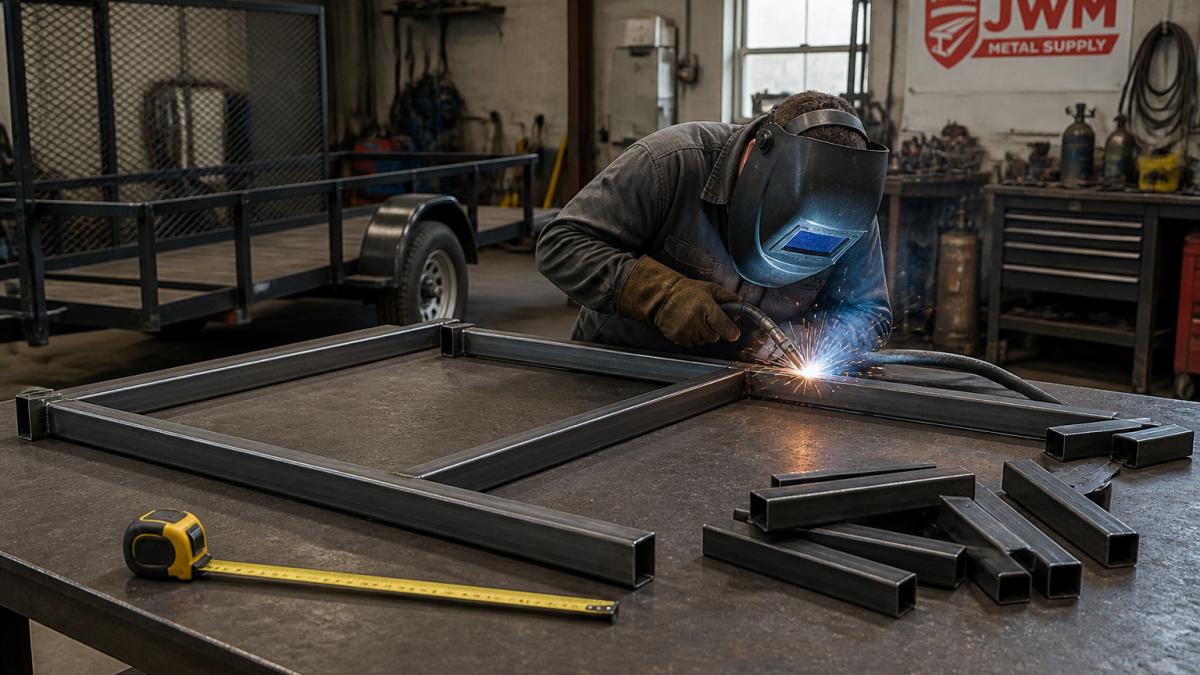
Trailer fabrication is the biggest use. Crossmembers, side rails, and gate frames all take this size well, especially in 11 gauge and heavier.
The size hits a sweet spot. It is small enough to handle and cut with basic shop tools, and large enough to build something that holds real weight.
If you are deciding between this and a solid bar for a specific joint, remember that tubing lets you run wiring, bolts, or a hinge pin through the hollow center.
Building a frame, a gate, or a trailer repair means getting the wall thickness and cut length right the first time, and that is where JWM Metal Supply comes in.
Frequently Asked Questions
What are the actual dimensions of 1x2 rectangular steel tubing?
The outside dimensions measure 1 inch by 2 inches, though actual mill dimensions can vary slightly from nominal. JWM Metal Supply lists 1x2 rectangle steel tubing with a length tolerance of plus or minus 1/8 inch on cut pieces. Wall thickness is measured separately and ranges from 16 gauge (0.065 inch) up to 3/16 inch (0.188 inch). Always account for wall thickness when calculating inside dimensions for inserts or telescoping fits.
What wall thicknesses are available for 1x2 steel tubing?
JWM Metal Supply stocks 1x2 rectangular steel tubing in 16 gauge (0.065 inch), 14 gauge, 11 gauge, and 3/16 inch (0.188 inch) wall thicknesses, all made in the USA. Thinner walls suit light frames, shelving, and sign structures, while heavier walls handle trailer fabrication, equipment repairs, and structural supports. If you need a wall thickness or quantity not listed, contact JWM Metal Supply for a custom quote.
How strong is 1x2 rectangular steel tubing?
Strength depends on wall thickness, steel grade, and orientation. JWM Metal Supply tubing is made from A500 Grade B or A513 carbon steel, both ERW welded. Orienting the 2-inch side vertically gives noticeably more resistance to bending than laying it flat. For load-bearing applications, match the wall thickness to the span and expected load, and consult a qualified engineer for structural projects.
Can 1x2 steel tubing be cut to a specific length?
Yes. JWM Metal Supply cuts every 1x2 steel tubing order to your selected length, so you are not forced to buy a full 20-foot or 24-foot stick and cut it down yourself. Pieces arrive with smooth saw-cut ends, ready to weld or drill. There is no minimum order quantity, and orders typically ship within 1 to 5 business days with free shipping.