

Table of Contents
- Understanding Steel Weight Calculations
- The Steel Weight Formula Explained
- Using a Steel Plate Weight Calculator
- Calculating Weight for Round Bars and Flat Stock
- Steel Tubing Weight Calculator and Hollow Sections
- Theoretical Weight vs. Actual Weight
- Project-Based Batch Calculation and Waste Factor
- Common Mistakes to Avoid When Calculating Steel Weight
- Frequently Asked Questions
Last Updated: October 8, 2026
Understanding Steel Weight Calculations
When you're planning a fabrication project, you need to calculate steel weight accurately, it's non-negotiable. Whether you're designing a trailer frame, building structural supports, or creating custom brackets, miscalculating material weight can derail your project.
Weight calculations affect three decisions: structural design, shipping costs, and material procurement. Get the math wrong, and you either over-spec your materials or under-build your structure. This guide walks through the exact process we use.
Why Weight Matters for Your Project
Structural integrity depends on accurate weight calculations. If you're designing a load-bearing frame or support system, you need to know the total weight your materials will carry.
Beyond safety, weight directly impacts cost: shipping charges, handling equipment, and foundation design all scale with it. Missing this calculation early means expensive redesigns later.
Material ordering matters too.
Material Density and Specifications
Different steel types have different densities. Carbon steel, the most common structural material, has a consistent density that makes calculation straightforward.
The density of carbon steel is approximately 0.284 pounds per cubic inch, or 7,850 kilograms per cubic meter. This number is the foundation of every weight calculation you'll do.
Why does density matter? Because weight equals volume times density.
The Steel Weight Formula Explained
The core formula is simple: Weight = Volume × Density. Volume is where most people get stuck.
For flat stock and plates, volume equals thickness times width times length. For round bars and tubes, you account for the circular or hollow cross-section.
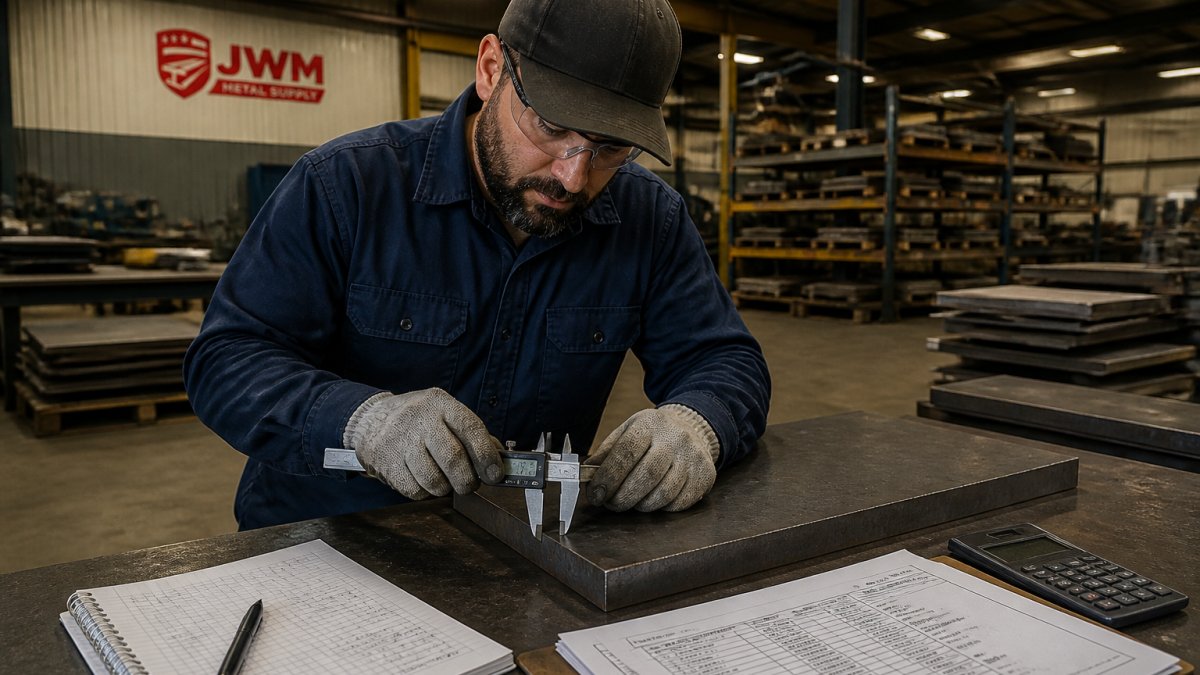
Breaking Down the Calculation
Start with your material dimensions: thickness, width, and length. Measure in consistent units, either all inches or all millimeters, not mixed.
For a rectangular plate:

- Thickness × Width × Length = Volume (in cubic inches)
- Volume × 0.284 = Weight in pounds
For example, a steel plate measuring 0.25 inches thick, 5 inches wide, and 12 inches long would be: 0.25 × 5 × 12 = 15 cubic inches.
The math is straightforward once your dimensions are locked down. The challenge is accurate measurement and knowing which formula fits your profile shape.
Metric to Imperial Conversion
If your specifications come in metric, convert before calculating or use metric density.
Carbon steel density in metric: 7,850 kg/m³ or 7.85 g/cm³
To convert kilograms to pounds, multiply by 2.205. To convert pounds to kilograms, divide by 2.205.
Many fabricators work in metric and convert the final weight to pounds for shipping quotes.
Using a Steel Plate Weight Calculator
A weight calculator automates the formula: input dimensions and material type, and the tool returns weight instantly, eliminating math errors and saving time on repetitive work.
Calculators are most useful when pricing multiple pieces or comparing thicknesses, instead of calculating by hand six times, you input six scenarios and compare results in seconds.
When to Use a Calculator vs. Manual Calculation
Use a calculator for:
- Multiple pieces with different dimensions
- Quick pricing quotes
- Batch orders with varying sizes
Use manual calculation when:
- You need to understand the math (for design work)
- You're verifying a supplier's weight claim
- You're working on a single piece and want confidence in the result
The best approach: do one calculation by hand, then verify with a calculator. This builds your intuition for what "reasonable" looks like.
Calculating Weight for Round Bars and Flat Stock
Round bars require a different formula because the cross-section is circular, not rectangular.
For a round bar, the formula is: Diameter² × Length × 0.00267 = Weight in pounds
The 0.00267 constant accounts for the circular cross-section and carbon steel density.
Flat bar (rectangular stock) uses the same formula as plate: thickness × width × length × 0.284.
Steel Tubing Weight Calculator and Hollow Sections
Hollow sections (tubing, pipe, channels) require accounting for wall thickness. Weight depends on both the outer dimensions and how much material is actually there, so think about the cross-section of steel itself, not the outside of the tube.
The Cross-Section Method
Every hollow section reduces to one idea: find the area of the steel in the cross-section, multiply by length, then multiply by density.
For a square or rectangular tube:
- Outer area = outer width × outer height
- Inner area = (outer width − 2 × wall) × (outer height − 2 × wall)
- Steel area = outer area − inner area
For a round tube or pipe:
- Outer area = π × (outer diameter ÷ 2)²
- Inner area = π × ((outer diameter − 2 × wall) ÷ 2)²
- Steel area = outer area − inner area
Worked Example: 1.5 in × 1.5 in Square Tube
Square tubing 1.5 inches × 1.5 inches with 0.083-inch wall thickness (14 gauge) is one of the most common sizes in fabrication.
15" x 27" Steel Rectangle Plate -- 1/4" Thick-A36 Hot Rolled →
- Outer area = 1.5 × 1.5 = 2.25 in²
- Inner area = (1.5 − 0.166) × (1.5 − 0.166) = 1.334 × 1.334 = 1.780 in²
- Steel area = 2.25 − 1.780 = 0.470 in²
- Weight per inch = 0.470 × 0.284 = 0.133 lb/in
Compare that to a solid 1.5-inch square bar: 2.25 in² × 0.284 = 0.639 lb/in, or 30.7 lb for the same 48 inches. The hollow section is roughly one-fifth the weight, which is exactly why tube is used for frames where stiffness matters more than raw mass.
Wall Thickness, Gauge, and Load Capacity
Thicker walls mean more weight and strength; thinner walls mean less weight but reduced load capacity. The relationship isn't linear, stiffness in bending scales roughly with wall thickness for a given outer size, while weight scales almost exactly with it.
A weight calculator handles the arithmetic automatically. Manual calculation means computing outer dimensions, subtracting the hollow interior, then multiplying by density, doable but error-prone when juggling several tube sizes.
For hollow sections, a calculator is worth using. The formula is more complex, and one mistake throws off your entire estimate.
Theoretical Weight vs. Actual Weight
Theoretical weight assumes perfect dimensions with no waste. Actual weight includes material variation, cutting loss, and manufacturing tolerance.
Steel mills don't produce to exact specifications, a plate marked 0.25 inches thick might actually be 0.248 or 0.252 inches. These variations add up across large orders.
Tolerance and Variance Factors
Manufacturing tolerance typically runs ±1/16 inch on plate thickness and ±1/8 inch on cut lengths. This means your actual weight could vary 2-3% from the theoretical calculation.
For small projects this variance doesn't matter; for large structural or load-bearing applications, it matters enough to account for.
The safest approach: calculate theoretical weight, then add 3-5% as a buffer for material variation.
Project-Based Batch Calculation and Waste Factor
Most real projects don't use a single piece of steel. You're cutting multiple components from larger stock, and that cutting generates waste, the step most weight calculators skip entirely, since they give you the weight of one part, not the steel you actually need to buy.
Build a Bill of Materials First
Before you touch a calculator, list every component with its profile, dimensions, and quantity. A simple trailer frame might look like this:
| Component | Profile | Dimensions | Qty | Weight Each | Total |
|---|---|---|---|---|---|
| Main rails | Rectangular tube | 2 in × 3 in × 0.120 in wall, 96 in long | 2 | 15.4 lb | 30.8 lb |
| Crossmembers | Rectangular tube | 2 in × 3 in × 0.120 in wall, 60 in long | 5 | 9.6 lb | 48.0 lb |
| Tongue | Square tube | 2 in × 2 in × 0.120 in wall, 48 in long | 1 | 7.7 lb | 7.7 lb |
| Gussets | Flat bar | 0.25 in × 3 in × 6 in | 8 | 1.28 lb | 10.2 lb |
| Finished weight | 96.7 lb |
That 96.7 pounds is the theoretical weight of the finished assembly, not the weight of steel you order.

Apply the Waste Factor
Cutting loss depends on your cutting method and material layout. Careful nesting reduces waste; a typical waste factor is 5-15% for professional cutting, up to 20-30% for manual methods.
Using the table above with a 12% waste factor:
- Finished weight: 96.7 lb
- Waste allowance: 96.7 × 0.12 = 11.6 lb
- Purchase weight: 108.3 lb
Round up to the nearest stock length or minimum order increment. If your supplier sells tube in 20-foot lengths, you're buying whole sticks, not fractions of a pound, so the real constraint is usually stock length, not weight.
Convert Weight to Stock Lengths
Weight tells you shipping and handling. Stock length tells you what to order. For each profile, add up the total linear inches required, add your waste percentage, then divide by the stock length your supplier carries.
Example: the main rails and crossmembers above total 2 × 96 + 5 × 60 = 492 linear inches of 2 in × 3 in tube. Add 12% waste: 551 linear inches.
Planning for Waste and Cutting Loss
Better nesting reduces waste.
Some fabricators provide nesting services, send your part list and they optimize the layout before cutting, reducing waste and cost.
For simple projects, a conservative waste estimate (15-20%) is safer than optimizing.
When you order from JWM Metal Supply, specify your exact lengths and we cut to order.

Common Mistakes to Avoid When Calculating Steel Weight
Pick one unit system (imperial or metric) and convert everything before you start. Double-check your conversions.
A second mistake: forgetting to account for hollow sections.
Third mistake: ignoring tolerance and variance.
Fourth mistake: not considering waste. Ordering exactly the finished-part weight leaves you short when cutting loss occurs.
Fifth mistake: using the wrong density.
A practical tip: when in doubt, ask your supplier.
Accurate weight calculations are the foundation of confident material ordering. JWM Metal Supply provides precision-cut steel to your exact specifications, backed by material certifications and fast, free shipping. Shop our selection of A36 steel plates and flat bar and get started today.
Frequently Asked Questions
What formula is used to calculate steel weight?
The basic formula is: Weight (lbs) = Volume (cubic inches) × Density (lbs per cubic inch). For carbon steel, the density is approximately 0.284 pounds per cubic inch. To find volume, multiply length × width × height (all in inches). For example, a steel plate 12 inches long, 6 inches wide, and 0.25 inches thick has a volume of 18 cubic inches, which equals 5.1 pounds. Always verify material density and dimensions for accuracy in your specific project.
How do you calculate the weight of a steel plate using a steel plate weight calculator?
A steel plate weight calculator simplifies the process by requiring only four inputs: length, width, thickness, and material type. Enter your plate dimensions in inches, select carbon steel as the material, and the calculator multiplies these values by the material's density to return total weight in pounds. For a 15" × 27" × 1/4" plate, the calculator instantly shows approximately 43 pounds. This method eliminates manual calculation steps and reduces errors, making it ideal for quick project estimates or multiple material orders.
What is the density of carbon steel, and why does it matter?
Carbon steel has a density of approximately 0.284 pounds per cubic inch or 7,850 kilograms per cubic meter. This density is critical because it's the multiplier in all weight calculations, without it, you cannot convert dimensions into actual weight. Different alloys have slightly different densities, which is why specifying your material type (A36 carbon steel, for example) ensures calculation accuracy. Using the correct density prevents underestimating material weight, which could affect load-bearing capacity, shipping costs, and equipment selection.
How do you calculate the weight of steel tubing using a steel tubing weight calculator?
A steel tubing weight calculator accounts for hollow sections by subtracting the inner diameter from the outer diameter to determine wall thickness and cross-sectional area. Input the outer dimensions, wall thickness, and length, and the calculator derives the actual steel volume (excluding the hollow interior). For example, 1.5" × 1.5" square tubing with 0.083" wall thickness and 10 feet length weighs approximately 5.5 pounds. This precision is essential because hollow sections carry significantly less weight than solid bars of the same outer dimensions, affecting both cost and structural performance.