

Last Updated: October 10, 2026
Start With Purpose and Load, Not the Metal
Every good bracket starts with one question: what is this thing holding up? Custom metal brackets are only as strong as the decision behind them, so answer the purpose before you pick a piece of steel.
Ask yourself:
- What will the bracket support?
- How much weight will it carry?
- Does the load pull straight down, or away from the wall?
- Indoors or outdoors?
- Bolted, screwed, or welded in place?
A small shelf bracket and a workbench bracket live in different worlds. Pull-out force is the one most people forget: a shelf pushes down, while a gate or hanging bike pulls out and down, changing everything about your design.
Measuring for Metal Bracket Dimensions That Actually Fit
Metal bracket dimensions come from the space, not a guess. Measure the span, height, and mounting surface before you draw anything.
Here is what to capture:
- Horizontal span from wall to the load point
- Vertical drop from the top of the bracket to the shelf or rail
- Wall type: studs, masonry, or hollow drywall
- Stud spacing, so your holes land on solid wood
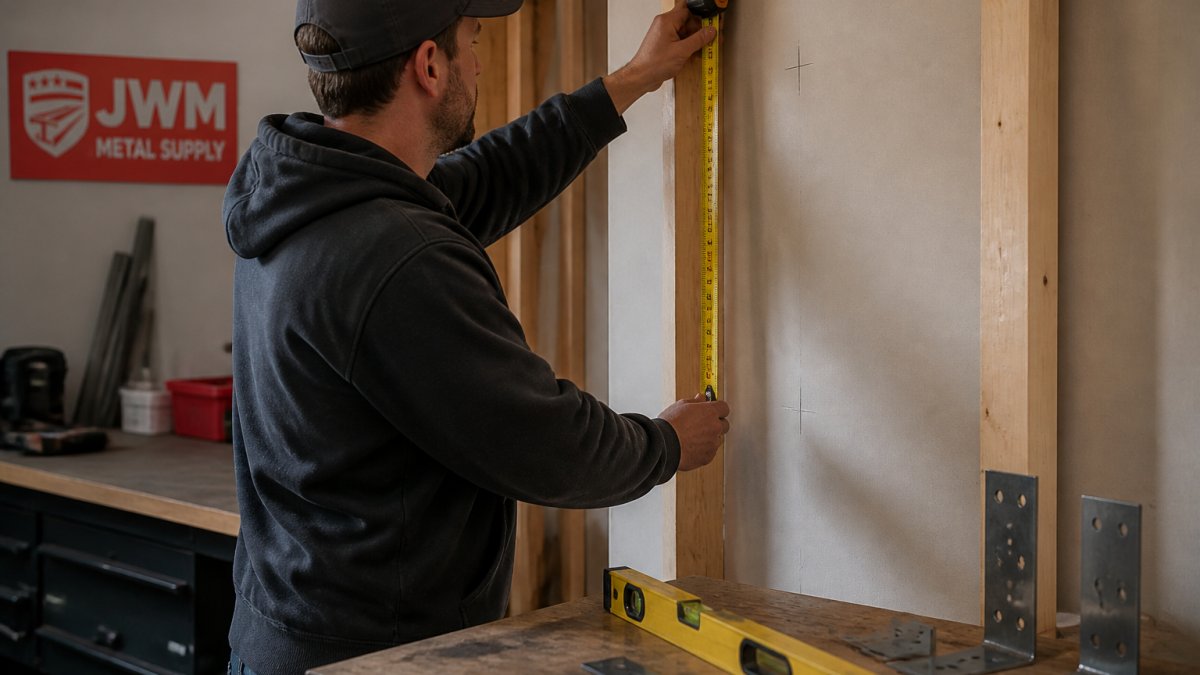
Measure twice and write the numbers down. A bracket built to a remembered measurement is a bracket you will rebuild. If you are mounting to studs, find the centers first and let those centers set your hole spacing. For a deeper look at safe fastening practice, the American Wood Council guide to wood construction is a solid reference.
Steel Bracket Design: Shape, Gussets, and Material Choice
Steel bracket design comes down to four decisions: shape, thickness, bracing, and whether the part can be made with the tools you have.
Common shapes and when to use them
- L-bracket: one 90-degree bend, simple and cheap, good for light shelves and straps. Weakest at the corner because the bend itself carries the moment.
- T-bracket: a flat plate with a welded rib running down the back. The rib adds stiffness in the direction that matters without adding much weight.
- Gusseted bracket: a triangle welded or bolted into the corner. For its weight, this is the stiffest common configuration, and it lets you use thinner material for the same load.
- Boxed or U-shaped bracket: two arms tied together with a plate or tube. Best when the load is heavy or the span is long, but it takes more cutting and welding.
Thickness by use case, not by habit

Thickness matters more than most beginners expect: thin flat bar flexes, heavier plate holds its shape. A practical starting point:
Use case |
Common stock |
Notes |
|---|---|---|
Decorative shelf, light load |
1/8" flat bar |
Fine indoors; add a gusset if the shelf is deeper than about 8" |
Utility shelf, garage or shop |
3/16" flat bar or plate |
Handles paint cans, tools, and moderate pull-out |
Workbench, equipment mount |
1/4" plate |
The practical ceiling for most home shops; pair with a gusset |
Outdoor or damp location |
Same thickness, plus finish |
Moisture drives the finish decision, not the thickness |
For home projects, 1/8" flat bar suits light shelves and straps, 3/16" covers most utility work, and 1/4" plate is the better call for workbenches and equipment mounts. Anything heavier usually solves a problem a gusset or shorter span would solve more cheaply.
Design for manufacturability
A clean drawing can still be impossible to build in a garage. Four numbers decide whether your design is makeable:
- Bend radius. Steel cracks when bent too tightly. A common shop rule is to keep the inside bend radius at least equal to the material thickness. A 1/4" plate wants roughly a 1/4" inside radius or larger; a 1/8" flat bar can take a tighter bend but still not a sharp crease.
- Bend allowance. When you bend metal, the material stretches, so the flat length you cut must be longer than the sum of the finished legs. For a 90-degree bend in 1/8" flat bar, a common allowance is roughly the material thickness: a bracket with a 6" leg and a 4" leg starts as about 10-1/8" of flat stock. Check your bender or a bend-allowance table before you cut.
- Hole-to-edge distance. Keep hole centers at least one and a half times the hole diameter from any edge. A 5/16" hole wants at least about 1/2" of material around it, or the edge tears out under load.
- Tolerances. Hand tools hold roughly 1/16" on a cut and a drill press holds closer on hole placement. If your design needs tighter than that, drill undersized and ream, or have the part cut for you.
Bracing is where the strength comes from
A gusset does the heavy lifting at the corner. Our 1/4" A36 Steel Triangle Gusset Plate is cut from premium ASTM A36 low carbon steel with clean, weld-ready edges in sizes from 4" to 30".

A quick sanity check before you commit
Stand on the finished bracket in your head. If the load is heavy, the span is long, or the pull is away from the wall, add a gusset, shorten the arm, or step up one thickness.
Sketching and Cutting: From Drawing to Finished Part
A sketch is the cheapest part of the build and saves the most time. Draw the bracket full size on paper or in a simple CAD program before you touch metal.
Your drawing needs:
- Overall length and height
- Bend locations and angles
- Hole centers and diameters
- Material thickness
Mark your cut lines with a scribe or marker, then cut with a band saw, angle grinder, or plasma cutter. After cutting, deburr every edge, sharp edges cut hands and create stress points that can crack later.
Keep the bend radius generous, tight bends crack steel. For drilling, clamp the work and use a center punch so the bit does not walk. Hole spacing should match your mounting surface, not the other way around.
1/4" A36 Steel Triangle Gusset Plate – Select Size →
DIY Metal Shelf Brackets: A Worked Example
Say you want DIY metal shelf brackets for a garage shelf holding paint cans and tools.
The plan: an 8" deep shelf, 36" long, mounted to two wall studs 16" apart.
Step 2: Check the arm. The load sits 8" out from the wall, creating a bending moment at the corner.
Step 3: Size the wall plate. The wall plate spreads the load across the stud.
Step 4: Pick the fasteners. For 2x framing, 5/16" x 3" lag screws are a common choice.
Step 5: Lay out the holes. Find the stud centers first, then mark your wall-plate holes to match.
Step 6: Brace the corner. Weld or bolt a triangle gusset into each corner.
Step 7: Finish and install. Paint or powder coat to fight rust.
Here is the full build at a glance:
Step |
What to do |
Why it matters |
|---|---|---|
1. Load |
Design for 80 lbs per bracket, 2x safety factor |
Sets thickness and bracing |
2. Dimensions |
8" arm, 6" wall plate |
Matches shelf depth and stud spacing |
3. Material |
1/4" A36 flat plate |
Handles the moment without flex |
4. Bracing |
Add a triangle gusset |
Stops the corner from bending |
5. Fasteners |
5/16" x 3" lag screws, two per stud |
Carries the load into the framing |
6. Holes |
5/16" for lags, 3/8" for arm bolts |
Fits fasteners, allows alignment |
7. Finish |
Paint or powder coat |
Fights rust in a garage |
Cut two arms and two wall plates, weld or bolt a gusset into each corner, then drill your holes. Our 1/4" Thick × 5" Wide A36 Steel Flat Plate comes cut to your length from 5" to 30", so you skip rough cutting and start at layout.
Metal Bracket Mounting Holes, Fasteners, and Wall Conditions
Metal bracket mounting holes only work if the wall behind them can take the load. Match your fastener to the wall, every time.
- Wood studs: lag screws or structural screws
- Concrete or masonry: wedge anchors or sleeve anchors
- Hollow drywall: toggle bolts, and only for light loads
Hole size should match the fastener shank, with a little clearance for alignment. Drill slightly oversized when bolting two parts together so they line up without a fight.
Outdoors changes the game: moisture, sun, and temperature swings wear on bare steel, so a protective finish like paint or powder coating slows corrosion. Keep holes away from the plate edge, because a hole too close tears out under load.
Build It or Buy It Cut to Size?
Building your own bracket wins when the shape is odd, the fit is tight, or you enjoy the work. Buying steel cut to size wins when you want the material right the first time and your time is worth more than the cutting.
Here is the honest trade-off:
- Build from scratch: full control, more time, needs tools
- Buy cut-to-length steel: faster start, less waste, consistent cuts
For most home projects, the smart move is a hybrid: design and drill your own bracket, but order the plate, flat bar, and gussets pre-cut. Our 3/16" A36 Steel Triangle Gusset Plate and 1/8" x 1/2" Wide Steel Flat Bar ship cut to length, so you spend time on layout and welding, not the saw.

One more thing worth knowing: material certifications. If your bracket is load-bearing or going into a structure, ask for the paperwork that proves the steel meets spec. For general guidance on structural connections, the Occupational Safety and Health Administration publishes reference material on load and rigging safety.
Designing custom metal brackets for home projects is mostly about asking the right questions before you cut. Load, dimensions, shape, and mounting all decide how the finished bracket performs.
Frequently Asked Questions
How do you choose the right steel thickness for a bracket?
Match thickness to the load and span. Light duty shelf brackets can use 1/8 inch flat bar, while heavier supports call for 3/16 inch or 1/4 inch material. A 1/4 inch thick by 5 inch wide A36 steel flat plate cut to length gives you a rigid base for brackets, mounting plates, and structural supports. Thicker steel resists bending at the corner, which is usually where a bracket fails first.
How do you calculate the load a bracket needs to support?
Add up everything the bracket will carry, then add a safety margin. A shelf holding 40 pounds of tools should be designed for at least double that, because a person leaning on it or a dropped load adds force. Consider whether the load pulls straight down or away from the wall, since outward pull stresses the fasteners and the top of the bracket far more than a vertical load.
How do you attach a custom metal bracket to a wall?
Drive fasteners into wall studs whenever possible, and use anchors rated for the load when no stud is available. Space mounting holes to match your stud layout so you are not fighting the framing. For welded or heavy brackets, drill holes slightly larger than the fastener diameter to allow alignment. Check that the mounting surface is flat, since a gap between bracket and wall causes the plate to bend when you tighten the bolts.
Where can I get custom brackets made if I do not want to fabricate them?
You can order steel cut to your exact length and have the bracket formed yourself, or send a drawing to a fabrication shop. Buying precut flat bar, plate, and gusset plates saves the cutting step and gives you clean, accurate edges. For example, a 1/4 inch A36 steel triangle gusset plate in sizes from 4 to 30 inches reinforces a welded corner without any cutting. Many suppliers ship in 1 to 5 business days with no minimum order.