

Last Updated: October 10, 2026
How Strong Is 2x2 Square Steel Tubing? The Short Answer
There is no single answer to how strong is 2x2 square steel tubing.
That is the honest answer, and it is the one most product pages skip.
Below, we break down how strong is 2x2 square steel tubing by loading mode, with a worked example you can copy for your own project.
What 2x2 Square Steel Tubing Actually Is
2x2 square steel tubing is a hollow structural section with 2-inch by 2-inch outside dimensions and a wall thickness that determines how much steel sits in the cross-section. The hollow core is what gives square tubing its high strength-to-weight ratio.
Outside Dimensions, Inside Dimensions, and Wall
The outside stays 2 inches square. The inside shrinks as the wall gets thicker.
Wall Thickness |
Inside Dimensions |
Weight Class |
|---|---|---|
14 gauge (0.083") |
~1.870" x 1.870" |
Light |
11 gauge (0.120") |
~1.750" x 1.750" |
Medium |
3/16" (0.188") |
~1.625" x 1.625" |
Heavy |
1/4" (0.250") |
~1.50" x 1.50" |
Extra heavy |
More steel in the wall means more weight per foot and more resistance to bending. It also means a smaller inside opening, which matters if you plan to run wiring or a sleeve through the tube.

A500 Grade B Carbon Steel and Yield Strength
Most 2x2 square structural tubing sold in the United States is A500 Grade B carbon steel. A500 Grade B carries a minimum yield strength of 46,000 psi, according to ASTM A500 standard specification for cold-formed welded carbon steel structural tubing.
That number is the ceiling your design works under, not a load rating. You still apply a safety factor on top of it.
2x2 Steel Tubing Wall Thickness: Gauge Chart and Trade-Offs
Thicker walls carry more load, cost more, and weigh more. The trick is picking the lightest wall that still meets your load with margin.
Gauge / Thickness |
Wall (in) |
Best For |
Trade-Off |
|---|---|---|---|
14 ga |
0.083 |
Light racks, furniture, trim |
Bends under heavy point loads |
11 ga |
0.120 |
General fabrication, gates, carts |
Middle ground on cost and strength |
3/16 |
0.188 |
Trailer frames, equipment |
Heavier, harder to bend by hand |
1/4 |
0.250 |
High-load structural work |
Heaviest, highest cost |
A common mistake is jumping straight to 1/4-inch wall "just to be safe." That adds weight and cost you may not need, and it can make welding trickier on thin equipment.
2x2 Square Tubing Load Capacity by Loading Mode
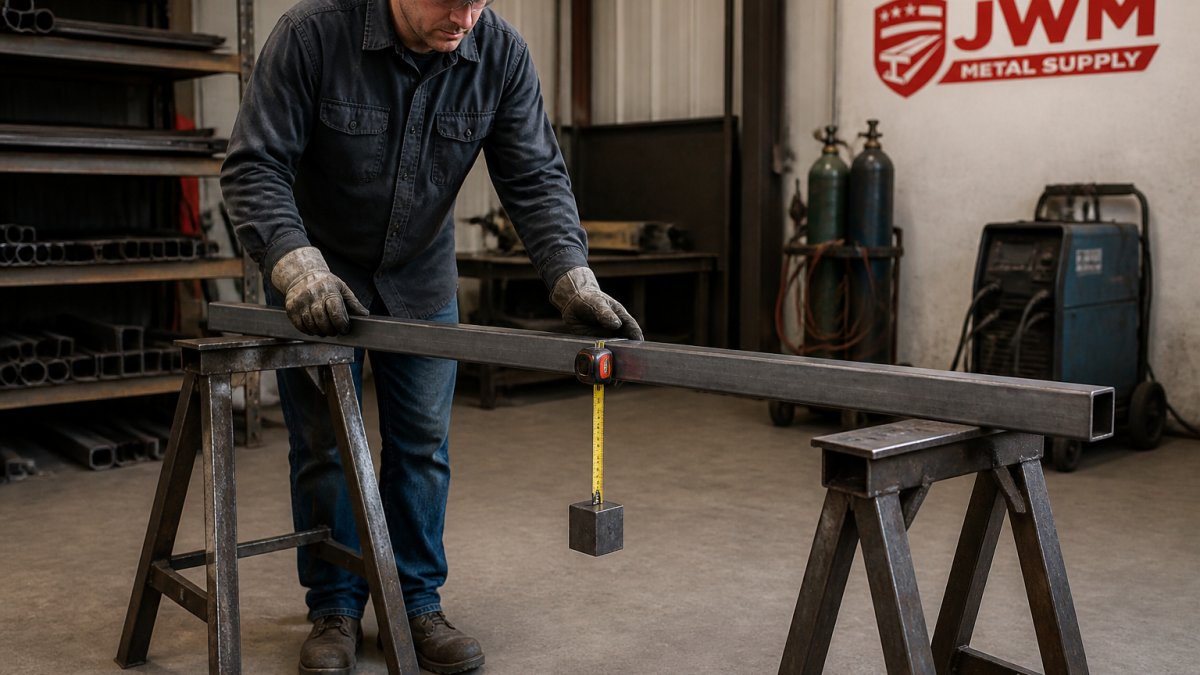
Capacity splits into two very different modes: axial compression (a column) and bending (a beam). The same tube handles far more load in compression than in bending over a long span.
Axial Compression and Column Buckling
In pure compression, a short 2x2 tube is very strong. The failure mode is buckling, not crushing. As the unsupported span grows, the column's capacity drops fast because slender columns buckle sideways before the steel reaches its yield strength.
So a 2x2 tube that holds a huge vertical load at 1 foot may hold a fraction of that at 8 feet. Length is the enemy of compression capacity.
Bending, Point Loads, and Distributed Loads
In bending, the tube acts as a beam. A point load sits at one spot, usually mid-span, and creates the worst bending moment. A distributed load spreads across the span and is gentler on the tube.
For the same total weight, a distributed load beats a point load every time. That is why a workbench top that spreads weight across the frame holds more than a single heavy item dropped in the middle.
How to Calculate Square Tube Strength for Your Span
You can estimate bending capacity for 2x2 square tubing with a few inputs and one formula. You do not need a full engineering suite for a hobby project, but you do need real numbers instead of a guess.
Gather these first:
- Wall thickness and the resulting inside dimensions
- Steel grade yield strength (46,000 psi minimum for A500 Grade B)
- Unsupported span length, in inches
Step 1: Find the Section Modulus
The section modulus (S) describes how much bending resistance the cross-section has. For a square hollow section with outside dimension b and inside dimension bi:
S = (b^4 - bi^4) / (6 x b)
For 2x2 tubing, b = 2.000 inches. Plug in the inside dimension for your wall:
Wall |
Inside (bi) |
Section Modulus (S) |
|---|---|---|
14 ga (0.083") |
1.834" |
~0.36 in^3 |
11 ga (0.120") |
1.760" |
~0.51 in^3 |
3/16" (0.188") |
1.624" |
~0.77 in^3 |
1/4" (0.250") |
1.500" |
~0.98 in^3 |
Notice how much S climbs with wall thickness. Going from 14 gauge to 11 gauge adds about 42% more bending resistance, and 1/4-inch wall is roughly 2.7 times stiffer in bending than 14 gauge.

Step 2: Multiply by Yield Strength for Moment Capacity
The bending moment capacity (Mn) is:
Mn = S x Fy
Using Fy = 46,000 psi for A500 Grade B:
- 14 ga: 0.36 x 46,000 = ~16,560 lb-in
- 11 ga: 0.51 x 46,000 = ~23,460 lb-in
- 3/16": 0.77 x 46,000 = ~35,420 lb-in
Step 3: Compare to the Moment Your Load Creates
For a simply supported beam with a point load P at mid-span and span L in inches:
M = (P x L) / 4
For a uniformly distributed load w (total pounds) over the same span:
M = (w x L) / 8
A distributed load produces half the moment of the same total weight applied as a point load at mid-span. That is why spreading the load matters so much.
2" x 2" 11ga (0.120") Carbon Steel Square Tube – Cut to Size →
Step 4: Apply a Safety Factor
Divide the moment capacity by a safety factor. A factor of 2 is a common floor for non-critical work; higher is better when people or property are below the load. So an 11-gauge tube at 46,000 psi gives a working moment of roughly 11,700 lb-in. Applying these conservative margins is essential when calculating load capacity for complex industrial storage systems where structural integrity remains the primary concern.
What This Method Leaves Out
This is a bending check only. It does not cover:
- Column buckling. If the tube is loaded in compression, length governs and this formula does not apply.
- Deflection. A tube can pass the strength check and still sag too far to be useful.
- Local failure. Bolt holes, concentrated loads, and thin walls can crush or tear before the beam reaches capacity.
For anything load-bearing over people or traffic, have a licensed engineer sign off. DIY math is for planning, not for structural guarantees. The Occupational Safety and Health Administration treats structural failure in the workplace as a serious hazard, and the same caution applies at home.
Worked Example: 2x2 Tubing at 5 Feet and 10 Feet
Here is the math most articles skip. Take a 2x2 A500 Grade B tube, simply supported at both ends, with a point load at mid-span. We will run 11-gauge and 3/16-inch wall at 5 feet and 10 feet, and apply a safety factor of 2.

Setup
- Fy = 46,000 psi
- Safety factor = 2
- Working moment = Mn / 2
11-Gauge (0.120" wall), S = 0.51 in^3
Mn = 0.51 x 46,000 = 23,460 lb-in Working moment = 11,730 lb-in
At 5 feet (60 inches): P = (4 x 11,730) / 60 = ~782 lb at mid-span
At 10 feet (120 inches): P = (4 x 11,730) / 120 = ~391 lb at mid-span
Doubling the span halves the safe point load.
3/16-Inch (0.188" wall), S = 0.77 in^3
Mn = 0.77 x 46,000 = 35,420 lb-in Working moment = 17,710 lb-in
At 5 feet (60 inches): P = (4 x 17,710) / 60 = ~1,181 lb at mid-span
At 10 feet (120 inches): P = (4 x 17,710) / 120 = ~590 lb at mid-span
Side-by-Side
Wall |
5 ft Span |
10 ft Span |
|---|---|---|
11 ga |
~782 lb |
~391 lb |
3/16" |
~1,181 lb |
~590 lb |
Going from 11 gauge to 3/16-inch wall buys roughly 50% more capacity at the same span. Adding a mid-span support at 10 feet, which cuts the effective span back to 5 feet, buys roughly 100% more. That is why supports usually beat wall upgrades on cost and weight.
Distributed vs Point Load
If the same total weight is spread evenly across the span instead of concentrated at mid-span, the moment drops from (P x L) / 4 to (w x L) / 8. That doubles the safe total load. An 11-gauge tube at 10 feet handles roughly 782 lb distributed versus 391 lb as a single mid-span point load.
What These Numbers Do Not Cover
These are bending-only figures with a safety factor of 2. They assume:
- Perfectly straight tubing with no dents, kinks, or rust
- Full-strength welds or bolted connections at the supports
- No bolt holes drilled through the tube at mid-span
A tube that passes this bending check can still fail at a weld, sag past a usable limit, or buckle if the load is actually compressive. Use these numbers as a planning starting point, not a stamped design.
Square Tubing for Trailer Frame Builds
For trailer frames, 2x2 square tubing is a workhorse. Many builders use 11 gauge for lighter utility trailers and step up to 3/16-inch wall for heavier loads and longer spans.
What matters on a trailer:
- Frame rails act as beams under distributed load
- Crossmembers carry deck weight between rails
- Tongue and hitch points see concentrated loads
Weld quality often decides whether a trailer frame lasts. A perfect tube with a cold, incomplete weld still fails.
For cut-to-length 2x2 tubing, JWM Metal Supply stocks 11-gauge, 3/16-inch, and 1/4-inch wall in A500 Grade B carbon steel, cut to your exact length with mill test reports available on request.
Connections, Welds, Deflection Limits, and What to Ignore
The tube is only as strong as its connections. A joint that tears out or a weld that cracks will fail long before the tube itself does.
Watch these:
- Deflection limits. A tube can be strong enough yet still sag too much to be useful. Serviceability limits (how much sag is acceptable) often govern the design.
- Weld quality. Proper fit-up, correct heat, and full penetration on critical joints.
- Local failure. Thin walls can crush or tear at a bolt hole or a concentrated load point.
What to ignore: single-number "capacity" claims with no span, support, or load direction attached. They tell you nothing you can design to.
If you want tubing that arrives cut to length and ready to weld, JWM Metal Supply ships American-made carbon steel with no minimum order, so a one-off garage project gets the same material as a production run.
Frequently Asked Questions
How much weight can 2x2 square steel tubing hold?
There is no single number. Capacity depends on wall thickness, steel grade, unsupported span, support conditions, and whether the load is axial or bending. A short, heavy-wall piece of 2x2 steel tubing braced as a column handles far more than a long, thin-wall piece spanning between two supports. Run the numbers for your exact span and loading, then apply a safety factor before you build.
Does thicker-wall 2x2 tubing make it stronger?
Yes, up to a point. Going from 14 gauge (0.083 inch) to 11 gauge (0.120 inch) to 3/16 inch (0.188 inch) adds steel to the cross-section, which raises both bending strength and resistance to local buckling. The gain is not linear, though, and the weight per foot rises with it. For short spans and compression members, heavier wall helps most; for long spans, deflection often governs before the tube actually fails.
What wall thickness should I use for 2x2 steel tubing?
Match the wall to the job. Light furniture frames, gates, and carts are usually fine with 14 gauge. General fabrication, trailer repairs, and equipment frames commonly use 11 gauge. Heavier 3/16 inch and 1/4 inch walls suit higher-load brackets, braces, and members where bending stress or impact is a concern. If the tube carries a rated load, have the design checked rather than picking by feel.
Is 2x2 square tubing strong enough for a trailer frame?
It can be, depending on the trailer size, the load it carries, and how the frame is braced. Many small utility and equipment trailers use 2x2 square tubing for crossmembers and lighter rails, with heavier main beams where the tongue and axle loads concentrate. Span between crossmembers, weld quality at the corners, and gusseting at the tongue all matter as much as the tube itself. For anything rated for road use, work from an engineered plan.
Sizing steel by guesswork is how frames bend and projects get rebuilt. JWM Metal Supply cuts 2x2 square tubing to your exact length in A500 Grade B carbon steel, with mill test reports available so you can verify the grade before you weld. Order a single piece or a full run with no minimum, and get it shipped in 1-5 business days. Get started with JWM Metal Supply and build your next frame on steel you can trust.