

Last Updated: November 3, 2026
Quick Summary
1x2 steel tubing is a rectangular hollow section with a 1-inch by 2-inch outside profile, and its weight per foot runs from 1.3 lb at 16 gauge up to 3.05 lb at 3/16-inch wall. Choose the wall thickness by load: 16ga for light frames and shelving, 14ga for general fabrication, 11ga for trailer frames, and 3/16-inch for structural supports.
- Wall thickness is the single spec that decides how much load a 1x2 steel tube carries.
- Ordering by gauge alone without checking actual wall thickness is a common mistake.
- Specify A500 when you need calculable load capacity and engineer sign-off.
- A513 sets dimensional tolerances but does not promise a structural strength floor.
- Cut-to-length orders ship in 1 to 5 business days with no minimum order quantity.
1x2 Steel Tubing Sizes and Weight per Foot
A 1x2 steel tubing is a rectangular hollow structural section with a 1-inch by 2-inch outside profile, and its weight per foot runs from 1.3 lb at 16 gauge up to 3.05 lb at 3/16-inch wall. The weight difference is what decides most builds, so the four wall thicknesses are worth comparing before you order. A lighter wall keeps a rack or trailer frame from gaining unnecessary pounds; a heavier wall carries the load. The chart below is the fastest way to compare them before you order.
Rectangular Steel Tube Sizes Chart
Wall Thickness |
Actual Wall |
Weight per Foot |
Best For |
|---|---|---|---|
16ga |
0.065" |
1.3 lb |
Light frames, guards, shelving |
14ga |
0.083" |
1.6 lb |
General fabrication, gates, racks |
11ga |
0.120" |
2.25 lb |
Trailer frames, machine bases |
3/16" |
0.188" |
3.05 lb |
Structural supports, heavy loads |
For a deeper look at the full size range, read our guide to 1x2 rectangle steel tubing sizes and uses.
1x2 Steel Tube Wall Thickness: 16ga vs 14ga vs 11ga vs 3/16"
Wall thickness is the single spec that decides how much load a 1x2 steel tube carries, and the jump from 16ga to 3/16" more than doubles the weight per foot. The metal gauge chart above shows the nominal numbers; here is what they mean in the shop.
- 16ga (0.065") bends easily and welds fast. It suits decorative work and light-duty frames, but it dents under a hammer blow.
- 14ga (0.083") is the middle ground most fabricators reach for. Enough stiffness for gates, benches, and utility racks.
- 11ga (0.120") takes a real load. This is the wall for trailer rails and machine frames that see vibration.
- 3/16" (0.188") is the heavy option, built for structural supports and equipment repairs where deflection is not acceptable.
Watch out: ordering by gauge alone without checking actual wall thickness is a common mistake, because gauge numbers do not scale linearly. Confirm the decimal every time.
If you already know you want the lightest wall, the 1x2 16ga rectangle tube is the direct order page. Leaning heavier? The 1x2 11ga rectangle tube covers the mid-heavy range.


How to Measure 1x2 Tubing Correctly
Measure outside dimensions across the flat faces, not corner to corner, and measure wall thickness with a caliper at the end of the cut. A tape measure reads outside dimensions fine; it will not read wall thickness accurately. Check both ends, since ERW tubing can vary slightly along the length. The 3/16" tube carries a length tolerance of ±1/8", so plan your cuts around that figure rather than assuming an exact dimension.
A500 Rectangular Steel Tubing: What the Grade Means
A500 rectangular steel tubing is a structural grade of carbon steel, specified by minimum yield and tensile strength. A500 is written for structural use, so it carries defined strength minimums a designer can calculate against.
The grade comes in lettered levels, and Grade B is the common specification for rectangular hollow structural sections. If your project needs a load capacity figure signed off by an engineer, A500 is the grade to specify.
A513 Rectangular Steel Tubing: How It Differs from A500
A513 rectangular steel tubing is a mechanical tubing grade, made to dimensional and finish standards rather than structural strength minimums. In practice, A513 is the grade you meet when the job cares about straightness, surface, and consistent wall dimensions.
The practical difference shows up in what each standard actually guarantees. A500 sets minimum yield and tensile strength, so a designer can calculate a load path against it. A513 sets dimensional tolerances, wall thickness, outside dimensions, straightness, and squareness, but does not promise a structural strength floor. That means two pieces of 1x2 A513 tube from different mills can both be "in spec" while carrying different strength, because strength is not the spec being held.
Here is how that plays out on real projects:
- A trailer frame, a stand you climb on, or a rack holding a load: specify A500. The strength minimums are the point, and an engineer can sign off against them.
- A machine guard, a display frame, a cart, or a jig: A513 is usually the better buy. You get straighter, more consistent tube, and the load is light enough that the missing strength floor does not matter.
- A repair where you are matching existing material: check what the original part was specified as. Mixing an A513 replacement into an A500 structure quietly removes the strength guarantee from that joint.
If your job requires one grade specifically, say so on the order and ask for material certifications, the mill test report is what proves which standard the tube was actually made to.
Both grades are carbon steel, both are weldable, and both are commonly produced as ERW tube, so the weldability question does not separate them. The standard does. A500 promises strength. A513 promises dimensional consistency. Pick the one that matches what your project is actually being asked to do.
A500 vs A513 at a Glance
What You Need |
Specify A500 |
Specify A513 |
|---|---|---|
Calculable load capacity |
Yes |
No strength floor |
Tight wall and dimension tolerances |
Good |
Better |
Straightness and surface finish |
Good |
Better |
Engineer sign-off on a structure |
Yes |
Not sufficient alone |
Light frames, guards, jigs |
Overkill but fine |
Good fit |
If your application requires one grade specifically, say so on the order and ask for material certifications.
Welding and Fabricating 1x2 Tubing
Welding 1x2 steel tubing starts with fit-up: square-cut ends, tight joints, and a clean surface at the weld zone. Grind the joint area to bright metal before you strike an arc, since mill scale contaminates a weld (How to Pass a Welding Test: Pro Tips from AWS).
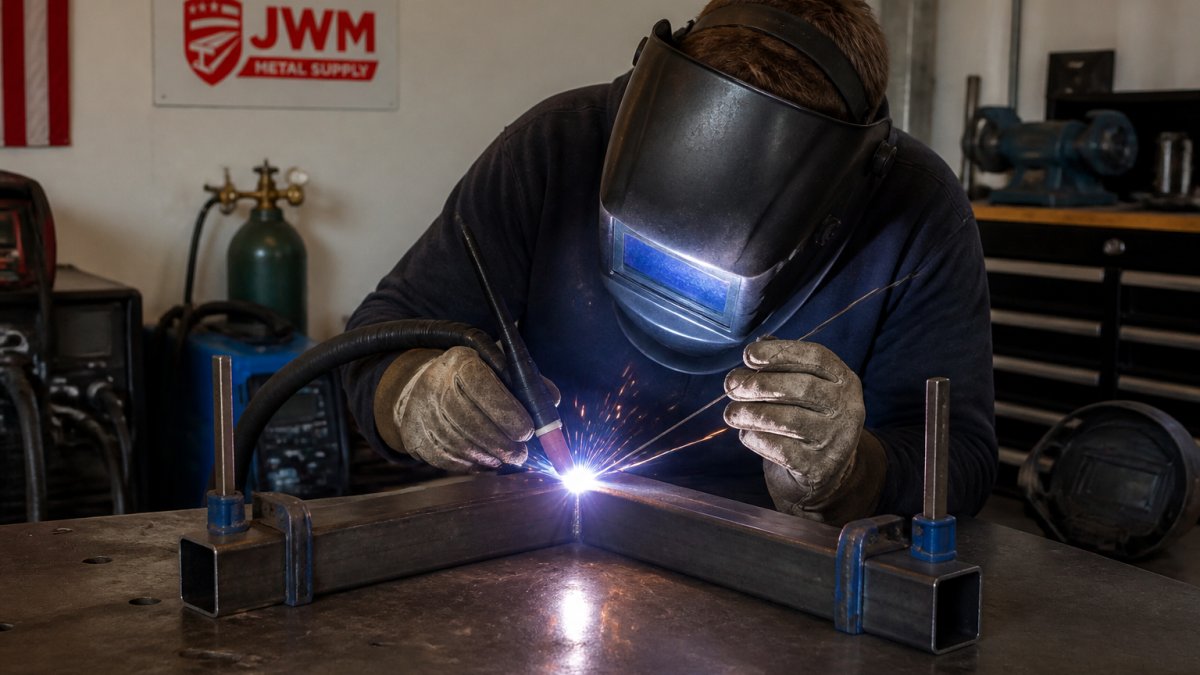
Step-by-step process of TIG welding a joint on rectangular steel tubing in a home workshop setting
The 1x2 rectangular profile has one behavior that drives every welding decision: it is asymmetric.
A few habits that save tubing:
- Clamp and tack before you run a bead. Tack all four corners, check square with a framing square on both faces, then run your beads in alternating passes, one corner, then the diagonal opposite, to balance heat.
- Match amperage to wall, not to the machine's max. Match amperage to the wall you are welding rather than to the machine's maximum setting, and start low on thin wall tube to avoid burn-through.
- Use the right joint for the load. A butt joint on a 1x2 tube concentrates stress at the weld toe; a mitered corner spreads it. For a trailer frame or a stand, miter and fully weld; for a light guard, a butt joint with a gusset is usually enough.
- Deburr every cut. Raw cut edges are sharp and will slice a glove, and a burr left inside a closed section becomes a rust starter.
- **** Any tube that will see weather needs a low-point drain, and it is far easier to drill before the frame is welded shut.
For grade selection before you weld, our comparison of carbon steel grades for welding projects covers the trade-offs. If you need helmets, gloves, or grinding supplies before the job, browse our welding and safety supplies.
Watch out: welding a 1x2 tube to a heavier member without preheating the thicker part is a common cause of cracking at the joint, because the two sections cool at different rates.
Corrosion Resistance and Painting Raw Mill Finish
Raw mill finish is bare steel with no coating, so it will flash rust if left damp. Plan for a finish before the tubing goes outdoors. The prep sequence is simple: degrease, remove mill scale and rust with a grinder or an acid etch, then prime within hours of cleaning.
For paint, an epoxy primer over blasted or ground steel holds best, followed by a topcoat of your choice. Pay attention to the inside of the tube, which traps moisture and rusts from within. Drill a small drain hole at the low point of any closed section, and plug the ends of tubes exposed to weather. A light oil coat works for indoor projects that will not be painted.
Corrosion resistance in carbon steel comes from the coating, not the alloy. Skipping prep is the most common reason a paint job fails within a season.
Ordering Cut-to-Length 1x2 Tubing from JWM Metal Supply
Ordering cut-to-length 1x2 steel tubing means you specify the outside dimensions, the wall thickness, and the exact length, and the material arrives saw-cut to that length. Pieces are cut to your specified length, so you skip the cutting step.
Here is how we would order a project:
- Pick your wall from the chart above.
- Measure each piece and add a small allowance for your weld gap.
- Enter your lengths at checkout.
- Confirm the grade if your job requires A500 specifically.
Orders ship in 1 to 5 business days, with no minimum order quantity and free shipping. Material certifications are available if you need paperwork for your application. For heavier walls, the 1x2 x 3/16" rectangle steel tubing page lists full specs and common uses.
Frequently Asked Questions
What does 1x2 steel tubing mean?
The numbers refer to the outside dimensions of the rectangular profile: 1 inch on one side and 2 inches on the other. Wall thickness is listed separately, either as a gauge number or a decimal. A 1x2 tube with a 16ga wall weighs 1.3 lb per foot, while the same outside size in 3/16" wall weighs 3.05 lb per foot. The outside dimensions stay the same across all four wall thicknesses, so the wall is what changes strength and weight.
What wall thicknesses are available for 1x2 steel tubing?
Four common walls are stocked: 16ga (0.065"), 14ga, 11ga, and 3/16" (0.188"). The 16ga tube weighs 1.3 lb per foot and suits light frames, racks, and furniture. The 14ga comes in at 1.6 lb per foot. The 11ga runs 2.25 lb per foot for heavier racks and equipment repairs. The 3/16" wall at 3.05 lb per foot is the choice for trailer fabrication, structural supports, and machine frames where load capacity matters.
What is the difference between A500 and A513 rectangular steel tubing?
A500 Grade B is a structural grade built around minimum yield and tensile strength, so it is the specification to cite when a tube carries load. A513 covers mechanical tubing made to dimensional tolerances rather than structural strength minimums. Both are carbon steel and both are weldable. JWM Metal Supply ships 1x2 tubing in A500 or A513 depending on supply, and material certifications are available if your project needs documented grade.
Can 1x2 steel tubing be cut to length before shipping?
Yes. Every 1x2 tube listed is precision cut to your selected length in-house with smooth saw-cut ends and a length tolerance of plus or minus 1/8". There is no minimum order quantity. Orders are ready to ship in 1 to 5 business days with free shipping, and custom quantities or larger runs can be quoted on request.
Picking the right 1x2 steel tubing comes down to three decisions: wall thickness, grade, and finish. Get those right and the fabrication goes smoothly. Get them wrong and you are reordering mid-project. JWM Metal Supply cuts American-made carbon steel to your exact lengths, ships in 1 to 5 business days, and offers material certifications when your project needs documented specs. Get started with JWM Metal Supply and order your cut-to-length tubing today.
