

Last Updated: October 10, 2026
11 Gauge vs 14 Gauge Square Steel Tubing: The Short Answer
Picking between 11 gauge and 14 gauge square steel tubing comes down to one question: how much load and abuse will the finished part take?

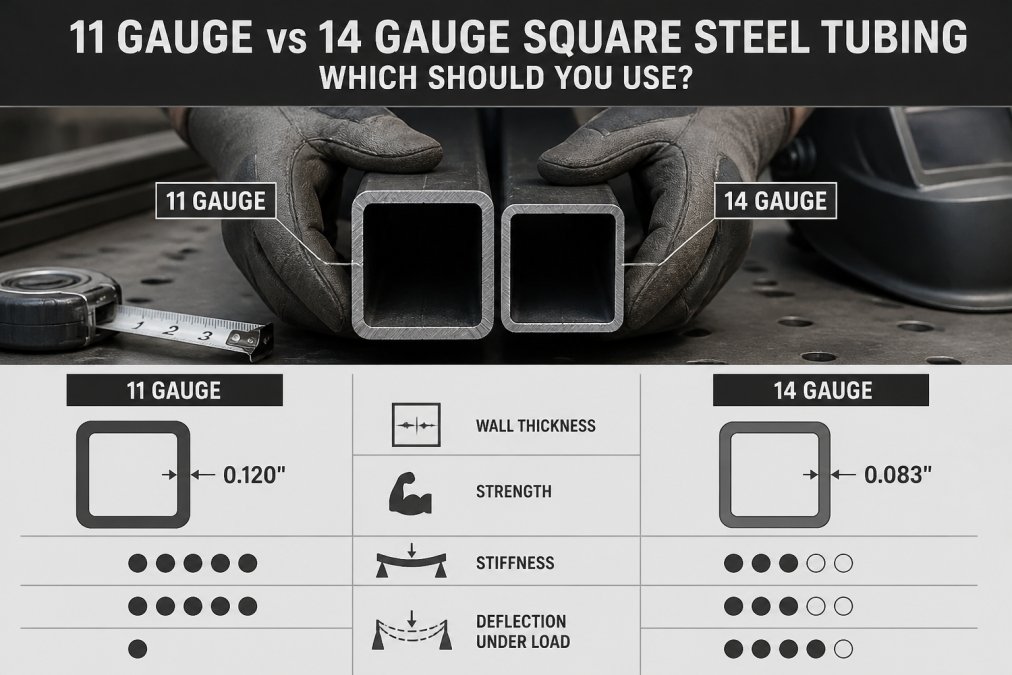
The wall thickness gap is the whole story. Nominal 11 gauge runs about 0.120 inch, while 14 gauge runs about 0.083 inch.
Below, we break down wall thickness, strength, deflection, span limits, and cost so you can pick the right gauge the first time.
Wall Thickness and Gauge Numbers: What 11ga and 14ga Actually Measure
Gauge is a legacy numbering system, not a measurement. Higher gauge numbers mean thinner steel, which is why 14 gauge is thinner than 11 gauge despite the bigger number.
Why Gauge Numbers Are Not a Measurement
Gauge numbers came from wire and sheet drawing standards and carried over to tubing, so a gauge number only tells you a nominal wall thickness, not an exact one. Two tubes labeled 14 gauge from different mills can vary slightly, and tolerances are normal in hot-rolled steel. Always check the decimal wall thickness on the spec sheet before you buy, that number, not the gauge label, is what your design depends on.
Same Outside Size, Different Inside Size
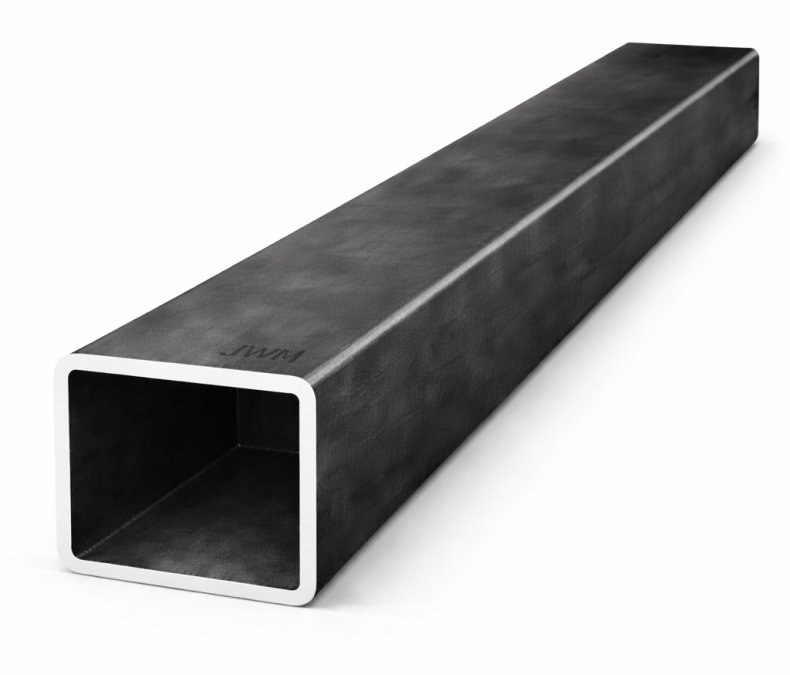
A 2" x 2" tube is 2" x 2" on the outside whether it is 11 gauge or 14 gauge, but the wall thickness eats into the inside.
- 2" x 2" 11 gauge (0.120"): inside dimensions roughly 1.750" x 1.750"
- 2" x 2" 14 gauge (0.083"): inside dimensions roughly 1.870" x 1.870"
If you are sliding a smaller tube inside, or running wiring through the hollow, that inside dimension matters as much as the wall.

ASTM A500 cold-formed welded carbon steel structural tubing standard
11 Gauge vs 14 Gauge: Strength, Stiffness, and Deflection Under Load
An 11 gauge tube is roughly 45% thicker in the wall than a 14 gauge tube of the same outside size, which translates directly into more stiffness and less flex under load. The reason is geometry: bending resistance depends on how far the steel sits from the neutral axis, and a thicker wall puts more material further out from the center, so the tube resists bending far better than the raw weight difference suggests.
What the Numbers Look Like at the Same Tube Size
Compare two 2" x 2" square tubes in A500 Grade B steel:
Property |
2" x 2" 11ga (0.120") |
2" x 2" 14ga (0.083") |
|---|---|---|
Wall thickness |
0.120" |
0.083" |
Inside dimensions |
~1.750" x 1.750" |
~1.870" x 1.870" |
Relative bending stiffness |
Higher |
Lower |
Relative weight |
Heavier |
Lighter |
Best for |
Trailer frames, equipment, structural |
Furniture, shelving, light frames |
Square Tubing Size Chart: Matching Tube Dimensions to the Job
Square tubing size is a two-part spec: outside dimensions and wall thickness. A 1" x 1" tube and a 2" x 2" tube in the same gauge behave very differently, the larger the cross section, the more bending resistance you get before wall thickness even enters the picture.
Outside Size |
Common Wall Options |
Typical Use |
|---|---|---|
1" x 1" |
11ga (0.120"), 14ga (0.083") |
Brackets, light frames, small supports |
1-1/4" x 1-1/4" |
11ga (0.120") |
Racks, braces, general fabrication |
2" x 2" |
11ga (0.120"), 14ga (0.083") |
Trailer frames, equipment, heavy frames |
JWM Metal Supply stocks 1" x 1" 11 gauge square tubing and 1" x 1" 14 gauge square tubing for smaller builds, plus 1-1/4" x 1-1/4" 11 gauge for mid-size frames. All of it is A500 Grade B carbon steel, cut to your length.
Square Tubing Load Capacity: Span, Supports, and Safety
Square tubing load capacity depends on span length, support conditions, wall thickness, tube size, and steel grade. Gauge alone is not a strength rating, and treating it like one is the most common mistake we see.
The Mechanics in Plain Terms
When a tube bends, the steel on the tension side stretches and the steel on the compression side shortens, while material near the center barely works at all. That is why wall thickness and tube size matter: both push steel away from the center, where it can resist bending. The property that captures this is the moment of inertia, usually written as I. For a square tube, I depends on the outside dimension to the fourth power minus the inside dimension to the fourth power. Two consequences follow:
- Doubling the outside size of a square tube increases stiffness roughly sixteen times at the same wall thickness.
- Increasing wall thickness at the same outside size raises stiffness, but by a much smaller margin, because the outside dimension dominates the equation.
That is the mechanism behind a rule most fabricators learn the hard way: a bigger tube in 14 gauge is often stiffer than a smaller tube in 11 gauge.
Why Span Length Dominates Everything
For a tube supported at both ends and loaded in the middle, deflection scales with the cube of the span: double the unsupported span and deflection goes up roughly eight times, not two. That explains why a 14 gauge tube can be perfectly safe across a two-foot span and clearly inadequate across a six-foot span carrying the same load.
A common pattern in shop practice:
- Short spans with light loads: 14 gauge is often plenty
- Long spans or heavy loads: step up to 11 gauge, or step up the tube size
- Overhead, occupied, or dynamic loads: size for the worst credible case, not the average
Support Conditions Change the Answer
How the ends are held matters as much as the span:
- Both ends simply supported: the baseline case most span tables assume
- Both ends fixed (welded into a rigid frame): noticeably less deflection
- Cantilever (one end free): the worst case by a wide margin, and the one most DIY builders underestimate
A tube that feels rock solid as a beam between two posts can flex alarmingly as a cantilever of the same length under the same load.
2" x 2" 11ga (0.120") Carbon Steel Square Tube – Cut to Size →
Load Placement Matters Too
A load concentrated at midspan produces more deflection than the same total load spread evenly along the tube. A point load at the quarter point sits between the two. If your real-world load is a person standing on a platform, a hitch pulling on a tongue, or a machine bolted at one spot, treat it as a point load, not a uniform one.
Where Gauge Fits In
Once tube size, span, and support conditions are fixed, gauge becomes the fine adjustment:
- Moving from 14 gauge to 11 gauge at the same outside size adds meaningful stiffness and load margin.
- It does not rescue a design that is undersized on tube dimension or over-spanned.
- It does add weight and material, affecting handling, mounting, and the loads the supporting structure sees.
Occupational Safety and Health Administration guidance on structural and welding safety
Square Tubing Weight Per Foot: Handling, Shipping, and Cost Trade-Offs
Square tubing weight per foot rises with wall thickness, and that weight shows up in three places: your back, your shipping bill, and your material cost. A thicker 11 gauge wall means more steel per foot, so the tube is heavier to lift and ship and costs more per length; a 14 gauge tube of the same outside size is lighter, easier to handle solo, and cheaper to move. In plain terms:
- 11 gauge: more strength, more weight, higher cost
- 14 gauge: less strength, less weight, lower cost
For a stationary workbench, the extra weight of 11 gauge is a feature. For a portable rack or a sign frame, the lighter 14 gauge is easier to live with.
Square Tubing for Trailer Frames: Why 11 Gauge Usually Wins
For trailer frames, 11 gauge is the safer default. Trailers take road vibration, shifting loads, and repeated stress down the highway, where a failure is dangerous.
For our full lineup, see the 2" x 2" 11 gauge square tube and the 2" x 2" 14 gauge square tube. Both are A500 Grade B / A513 carbon steel, made in the USA, and cut to your exact length.
- Trailer frames and tongues: 11 gauge
- Light utility trailers with short spans: 14 gauge can work if an engineer signs off
- Ramps, gates, and tie-down points: 11 gauge for anything taking shock loads
Welding, Drilling, and Corrosion: Fabrication Differences Between 11ga and 14ga
Both gauges weld and drill with standard shop tools, but the thicker 11 gauge wall changes how you work with it, and the thinner 14 gauge wall punishes sloppy technique faster.
Welding: Heat, Burn-Through, and Distortion
11 gauge (about 0.120 inch wall) holds heat well and resists burn-through, making it forgiving for beginners and faster for production work because you can run more amperage and travel speed without blowing through.
14 gauge (about 0.083 inch wall) is thin enough that you must watch amperage and travel speed closely, a common pattern is to drop one wire size or heat setting and move faster.
Drilling and Tapping
11 gauge takes more force and a sharp bit, but it holds threads and tapped holes better because there is more material for the thread to bite into, the safer choice if you plan to bolt through the wall and rely on the thread. 14 gauge drills easily but has less material for a strong tapped hole, so for anything disassembled repeatedly, use a through-bolt and nut rather than a tapped hole.
Corrosion and Service Life
Both gauges are raw, uncoated carbon steel, so both need protection. Paint, powder coat, or an oil finish extends service life. Thicker walls take longer to rust through, so 11 gauge gives more margin in damp or outdoor conditions, but the coating matters more than the gauge for how long the part lasts.
Choosing by Consequence, Not Just by Gauge
The right question is not "which gauge is stronger" but "what happens if this part fails."
Application |
Failure Consequence |
Practical Default |
|---|---|---|
Shelving, signs, light furniture |
Inconvenience |
14 gauge |
Workbenches, equipment stands |
Damage to equipment |
11 gauge for anything taking shock loads |
Trailer frames, tongues, ramps |
Injury on the road |
11 gauge, engineer-reviewed |
Overhead or occupied structures |
Injury |
Engineer-reviewed, gauge is only one input |
Use the table as a starting point, not a substitute for judgment. When the consequence is injury, the gauge stops being the deciding factor and the design review takes over.
Frequently Asked Questions
What is stronger, 11 gauge or 14 gauge steel?
11 gauge is stronger. At the same outside tube size and steel grade, 11 gauge square steel tubing has a 0.120 inch wall versus roughly 0.083 inch for 14 gauge, so there is about 45 percent more steel in the cross section. That extra wall thickness raises both bending strength and stiffness, which is why 11 gauge is the default for trailer frames, equipment skids, and anything carrying repeated or shifting loads. 14 gauge still works well for light-duty frames, shelving, and furniture where weight savings matter more than maximum capacity.
How thick is 11 gauge square steel tubing?
Nominal 11 gauge steel tubing runs about 0.120 inch wall thickness. On a 2 x 2 tube that leaves an inside dimension near 1.750 x 1.750 inches. Gauge is a naming convention rather than a true measurement, so actual wall thickness can vary slightly between mills and product lines. Always confirm the wall thickness and mill test reports for the specific tubing you buy, especially on load-bearing work where a few thousandths of an inch change the calculation.
Does thicker square tubing always support more weight?
No. Wall thickness is only one variable. Span length, how the tube is supported at both ends, the cross-sectional size, the steel grade, and the connection details all change load capacity. A short 2 x 2 14 gauge span can outperform a long 1 x 1 11 gauge span. Increasing tube size often adds more capacity per pound than stepping up a gauge, so match the outside dimensions and span to the load first, then decide whether 11 gauge or 14 gauge is the right wall.
Which gauge should I use for a trailer frame?
Use 11 gauge for trailer frames. Trailers see dynamic loads, road vibration, and point loads at hitch, axle, and crossmember connections, and 14 gauge flexes more over the same span. A 2 x 2 11 gauge tube in A500 Grade B steel is a common starting point for main rails and crossmembers, with gussets and bolting plates at the joints. If you are sizing a specific trailer, check the span and expected tongue and axle loads, and request mill test reports for the material.