

Last Updated: October 4, 2026
Why Most Online Metal Orders Go Wrong
The most common mistakes when buying metal online come down to five things: wrong grade, bad math, ignored tolerances and fees, and wrong assumptions about shipping.
Most of these mistakes are avoidable before you ever click "add to cart." Buyers who slow down and read the spec sheet, measure twice, and ask about shipping upfront tend to get exactly what they ordered.
Below, we break down each mistake, how it shows up in practice, and what to do instead.
Mistake 1: Ordering the Wrong Steel Grade or Finish
Ordering the wrong grade or finish is the single most expensive mistake in online metal buying. It usually means the material arrives, looks fine, and then fails during welding, machining, or finishing because it wasn't matched to the job.
Steel grade refers to the chemical composition and mechanical properties of the metal, such as A36 structural carbon steel or 1018 cold rolled steel. Finish refers to the surface condition, such as hot rolled mill scale or a smooth cold finished surface.

Hot Rolled vs. Cold Rolled: Pick for the Finish You Need
Hot rolled steel is formed at high temperatures, which leaves a mill scale surface and looser dimensional tolerances. It's economical, welds well, and suits structural and general fabrication work.
If your project is a bracket, a support, or a repair, hot rolled is usually the practical pick. If it's a shaft, a pin, or a bushing that needs a clean finish and consistent dimensions, cold rolled is worth the extra cost.
When a 1/4 Steel Plate Is the Right Call
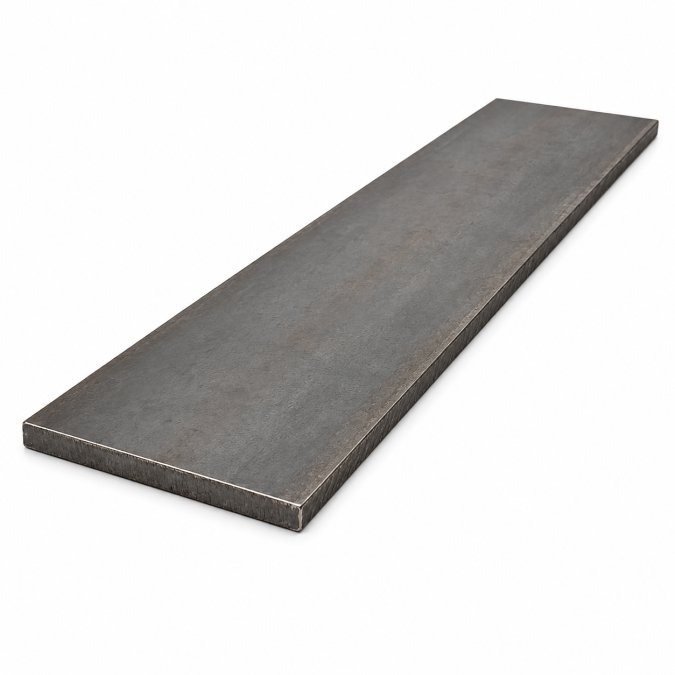
A 1/4 steel plate is the right call for mounting plates, brackets, trailer repairs, structural reinforcement, and equipment repairs where you need strength and weldability without excess weight. It's a workhorse thickness that handles most fabrication and repair jobs.
JWM Metal Supply stocks a 1/4" thick × 5" wide A36 steel flat plate in lengths from 5 to 30 inches, cut to order with a ±1/16" tolerance. For larger flat work.
Mistake 2: Skipping the Math on Calculating Metal Project Requirements
Skipping the math on material requirements is the mistake that costs the most in reorders. Under-order and you pay shipping twice. Over-order and you pay for scrap you'll never use.
Here's how we'd work through it:
- Sketch the finished part and label every piece
- List each piece's length, width, and thickness
- Add a waste allowance for cuts, mistakes, and clamping
- Group pieces by material and shape
- Convert to the lengths and quantities suppliers actually sell
- Round up to the nearest available size
For linear stock like tubing and bar, add a few inches per cut for blade kerf and cleanup. For plate, add a margin on both dimensions so you have room to square an edge.
Mistake 3: Ignoring Cut Tolerances, Minimums, and Hidden Fees
Ignoring tolerances, minimums, and fees is where online metal orders quietly go over budget. A cut that's "close enough" on a spec sheet can be a misfit on your bench, and a minimum order or custom-cut surcharge can double your per-piece cost.
Cut Tolerance: What ±1/8" Actually Means for Your Part
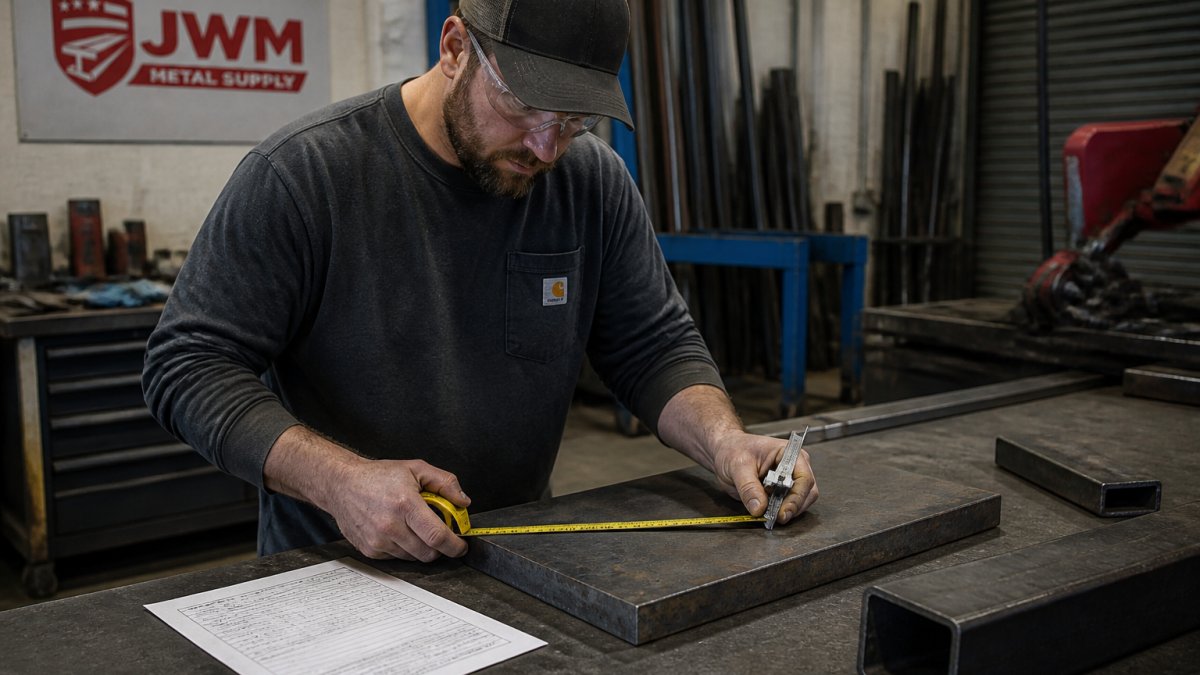
Cut tolerance is the acceptable range of variation in a cut length, usually expressed as a plus-or-minus figure. A ±1/8" tolerance is normal for saw-cut steel, and it's fine for most fabrication.
Here's the mechanism: a saw blade removes material (kerf) on every cut, and the stock feeds and clamps with some play. That's why a supplier can't promise a perfect length. If your design needs a tighter fit, you have three options:
- Order oversize and machine to final dimension yourself.
- Ask the supplier for their tightest available tolerance and confirm it in writing.
- Design the joint with a slip fit or weld gap so a small variation doesn't matter.
Minimum Order Quantities: The Small-Buyer Trap
MOQs are the single biggest friction point for hobbyists, small machine shops, and one-off repair jobs. A supplier set up for wholesale may require a full mill length, a minimum weight, or a minimum dollar value before they'll quote.
Before you buy, ask:
- Is there a minimum by piece, weight, or dollar value?
- Will they cut to length, or must you buy the full stock length?
- Is there a small-order surcharge, and at what threshold does it kick in?
Suppliers that serve small buyers typically cut to length, publish their tolerance, and ship parcel. If a supplier can't answer those three questions clearly, they're probably not built for your order size.
1" Diameter 1018 Cold Rolled Steel Round Bar – Cut to Length →
Hidden Fees: Where the Budget Actually Goes
Custom-cut fees, certification surcharges, packaging charges, and freight accessorials are the line items that turn a quote into a surprise. The fix is simple: ask for the full delivered quote in writing before you commit, and compare total delivered cost, not sticker price.
Problem |
What It Costs You |
How to Avoid It |
|---|---|---|
Tolerance too loose for the fit |
Rework or a reorder |
Confirm tolerance in writing before ordering |
Minimum order quantity |
Unwanted extra stock |
Buy from a no-minimum, cut-to-length supplier |
Hidden custom-cut fee |
Budget overrun |
Get the full quote in writing |
Certification surcharge |
Surprise line item |
Ask if material certs are included |
Freight accessorials (liftgate, residential) |
Unexpected delivery cost |
Request delivered price to your ZIP code |
Mistake 4: Assuming Every Supplier Ships the Same Way
Assuming every supplier ships the same way is the mistake that turns a five-day promise into a two-week wait, and a cheap quote into an expensive invoice. Shipping method, packaging, handling, and freight accessorials vary widely, and the differences show up exactly when you have a deadline.
Freight vs. Local Pickup: Run the Delivered-Cost Math
The sticker price on a cut piece is not the price you pay. The delivered cost is material + cut charge + packaging + freight + any accessorials. For small orders, freight can exceed the material cost, which is why local pickup or a supplier with flat-rate small-parcel shipping often wins.
A practical way to compare:
- Get the delivered quote to your ZIP code from each supplier, not the FOB price.
- Ask whether the shipment goes parcel (UPS/FedEx) or LTL freight.
- For LTL, ask about liftgate, residential delivery, inside delivery, and reconsignment fees, these are the line items that blow up a budget.
- Compare the delivered total against the cost of driving to a local will-call counter, including your time and fuel.
If you have a loading dock or forklift, say so upfront, it can remove a liftgate charge entirely.
Small-Batch vs. Wholesale: Watch the Minimum Order Quantity
Hobbyists, machinists, and repair shops routinely get burned by minimum order quantities (MOQs). A supplier built for wholesale may not quote a single cut piece at all, or may pad the price to make a small order worth their setup time. Before you commit, ask three questions:
- What is the minimum order, by piece, by weight, or by dollar value?
- Is there a small-order surcharge below a certain threshold?
- Will the supplier cut to length, or do you have to buy a full mill length?
Suppliers that cater to small orders typically cut to length, publish their cut tolerance, and ship parcel rather than requiring a freight account. That combination is the signal you want.
Vet Packaging Before You Trust the Supplier
Damage-free arrival is a reliability test, not a marketing claim. Ask how the supplier packages your specific order:
- Long bar and tube: bundled, banded, and shipped in a rigid tube or on a skid, not loose in a box.
- Plate and flat stock: edge-protected and separated so pieces don't rub and gall in transit.
- Small cut pieces: padded, boxed, and labeled with the cut length so you can verify against your order sheet on arrival.
A supplier that ships small cut pieces in a padded box handles a 30-inch plate very differently than one that palletizes freight. Ask how your specific order will ship, not how the supplier ships in general.
Best Practices for Ordering Steel Online
The best practices for ordering steel online come down to five habits: verify the grade, build a cut list, confirm tolerance, get the full quote, and check the shipping method. Buyers who do all five rarely reorder.
- Confirm the grade and finish match the job, not just the price
- Build a cut list with a waste allowance before you shop
- Ask for the cut tolerance in writing
For buyers who want a smooth finish on precision parts, the 1" diameter 1018 cold rolled steel round bar offers tight tolerances and excellent machinability. For general fabrication and welding, the 1" A36 hot rolled round bar delivers strength and weldability at a lower cost.
Conclusion: Check the Spec Sheet Before You Check Out
The gap between a smooth order and a frustrating one is almost always the spec sheet. Grade, finish, tolerance, minimums, and shipping method decide whether your material fits on the first try.
At JWM Metal Supply, we cut American-made carbon steel to your exact length with no minimum order and fast, free shipping, and we offer material certifications on request.
Frequently Asked Questions
How do I calculate the weight of steel for shipping?
Steel weighs roughly 0.283 pounds per cubic inch. Multiply length x width x thickness in inches to get cubic inches, then multiply by 0.283. A 1/4-inch plate at 15 x 27 inches works out to about 28.6 pounds. Knowing the weight before checkout tells you whether a carrier will handle the piece as a parcel or freight, and it prevents surprise fees when buying metal online.
What is the difference between hot-rolled and cold-rolled steel?
Hot-rolled steel is formed above its recrystallization temperature, which leaves a mill-scale surface and standard tolerances. Cold-rolled steel is processed further at room temperature, giving a smoother finish and tighter dimensional accuracy. For welding and general fabrication, hot-rolled A36 round bar is economical and easy to work. For machining shafts, pins, or bushings, cold-rolled 1018 round bar holds tighter tolerances and machines cleanly.
How do I ensure I am ordering the correct steel dimensions?
Measure your project, then add a buffer for cutting and fitting. Write down the exact length, width, and thickness, and compare those numbers against the product's listed cut tolerance. A bar listed at plus or minus 1/8 inch on length can arrive slightly short or long, so plan your cuts around that range. When calculating metal project requirements, order the next standard size up rather than assuming a supplier will hit an exact fraction.
Why is it important to check for minimum order requirements before buying metal online?
Minimum order rules decide whether a one-off garage project is even possible. Some suppliers quietly require a minimum dollar amount or a minimum weight, which turns a small order into an expensive one. Suppliers with no minimum order quantity let hobbyists and small shops buy exactly what the job needs. Confirm the policy before you build a cart, not after.
What should I look for in an online metal supplier's shipping policy?
Look for the stated production window, the packaging method, and the freight threshold. A supplier that ships in 1 to 5 business days and packages cut lengths to prevent transit damage gives you a timeline you can plan around. Check whether long pieces move as parcel or freight, and whether shipping is free or quoted separately. Ask for material certifications up front if the part is load-bearing.