

- Last Updated: October 3, 2026
How to Read Metal Specifications: What Each Line Tells You
Learning how to read metal specifications comes down to one skill: knowing which numbers control your project and which ones are just paperwork. A metal specification is a written record of what a piece of steel actually is, covering its chemistry, strength, size, and finish.
Here is the good news. Most spec sheets repeat the same handful of fields in the same order. Once you can read one, you can read them all.
The Five Fields on Every Spec Sheet
Every mill spec sheet carries five core fields:
- Grade - the steel family, such as A36 or A500
- Chemistry - the elements in the heat, listed by percent
- Mechanicals - yield strength, tensile strength, and elongation
Read those five lines and you know almost everything about the steel in front of you.
How to Read Mill Test Reports Line by Line
A mill test report, often shortened to MTR, is the document that proves your steel matches its grade. It travels with the material from the mill to your shop.
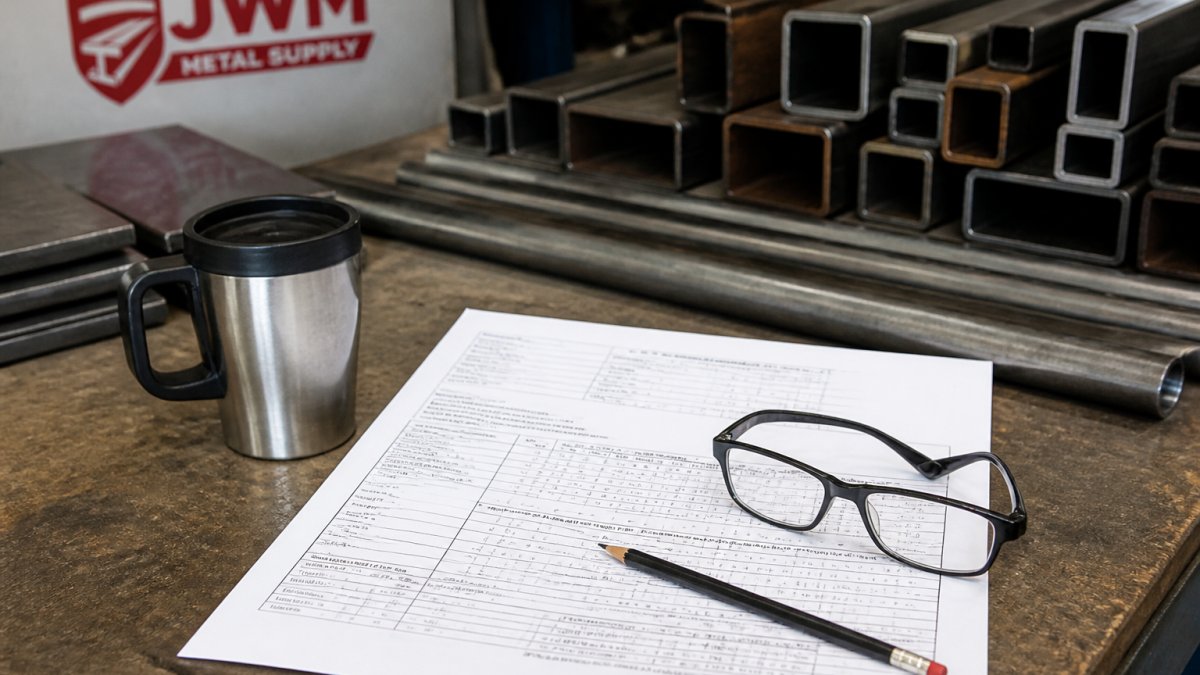
Start at the top. The header names the mill, the date, and the purchase order. Then comes the heat number, which ties this sheet to one specific batch of steel.
Heat Number, Lot Number, and Traceability
The heat number is the single most important line on the report. One "heat" is one melt of steel at the mill, and every piece poured from that melt shares the same chemistry.
That matters for two reasons:
- If a problem shows up later, the heat number traces it back to the source
- If your project needs certified material, the heat number links your steel to its paperwork
Lot numbers work the same way but at a smaller scale, tracking a batch cut from the same heat.
Keep your MTRs on file. If an inspector or engineer asks for proof, the heat number is what they will want to see.
ASTM Steel Standards Guide: Decoding the Code System
An ASTM steel standards guide is really a translation key. ASTM International writes the voluntary standards that most carbon steel in the United States is made to, and each standard has a letter and number that tells you what the steel is built for.
The pattern is simple once you see it:
- A means ferrous metal, which covers most steel
- The number identifies the specific standard
- The grade inside that standard sets the exact chemistry and strength
So A36 and A500 are both ASTM standards, but they describe different steels for different jobs. A36 covers general structural carbon steel. A500 covers cold-formed welded and seamless structural tubing (A500/A500M Standard Specification for Cold-Formed Welded and Seamless Carbon Steel...).
Carbon Steel Grade Identification: A36, A500, A53, and A513
Carbon steel grade identification starts with matching the grade to the job.
- A36 is the workhorse.
A500 Grade B covers structural tubing. Our 3" x 4" rectangle steel tubing in 11ga A500 Grade B is made to that spec.

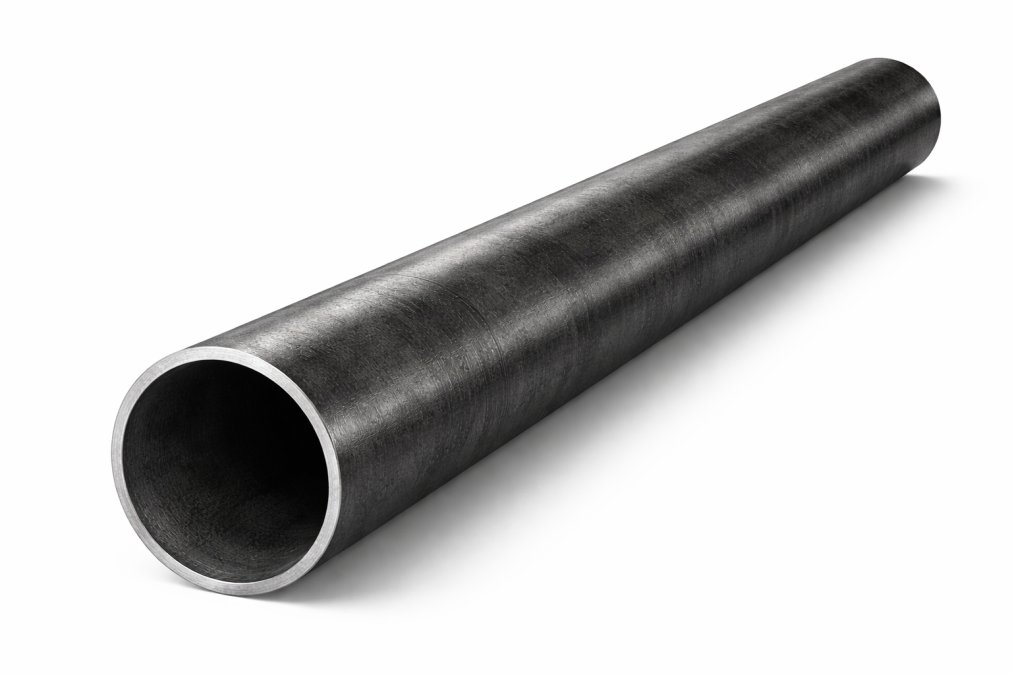
A53 covers pipe. Our 2-1/2" Schedule 40 steel pipe is made to ASTM A53 or equivalent.
A513 covers mechanical tubing, including many square and rectangular tube sizes.
Grade |
What It Covers |
Common Uses |
Watch For |
|---|---|---|---|
A36 |
General structural plate and bar |
Brackets, base plates, repairs |
Lower yield than A500 |
A500 |
Structural tubing |
Frames, trailers, supports |
Grade B vs Grade A strength |
A53 |
Steel pipe |
Posts, handrails, structural pipe |
Schedule number changes wall |
A513 |
Mechanical tubing |
Square and rectangular tube |
Size-dependent spec |
How to Read Metal Specifications for Mechanical Properties
Mechanical properties tell you how the steel behaves under load, and they are the lines most people skim past. Three numbers do most of the work, and each one answers a different question.
- Yield strength - the stress where the steel stops springing back and starts bending permanently. Reported in ksi (kips per square inch) or psi.
- Tensile strength - the stress where it finally breaks. Also reported in ksi or psi.
- Elongation - how far it stretches before breaking, shown as a percent in a 2-inch gauge length.
Higher yield strength means the steel holds its shape under more load. Higher elongation means it bends before it snaps, which is often the safer failure mode because it gives warning instead of letting go all at once.
Reading the Numbers in Context
A mechanicals block on a mill test report usually looks like this: yield, tensile, elongation, and sometimes a reduction-of-area figure. The order matters less than the relationship between them.
A common mistake is reading tensile strength and ignoring yield. For most structural work, yield is the number that matters. It tells you when the steel stops springing back, and that is the point where a bracket, frame, or support starts to deform.
Why the Same Grade Can Show Different Numbers
Two heats of the same grade rarely post identical mechanicals. A standard sets a floor, not an exact figure, so a mill can ship steel that meets the minimum and still varies heat to heat.
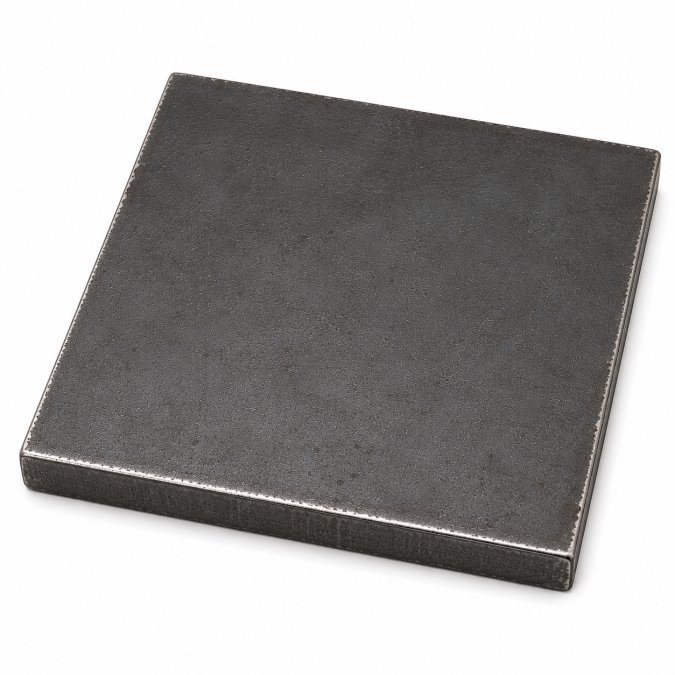
15" x 27" Steel Rectangle Plate -- 1/4" Thick-A36 Hot Rolled →
When you compare a spec sheet to a standard, read it as "does this meet or exceed the floor" rather than "does this match exactly." A yield of 40 ksi on an A36 sheet clears the 36 ksi minimum.
Elongation and Ductility in Plain Terms
Elongation is the ductility metric. A steel with 20% elongation in 2 inches stretches noticeably before it fractures; a steel with 10% gives much less warning.
Most practitioners treat elongation as the tiebreaker when two grades have similar yield. If one grade bends and one snaps, the bending one is easier to work with and more forgiving of field conditions.
Dimensional Tolerances and Surface Finish Notes
Tolerances and finish notes are where spec sheets get ignored, and where projects go wrong.
That means a 48" cut may arrive at 47-7/8" or 48-1/8". Plan your fit-up around that range, not around a perfect number.
Surface finish notes cover the look and feel of the steel:
- Mill scale - the dark, flaky layer left from hot rolling
- Light surface rust - normal on raw carbon steel and not a defect
- Oil or residue - applied to protect the steel in transit
None of these affect structural strength. If your project needs a clean finish, plan to grind, wire-brush, or paint before assembly.
Common Mistakes When Reading Metal Specifications
Most spec-reading errors come from skimming, and the costly ones are not exotic. They are the same handful of misreads showing up project after project. Here is what to watch for, framed as the misread itself so you can spot it on your own sheet.
Misread 1: Confusing Yield and Tensile Strength
These are two different numbers with two different jobs. Yield is where the steel stops springing back; tensile is where it breaks. If you size a member off the tensile number, you have designed past the point where the steel already started to deform. Read yield first, every time.
Misread 2: Treating a Grade Letter as Interchangeable
A500 Grade A and A500 Grade B are not the same steel. They share a standard but carry different strength floors, and a tube stamped Grade A will not meet a Grade B callout. The same trap exists anywhere a standard splits into grades. Read the grade letter, not just the standard number.
Misread 3: Ignoring the Schedule on Pipe
A Schedule 40 pipe and a Schedule 80 pipe of the same nominal size have different wall thickness. The nominal size describes the outside, not the wall, so two pipes that look identical on the rack can carry very different loads. If a drawing calls out a schedule, that schedule is part of the spec.
Misread 4: Skipping the Tolerance Line
A ±1/8" cut tolerance changes how parts fit. If you plan fit-up around a perfect number, a cut that lands at the edge of the tolerance can throw off a weld gap or a bolt hole. Read the tolerance, then design to the range, not the target.
Misread 5: Reading Surface Rust as Damage
On raw hot rolled carbon steel, light surface rust is expected and does not affect structural strength. Rejecting a shipment over it wastes time and money. What does matter is pitting, deep scaling, or rust that has eaten into the section, those are worth a call to your supplier.
Misread 6: Skipping the Heat Number
Without the heat number, you cannot trace the steel back to its certification. If an inspector or engineer asks for proof later, the heat number is the link between the steel in your hand and the paperwork that proves its grade. File the MTR with the heat number visible.
Misread 7: Assuming the Standard Number Is the Whole Story
The ASTM code tells you which rulebook the steel was made to. It does not tell you the grade, the mechanicals, or the tolerances inside that rulebook. Two sheets can both say A500 and still describe different steels. Read the standard and the grade together.
The fastest way to avoid all seven is to buy from a supplier who sends the certification with the steel. We include material certifications with our orders so the heat number and grade travel with your material.
Conclusion
Reading a spec sheet is a skill, and like any skill it rewards practice. Start with the grade and yield strength, then check the heat number, tolerances, and finish notes.
When you need carbon steel that arrives with its paperwork in order, JWM Metal Supply cuts to your exact length with no minimum order and ships fast and free nationwide.
Frequently Asked Questions
What do the numbers in metal specifications mean?
Numbers in metal specifications typically refer to grade designations, mechanical property minimums, or dimensional measurements. For example, A36 indicates a minimum yield strength of 36,000 psi, while A500 Grade B has a 46,000 psi yield strength. Wall thickness might be listed as 11ga (0.125") or 14ga (0.083"). Always cross-reference the number with the standard it belongs to, since the same number can mean different things across ASTM, SAE, or AISI systems.
How do I interpret ASTM standards for carbon steel?
ASTM standards follow a letter-number format. The letter indicates the category (A for ferrous metals), and the number identifies the specific standard. ASTM A36 covers structural carbon steel, A500 covers cold-formed welded and seamless carbon steel structural tubing, A53 covers pipe, and A513 covers electric-resistance-welded carbon steel mechanical tubing. Each standard defines chemical composition limits, mechanical properties, tolerances, and testing requirements. Match the ASTM number on your spec sheet to the application requirements before ordering.
What is a Mill Test Report and how do I read it?
A Mill Test Report (MTR) is a certified document from the steel mill that lists the chemical composition and mechanical properties of a specific heat or lot. To read it, start with the heat number for traceability. Then check the chemical composition against the ASTM limits for your grade. Next, verify yield strength, tensile strength, and elongation meet the minimums. Finally, confirm the specification code and grade match what you ordered. If any value falls outside the standard, the material does not conform.
How do I ensure the steel I buy meets safety requirements?
Request the Mill Test Report and verify it against the ASTM standard for your application. Check that the grade matches the design specification, the mechanical properties meet or exceed minimums, and the chemical composition is within limits. For load-bearing applications, confirm yield strength and tensile strength. Also verify dimensional tolerances and surface finish meet your project needs. Buy from suppliers who provide material certifications and source American-made steel, which simplifies traceability and compliance.
Spec sheets only help if the steel behind them is right. JWM Metal Supply cuts American-made carbon steel to your exact length, ships it fast and free, and backs every order with material certifications. Shop Now and get project-ready steel with the paperwork to match.