

Last Updated: October 13, 2026
What to Compare When Choosing Metal Suppliers Near Me
Searching for metal suppliers near me usually ends the same way: a dozen tabs, three phone calls, and no clear answer on whether the steel you need is actually in stock. At JWM Metal Supply, we hear that frustration daily from hobbyists and shop owners alike. The fix is knowing exactly which details separate a supplier worth your time from one that wastes it.
Two categories decide almost everything: how precisely they cut and document your material, and how well their service area, inventory, and pickup options match your timeline.
Cut Accuracy, Material Grade, and Certifications
Cut accuracy is the first filter. A supplier advertising "cut to size" might mean a rough saw cut with a wide tolerance, while a fabrication-focused operation holds tolerances closer to ±1/8" or ±1/16".
Material grade matters just as much. A36 hot rolled carbon steel is the standard for structural and general fabrication work, while A500 Grade B covers structural tubing. Ask for the grade in writing before you order.
Certifications close the loop. Material test reports trace a batch of steel back to its mill, which matters for load-bearing work and for anyone who needs to prove domestic origin. A supplier who cannot produce paperwork on request is a risk you do not need to take.
Service Area, Inventory, and Pick-Up Options
Service area and inventory determine whether you drive across town or wait on a truck. Local yards win on speed for urgent, small orders, but their stock varies by location.
- Local pickup: Fastest for one-off pieces, limited to what is on the rack that day
- Nationwide shipping: Broader inventory, delivered to your door, usually 1-5 business days
- Will-call counters: Good middle ground if you can arrive during business hours
Inventory depth is the quiet differentiator. A supplier who stocks common plate, tubing, and flat bar sizes in multiple lengths will not leave you improvising a workaround.

What to Compare |
Why It Matters |
What to Ask |
|---|---|---|
Cut tolerance |
Decides fit on the first try |
"What is your tolerance in inches?" |
Material grade |
Affects strength and weldability |
"Is this A36 or A500 Grade B?" |
Certifications |
Proves origin and spec compliance |
"Can you send the mill cert?" |
Service area |
Sets your delivery timeline |
"Do you ship nationwide?" |
Inventory depth |
Prevents substitutions |
"What lengths are in stock?" |
Why More Buyers Choose to Buy Metal Online
Buying metal online removes the two biggest friction points of a local yard: limited hours and limited stock. You order at midnight, pick your exact length from a dropdown, and skip the counter entirely.
The model works because cut-to-length ordering eliminates waste. Instead of buying a 20-foot stick and cutting it down, you order the length your project needs. That saves material cost and shop time at once.
Shipping has also caught up. Standard orders from fabrication-focused suppliers ship in 1-5 business days, which is competitive with a same-week trip to a local counter. For anyone outside a major metro, online ordering is often the faster path, not the slower one.
When Online Ordering Beats a Local Yard
Online ordering is not automatically better. It wins in specific situations:
- You need an exact length, not a standard stick. Cut-to-order pricing means you pay for the material you use.
- Your local yard does not stock the profile. A yard that carries angle iron but not 11ga rectangular tubing cannot help you regardless of distance.
- You are outside a metro area. If the nearest full-line supplier is a 90-minute drive, a 1-5 day ship window is faster than a half-day round trip.
- You order outside business hours. Online checkout does not close at 4:30 p.m.
When a Local Yard Still Wins
- You need it today. No ship window beats a will-call counter for an emergency repair.
- You want to inspect the material. Seeing the cut edge and checking for mill scale or rust before you pay is a real advantage.
- You need a cut the online supplier does not offer. Some profiles and thicknesses are only practical to cut in person.
- Freight cost exceeds the material cost. Heavy or oversized pieces can make shipping uneconomical for a single small order.
The practical rule most buyers land on: order online for planned work with a few days of lead time, and keep a local yard in your contacts for same-day emergencies. The two are complements, not substitutes.
Cut-to-Size Steel Plate: What You Can Order
Cut-to-size steel plate is steel cut to your specified dimensions before it ships, so it arrives ready to weld, drill, or bolt without a trip to the saw. The category covers more than plate: tubing, flat bar, and angle iron all fall under the same cut-to-order model.
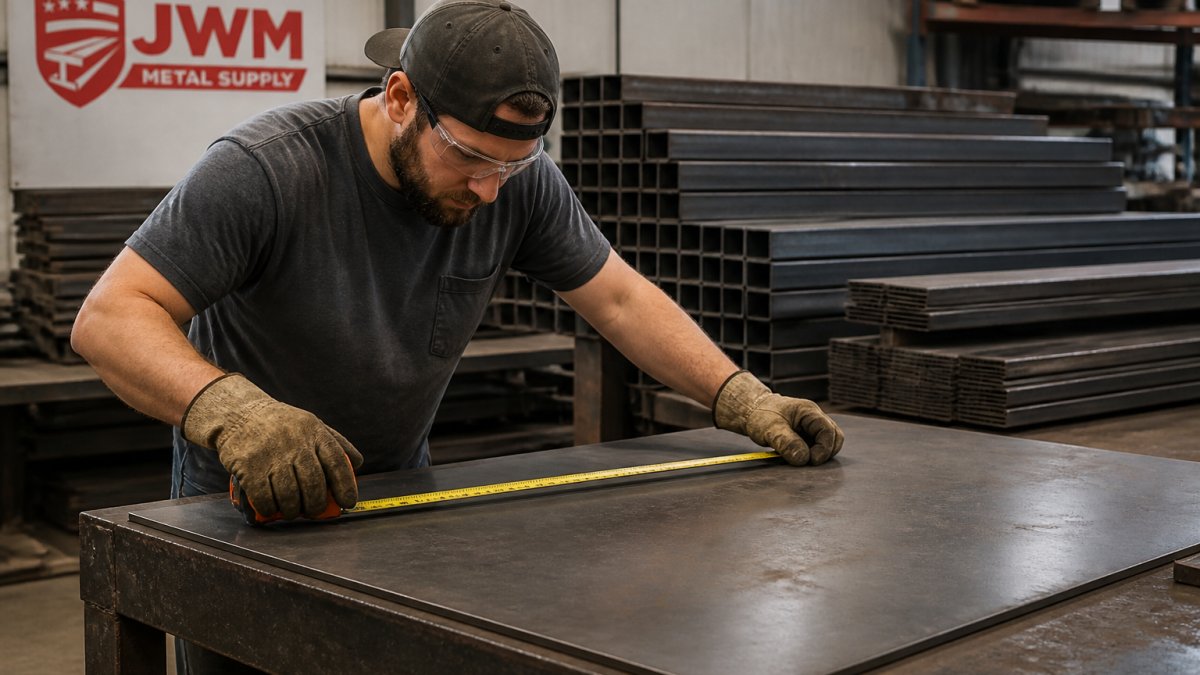
Ordering by exact length changes how you plan a project. You stop designing around standard stock sizes and start designing around the part you actually need.
Plate, Tubing, and Flat Bar Options
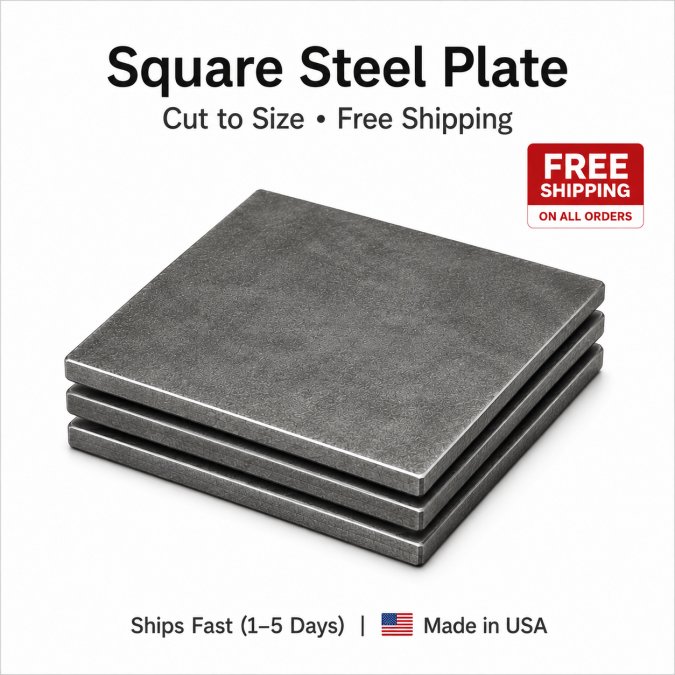
Plate comes in hot rolled carbon steel, with 1/4" thickness being the workhorse for brackets, mounting plates, and structural reinforcement. A 15" x 27" A36 hot rolled steel plate covers many fabrication and repair jobs, and custom sizes are available on request when a standard dimension does not fit.
Tubing covers frames, trailers, and equipment. Rectangular and square profiles in 11ga (0.125") and 14ga (0.083") walls handle most structural and DIY work, and both are cut to your ordered length with a saw cut and roughly ±1/8" tolerance.
Flat bar rounds out the order for brackets, supports, and repair plates. A 1/4" thick by 5" wide A36 flat plate in lengths from 5" to 30" is a practical example of ordering exactly what a job needs.
15" x 27" Steel Rectangle Plate -- 1/4" Thick-A36 Hot Rolled →
Metal Shipping Times: What to Expect After Checkout
Metal shipping times depend on whether the supplier cuts to order or pulls from finished stock. Cut-to-order operations typically ship in 1-5 business days, since your material is cut after you order.
Three factors drive the timeline:
- Cut queue: Orders placed before a daily cutoff usually enter the queue same day
- Length and quantity: Large or unusual cuts take longer than standard ones
- Destination: Transit time adds to processing time, and remote areas add more
For a deadline next week, order early in the week and confirm the processing window before checkout. A supplier who publishes a clear ship window is easier to plan around than one who promises "fast shipping" with no number attached.
Metal Supplier Minimum Order Rules and Hidden Fees
Minimum order rules and add-on fees are where online quotes and final invoices drift apart. Some suppliers set a dollar minimum, others a weight minimum, and some charge separately for cuts, certifications, or rush handling. Understanding how each is structured is the difference between a quote you can trust and a number that grows at checkout.
How Minimums Are Structured
Minimums come in three common forms, and they behave differently:
- Dollar minimum: You must spend a set amount per order. Easy to clear with a single plate, but it can force you to add material you do not need.
- Weight minimum: You must order a set total weight. This penalizes small, light orders even when the dollar value is fine.
- Per-line minimum: Each item on the order must meet a minimum quantity or length. This is the most common trap for one-off buyers, because a single short cut can fail the line minimum even when the overall order is large.
A supplier with no minimum order removes all three constraints, which is why one-off buyers gravitate to cut-to-order operations.
Common Fees to Ask About Before You Commit
- Cut charges: Per-cut fees on top of material price. Ask whether the fee is per cut, per piece, or per order.
- Certification fees: Charges for mill test reports. If your work requires traceability, confirm the fee before ordering.
- Rush fees: Premium for expedited processing. Confirm the cutoff time that triggers it.
- Handling fees: Added for oversized or heavy pieces. Ask the weight or dimension threshold.
- Freight surcharges: Residential delivery, liftgate service, and limited-access locations can each add a line item.
How to Compare Two Quotes Apples-to-Apples
The cleanest way to compare is to request a full quote with every line itemized. Then normalize both quotes to the same basis:
- Same quantity and length. A quote for one 24-inch cut is not comparable to a quote for a full stick.
- Same cut tolerance. A ±1/8" saw cut and a ±1/16" cut are different products; confirm both quotes describe the same tolerance.
- Same certification status. A quote with a mill cert and one without are not the same price for the same material.
- Same delivery terms. A delivered price and a will-call price differ by freight; compare like to like.
- All-in total. Add material, cuts, certification, handling, and freight before you compare the bottom line.
A supplier with no minimum order and free shipping removes most of the guesswork, because the price you see is the price you pay.
How Metal Suppliers Near Me Handle Small and One-Off Orders
Small orders are the real test of a supplier.
Fabrication-focused suppliers handle one-offs differently. Because material is cut to order rather than pulled from pre-cut stock, a single piece costs the same per unit as part of a larger run, and there is no minimum quantity to clear.
What to look for if you order small:
- No minimum order quantity
- Published per-piece pricing
- Clear cut tolerances
- Stock availability shown before checkout
For repeat buyers, the question shifts to consistency. A supplier who holds stock and publishes a ship window is easier to build a production schedule around than one whose lead times swing week to week.
Frequently Asked Questions
How fast do online metal orders ship?
Turnaround depends on the supplier and whether your order needs custom cutting. At JWM Metal Supply, standard orders ship in 1-5 business days, and custom-cut carbon steel is typically ready in 1-3 business days. If you have a deadline, confirm the ship date before you order rather than assuming the listing's best-case number applies to your cut lengths.
Can I order cut-to-size steel plate for a small project?
Yes. Cut-to-size steel plate is sold by the piece, not just by the pallet. JWM Metal Supply cuts A36 hot rolled plate to your exact length and has no minimum order, so a single 1/4 inch plate for a bracket or trailer repair ships the same way a bulk order does. Order the finished dimensions you need and skip the extra cutting at home.
Do metal suppliers have minimum order requirements?
Some do, especially yards that mainly serve industrial accounts. A metal supplier minimum order can range from a dollar threshold to a full sheet, which prices out hobbyists. JWM Metal Supply has no minimum order quantity, so a one-off garage project and a fabrication shop's recurring order go through the same checkout.
How do I know the steel I order is actually American-made?
Ask for the material certification before you buy. JWM Metal Supply cuts carbon steel sourced from a Kansas manufacturing facility and offers material certifications on request, which document the grade and heat information for load-bearing work. If a supplier cannot produce that paperwork, treat the claim as unverified.
Sourcing steel should not require a dozen phone calls and a guess about whether your material is actually in stock. JWM Metal Supply cuts American-made carbon steel to your exact specifications, ships free nationwide with no minimum order, and backs every order with material certifications on request. Browse our cut-to-size plate, tubing, and flat bar, and get the material your project needs without the runaround.