

Table of Contents
- What to Look for in Steel Plate Cutting Services Near Me
- Laser Cutting vs. Plasma Cutting for Steel Plate
- How to Prepare CAD Files for Metal Cutting
- Steel Plate Cutting Cost per Inch: What Drives the Price
- Material Selection and Thickness Guide for Beginners
- Turnaround Times, Secondary Services, and Ordering Custom Metal Parts
- Frequently Asked Questions
Last Updated: September 25, 2026
What to Look for in Steel Plate Cutting Services Near Me
Searching for steel plate cutting services near me usually starts with price and ends with a bad part. The better filter is capability: can the shop hold your tolerance, cut your thickness, and document your material? At JWM Metal Supply, we ship precision-cut carbon steel nationwide, so we see both sides of this decision every day.
- Process range: Does the shop cut both thin gauge and thick plate, or only one end of the spectrum?
- Certifications: Look for traceable mill certifications on the material.
- Quality control: Ask how they verify dimensions before the part ships, not after it arrives wrong.
Equipment and Certifications That Matter
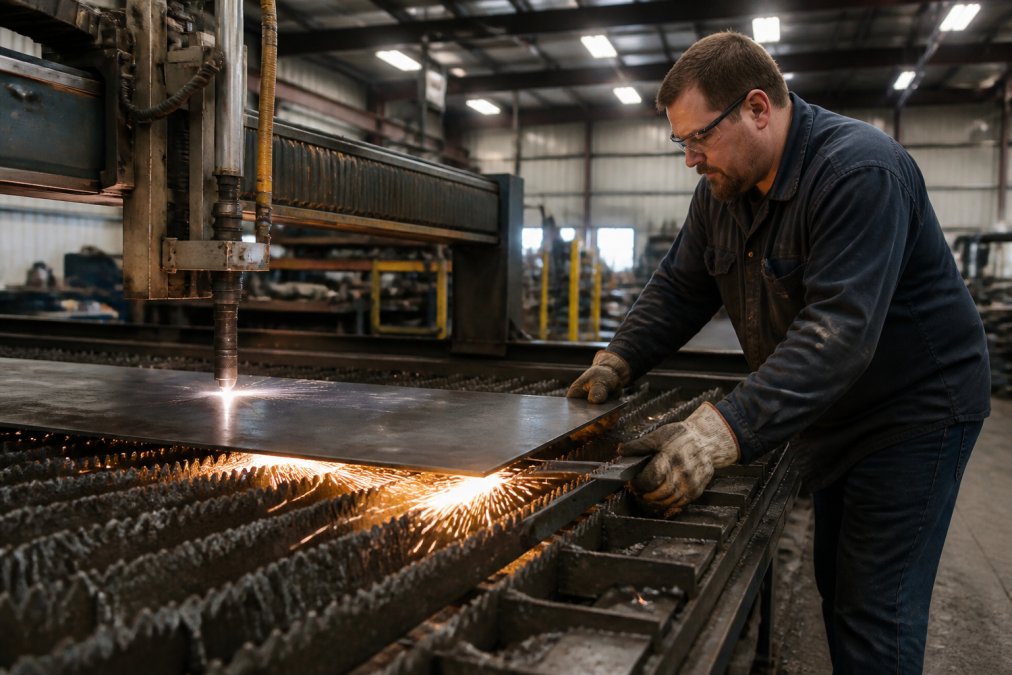
Equipment determines what the shop can cut. A fiber laser handles thin plate fast and clean. A CNC plasma table or oxy-fuel torch handles thick plate that a laser cannot touch economically. Water jet cutting sits in the middle, cutting without heat distortion but at a slower pace.
Local Shop vs. Online Fabrication Service
A local shop wins when you need same-day pickup, a physical walkthrough, or a part that needs fitting on site. An online fabrication service wins on selection, price transparency, and delivery to a job site anywhere in the country.
Laser Cutting vs. Plasma Cutting for Steel Plate
Laser cutting wins on thin plate and tight tolerance. Plasma cutting wins on thick plate and lower cost per part. The crossover point depends on your thickness, edge quality requirement, and volume.
| Factor | Laser Cutting | Plasma Cutting |
|---|---|---|
| Best thickness range | Thin to medium plate | Medium to thick plate |
| Edge quality | Smooth, minimal dross | Rougher, may need cleanup |
| Heat distortion | Low | Higher on thin material |
| Cost per part | Lower on thin, high volume | Lower on thick plate |
| Best for | Precision brackets, prototypes | Structural plate, heavy parts |
How to Prepare CAD Files for Metal Cutting
Clean CAD files cut faster and cheaper. Most shops accept DXF files, and a well-built DXF removes the back-and-forth that stalls a quote. This is the step most first-time buyers underestimate: a file that looks correct on screen can still force a programmer to redraw geometry, and redraw time shows up on your invoice.
The DXF Standard Most Shops Expect
DXF (Drawing Exchange Format) is the common language between CAD software and cutting machines. A production-ready DXF usually follows these conventions:
- 1:1 scale, no scaling in the file. Draw in real units, inches or millimeters, and state which in the file name.
- One layer for the cut path. Some shops want separate layers for cut, etch, and drill; ask before you export.
- Closed contours only. Every outside profile and every hole must be a closed loop. Open contours force the programmer to guess where the cut starts and stops.
- No overlapping or duplicate lines. Duplicated geometry can cause a machine to cut the same path twice, which burns consumables and can distort the edge.
- Text converted to geometry or removed. Fonts that are not embedded may not render on the shop's system.
Kerf, Tolerance, and What the Machine Adds
Every cutting process removes material, and that gap is called kerf. A fiber laser kerf on thin plate is narrow, often a few thousandths of an inch. A plasma kerf on thick plate is wider, sometimes a fraction of an inch. If your part must fit another part, tell the shop whether the dimension on your drawing is the finished part or the cut path.
Nesting and Material Yield
Nesting is how parts are arranged on the plate to minimize waste. A shop with nesting software can often fit more parts per sheet than a manual layout, which lowers your material cost. You can help by:
- Grouping parts of the same thickness and grade in one file
- Avoiding long, thin parts that force awkward layouts
- Leaving enough spacing between parts for the kerf and for clamping
File Formats to Avoid
Never send a raster image, a PDF, or a hand sketch as your only reference. A shop that traces your drawing introduces dimensional error you cannot see until the part arrives. If a sketch is all you have, say so up front, many shops will redraw it for a fee, and that fee is cheaper than a wrong part.
Steel Plate Cutting Cost per Inch: What Drives the Price
Steel plate cutting cost per inch is not a fixed rate. It moves with material thickness, cut length, material grade, quantity, and tolerance, so two shops can quote the same part very differently. The reason is that most shops price the job in three buckets, material, machine time, and handling, and only the first bucket is obvious on a quote.
Here is how each bucket behaves:
- Material: Priced by the pound or by the square foot of the plate consumed, not the finished part. If your part is 12 inches by 12 inches and the shop has to cut it from a 48-inch by 96-inch plate, you pay for the nest, not just the part.
- Machine time: Billed per inch of cut path or per minute of table time. A plasma torch running 1/2-inch A36 might travel 60 to 100 inches per minute; a fiber laser on 1/8-inch plate can run several times that. The faster the process, the lower the per-inch rate, but only if the edge quality meets your spec.
- Handling: Setup, fixturing, deburring, inspection, and packaging. This is where small orders get expensive, because setup is fixed. One bracket and one hundred brackets carry the same setup cost.
How to Design Parts That Cost Less to Cut
Cost optimization starts at the drawing, not the quote. Most practitioners find that three changes cut per-part cost without changing function:
- Reduce total cut length. Every hole, notch, and contour adds inches. A slot that can be a drilled hole, or a corner that can be a standard radius instead of a sharp inside corner, removes cut path.
- Use standard thicknesses and grades. A36 and 1018 are stocked broadly. A specialty grade may require a mill order, which adds weeks and a minimum buy.
- Design for nesting. Parts that tile cleanly on a 48-inch by 96-inch or 60-inch by 120-inch plate waste less material. Irregular shapes that leave large offcuts raise your effective material cost even if the cut rate is unchanged.
- Loosen tolerance where it does not matter. A +/-0.005 inch tolerance on a decorative panel adds inspection time. Reserve tight tolerance for mating surfaces.
What a Quote Should Itemize
A shop quoting per inch without asking about quantity is quoting half the job. Ask for a quote that separates:
- Material cost (with grade and thickness stated)
- Cutting cost (process, cut length, and rate)
- Secondary operations (bending, welding, finishing)
- Certification and rush surcharges, if any
Material Selection and Thickness Guide for Beginners
Match the steel to the job, not to what is cheapest. For most home and repair projects, mild carbon steel is the right starting point because it welds and machines easily.
A quick guide:
- A36 carbon steel: General fabrication, brackets, frames, repair work
- 1018 cold-finished: Shafts and parts needing a smoother finish and tighter tolerance
- 4140 alloy: High-stress parts like axles and tooling that need more strength
- AR plate: Wear-resistant surfaces on equipment that takes abrasion
Turnaround Times, Secondary Services, and Ordering Custom Metal Parts
When you order, confirm three things in writing: the lead time, the tolerance, and whether the material certification is included. That single email prevents most disputes.
American Welding Society certification standards
Frequently Asked Questions
How much does steel plate cutting cost per inch?
Pricing depends on material type, thickness, cut length, and edge quality required. Laser cutting is usually priced per inch of cut path, plasma per pierce plus cut length, and water jet costs more because it is slower. Online providers typically quote from an uploaded DXF file, so exact pricing depends on your drawing. Request a quote from JWM Metal Supply for current pricing.
What information do I need to provide for a custom steel cutting quote?
You will need a DXF or CAD file with the correct scale, plus the material grade, thickness, quantity, and required tolerance. Note any secondary operations like bending, welding, or finishing. If you do not have a CAD file, a dimensioned sketch with lengths and angles works for straight cuts. Clear specifications reduce back-and-forth and speed up your lead time.
Is it better to cut steel plate at home or hire a professional service?
For thin plate and simple straight cuts, an angle grinder or plasma cutter works at home. For thick plate, tight tolerances, or parts with holes and curves, a fabrication shop delivers cleaner edges and repeatable results. Professional services also provide material certifications for load-bearing work, which home cutting cannot. Weigh your deadline and precision needs before deciding.
Can big-box hardware stores cut thick steel plate to size?
Big-box stores typically cut only thin sheet metal, threaded rod, and similar stock, and usually not steel plate over a quarter inch. They do not offer CNC cutting, tight tolerances, or material certifications. For steel plate cutting services, a dedicated fabrication shop or online custom-cut supplier is the practical choice for anything structural or load-bearing.
Sourcing steel plate that arrives on spec and on time should not be a gamble. JWM Metal Supply cuts American-made carbon steel to your exact length with no minimum order, ships free nationwide in 1-3 business days, and provides material certifications on request. Send your DXF file and specs, and get a quote that holds up when the part hits your bench. Shop Steel with JWM Metal Supply.