

Last Updated: November 4, 2026
Quick Summary
The best trailer tie down system for heavy cargo matches rated working load limit to the load's per-point share, not breaking strength alone. Tire-style straps suit wheeled vehicles, E Track rail kits suit enclosed trailers with mixed loads, and retractable ratchet straps are a sensible default for general cargo.
- Working load limit is the maximum load a tie-down is rated to secure in normal service.
- A 2" x 120" ratchet tire tie-down strap set is rated at 5,512 lb working load and 11,023 lb breaking strength.
- The WLL of an assembly is set by its weakest link, so a 5,400 lb strap on a 1,000 lb hook gives a 1,000 lb tiedown.
- Hauling a 6,000 lb vehicle means your aggregate WLL must clear 3,000 lb before dynamic load.
- Retire any strap with knots, chemical damage, or a tag you cannot read.
Table of Contents
- How Heavy Cargo Changes What You Need From a Trailer Tie Down
- Working Load Limit vs. Breaking Strength: The Number That Decides Your Setup
- Quick Comparison: Tie-Down Systems for Heavy Loads
- Ratchet Straps vs. Cam Buckles vs. Chain: Which Holds Heavy Cargo
- Building an E Track System for Trailers That Handles Heavy Loads
- DOT Cargo Securement Standards: What the Rules Actually Require
- Strap Failure, Weather Damage, and Inspection Habits That Prevent Both
- Matching the System to Your Load and Ordering the Right Kit
- Frequently Asked Questions
How Heavy Cargo Changes What You Need From a Trailer Tie Down
A trailer tie down system that works for a lawn mower will fail under a 6,000 lb vehicle. The difference comes down to rated capacity, anchor geometry, and how the load shifts when you brake.
Heavy cargo changes three things. Momentum rises sharply, so every strap, hook, and anchor carries more force during a hard stop. Tie-down points must spread that force across the trailer frame rather than one welded tab. And the hardware must resist abrasion and weather over repeated trips.
Watch out: the most common mistake is buying straps by break strength alone and ignoring how the anchor points attach to the trailer. A 10,000 lb strap on a 500 lb hook is a 500 lb system.
Working Load Limit vs. Breaking Strength: The Number That Decides Your Setup
Plan around the WLL. Securing a 4,000 lb vehicle with four straps spreads roughly 1,000 lb of static load across each corner, and braking or turning pushes that higher. Choose straps whose WLL comfortably exceeds each one's share.
A good example of both numbers stated clearly is our 2" x 120" ratchet tire tie-down strap set, rated at 5,512 lb working load and 11,023 lb breaking strength.
Quick Comparison: Tie-Down Systems for Heavy Loads
Here is how the three main systems stack up for heavy cargo, with current pricing from our catalog.
| System | Working Load | Price | Best For |
|---|---|---|---|
| Retractable ratchet straps | Heavy-duty break strength | $59.99 | General cargo, one-person loading |
| Tire-style vehicle straps | 3,333 lb (4-pack) / 5,512 lb (2-pack) | $89.99-$115.99 | Cars, ATVs, UTVs on trailers |
| E Track rail kits | Up to 2,000 lb per rail set | $62.16-$140.88 | Enclosed trailers, mixed loads |
Retractable Ratchet Straps
Our VEVOR retractable ratchet tie-down straps solve the tangle problem: the strap retracts into its housing automatically, so you are not coiling 15 feet of polyester after every haul. Heavy-duty polyester webbing, steel S-hooks, and a weather-resistant build make these a sensible default for utility trailers, cargo trailers, and pickup beds.

Best for: haulers who load and unload often and want fast, one-person operation.
Tire-Style Vehicle Straps
Tire straps are built for vehicle hauling. Our 2" heavy-duty car trailer tie-down straps come as a 4-pack with a 3,333 lb working load and 10,009 lb break strength. The tire-style design wraps the wheel and is intended to help protect wheels and rims during transport.

Best for: car trailers, tow dollies, and equipment trailers moving wheeled vehicles. Skip if: your cargo has no wheels to wrap.
E Track Rail Kits
E Track turns a trailer wall or floor into a grid of movable anchor points. Our rail kits range from a compact 4-pack of 1.3 ft rails at $62.16 up to a 4-pack of 7.7 ft rails rated to 2,000 lb for full-length enclosed trailers.

Best for: enclosed trailers and vans carrying varied loads. Skip if: you only ever haul the same item and want a permanent, fixed anchor.
Ratchet Straps vs. Cam Buckles vs. Chain: Which Holds Heavy Cargo
The Federal Motor Carrier Safety Administration publishes the cargo securement rules that govern commercial hauling.
FMCSA cargo securement overview
Building an E Track System for Trailers That Handles Heavy Loads
An E Track system for trailers works by mounting steel rails to the floor or walls, then clipping D-rings, O-rings, and strap ends into the slots wherever you need an anchor.
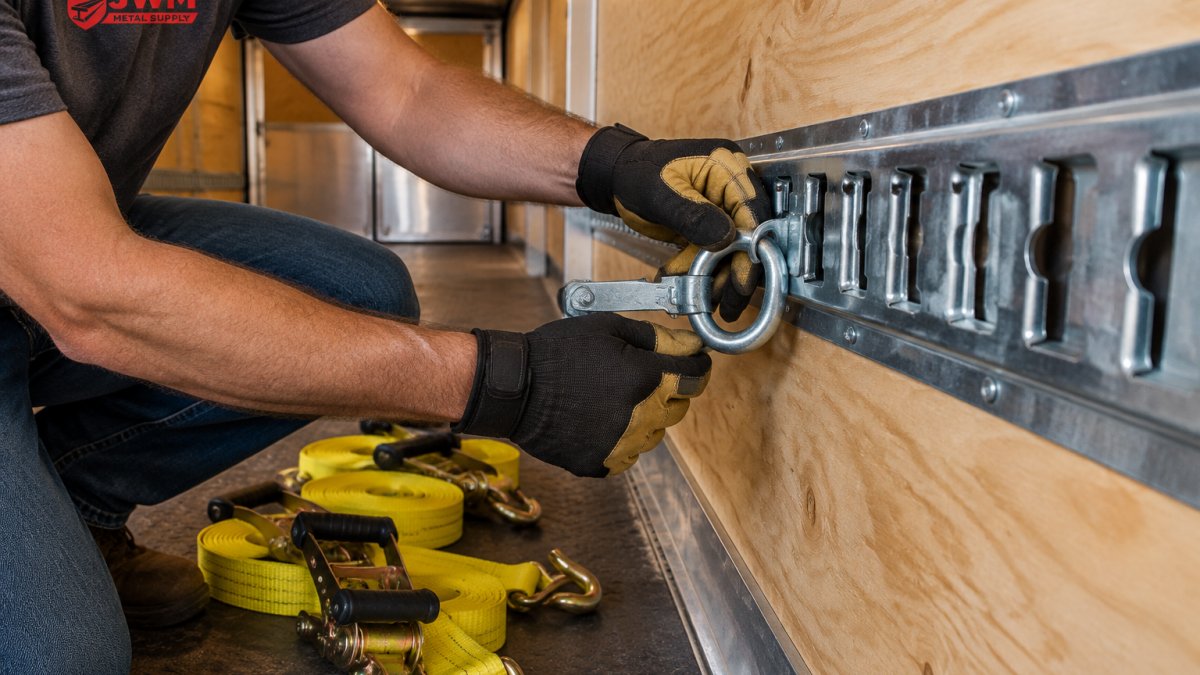
Plan rail placement around your heaviest and most frequent loads. Run rails along both walls at a consistent height for vehicle tie-downs, and add floor rails for low-sitting equipment.
For a full walkthrough of mounting, spacing, and fastener choice, our guide on installing E-Track systems in utility trailers covers the sequence step by step.
How E Track Actually Carries Load
That is why rail placement matters as much as rail rating. A 2,000 lb rail set bolted to a thin wall panel with no backing will pull out long before the rail itself fails. The fastener and the substrate set the real limit.
Fasteners, Spacing, and Backing
For heavy loads, plan the rail so the fasteners land on frame members. If the frame spacing does not line up with the rail's pre-drilled holes, a backing plate that bridges the frame members restores the load path. Securing these structural foundations remains the most critical step in transporting heavy machinery safely, a process that requires careful attention to weight distribution and equipment stability.
DIY vs. Professional Installation
Whether to install E Track yourself or hire it out comes down to what the rail is fastening into:
- DIY is reasonable when the trailer has exposed frame members you can hit with fasteners, the rail runs along a flat surface, and loads are moderate.
- Professional installation is the safer call when the rail must carry heavy vehicle loads, when the mounting surface is composite or thin panel with no accessible frame, or when the trailer is a finished enclosed unit where a mistake means water intrusion or structural damage.
The deciding question is not the rail rating, it is whether you can prove the fastener has a solid load path into the frame. If you cannot, the professional has the tools to add backing and seal the penetrations correctly.
Sealing and Long-Term Durability
Inspect fasteners for loosening at the same interval you inspect straps.
DOT Cargo Securement Standards: What the Rules Actually Require
DOT cargo securement standards require that cargo be immobilized against shifting, that tie-downs meet minimum working load ratings relative to the cargo weight, and that the system be inspected before and during transport.
The core idea is a ratio: the aggregate working load limit of your tiedowns must meet or exceed a set multiple of the cargo weight, with the exact figure depending on the commodity.
FMCSA cargo securement regulations
For private haulers, the same logic is good practice even where the letter of the rule does not apply.
The Aggregate WLL Math, Worked Out
Work the math before you load:
- Weigh the cargo, including any pallet or skid.
- Add up the WLL stamped on every tiedown you plan to use, strap, chain, binder, and anchor hardware, using the lowest rated component in each assembly.
- Confirm the total meets or beats the required multiple for your commodity.
- Confirm each individual tiedown is rated for at least the share of load it carries.
Watch out: the WLL of an assembly is set by its weakest link. A 5,400 lb strap on a 1,000 lb hook gives you a 1,000 lb tiedown, and the aggregate math has to use that lower number.
Commodity-Specific Rules That Override the General Ratio
The general freight rule is the fallback. Specific commodities carry their own tables, and those tables win when they apply:
- Vehicles and equipment: wheeled and tracked equipment has its own securement requirements covering the number of tiedowns, attachment points, and the use of tire straps or wheel chocks.
- Logs: log hauling has dedicated requirements for bunk placement, wrappers, and the number of wrappers relative to load length.
- Intermodal containers: container chassis securement has its own rules for the twist locks and the number of securement points.
- Roll-on/roll-off and flattened or crushed vehicles: these carry separate requirements that differ from general freight.
If your load falls under a commodity-specific table, follow that table. The general half-the-weight ratio does not substitute for it.
Inspection and Enroute Requirements
A good load at the dock is not enough.
What This Means for a Private Hauler
A non-commercial hauler is not bound by the FMCSA rule the same way, but the logic transfers. Hauling a 6,000 lb vehicle on a utility trailer, the half-the-weight floor means your aggregate WLL must clear 3,000 lb before dynamic load, and each individual tiedown still has to cover its per-point share. Sizing to the commercial rule is the conservative choice.
Strap Failure, Weather Damage, and Inspection Habits That Prevent Both
Most strap failures start long before the strap snaps. Polyester webbing loses strength when it abrades against sharp edges, when UV breaks down the fibers, and when it is stored wet and mildewed. The ratchet mechanism can seize or slip if grit works into the pawl.
Build a simple pre-trip inspection into your routine:
- Run your hand along the full length of the webbing, feeling for cuts, fraying, or thinning spots
- Check the stitching at both ends for loose or broken thread
- Confirm hooks are not bent, cracked, or worn thin at the throat
- Cycle the ratchet and listen for smooth, positive engagement
- Look for rust or corrosion on metal components
- Retire any strap with knots, chemical damage, or a tag you cannot read
Store straps dry and out of direct sun.
Matching the System to Your Load and Ordering the Right Kit
Match the system to the load's shape and weight, not to whatever strap is closest to hand. Wheeled vehicles want tire-style straps. Enclosed trailer cargo wants E Track with movable anchors.
Use this decision path:
- Weigh the load and note whether it rolls, sits flat, or stands tall.
- Divide the weight across the number of anchor points you can realistically use.
- Pick a system whose WLL exceeds that per-point share with margin.
- Confirm the anchor points on the trailer are rated for the same force.
- Buy the kit size that covers your longest span with webbing to spare.
If you are building your own anchor brackets or reinforcement plates for a custom trailer, carbon steel can be cut to your exact length with no minimum order, and material certifications are available.
Frequently Asked Questions
What is the best trailer tie down system for an enclosed trailer?
A kit such as the 6-pack 5 ft E Track rail set ($140.88) includes rails, ratchet straps, O-rings, and D-ring tie-offs, so you can move anchor points to match each load. Pair the rails with 2-inch polyester ratchet straps rated above your cargo weight. For a single vehicle, tire-style straps that wrap the wheels are designed to help protect wheels and rims.
How many tie downs are required on a 20 ft load under DOT cargo securement standards?
Consult the current FMCSA cargo securement rules for the required number of tie downs and load-holding percentages for your cargo. Check the aggregate working load limit of your straps, not just the count, before you pull out.
Are heavy-duty E Track systems better than floor-mounted D-rings?
E Track lets you reposition compatible anchors along the rail, which suits trailers that haul varied cargo. The 4-pack 7.7 ft E Track rails ($139.71) are designed to secure loads up to 2,000 lbs.
What is the 60/40 rule for trailer weight distribution?
Tie-downs hold cargo in place but do not correct weight distribution, so check how the load sits on the trailer before tensioning your straps.
How do I know my straps are rated high enough for heavy cargo?
Work from the working load limit, never the breaking strength. The 2-inch by 120-inch tire straps ($89.99) carry a 5,512 lb working load limit against an 11,023 lb breaking strength. Add up the working load limits of every strap holding the load and confirm the total meets the requirements that apply to your cargo. Replace any strap with cut webbing, a bent hook, or a ratchet that slips.
Heavy cargo does not forgive guesswork, and the right tie-down system is the cheapest insurance you will ever buy for your trailer and everything on it. JWM Metal Supply stocks American-made, precision-cut steel and a full range of rated tie-down hardware, with free shipping and orders ready in 1-3 business days. Get started with JWM Metal Supply and build a securement setup that matches your heaviest load.
