

Last Updated: October 1, 2026
What Is ¾ x 1-1/2 x 14ga Rectangle Steel Tubing?
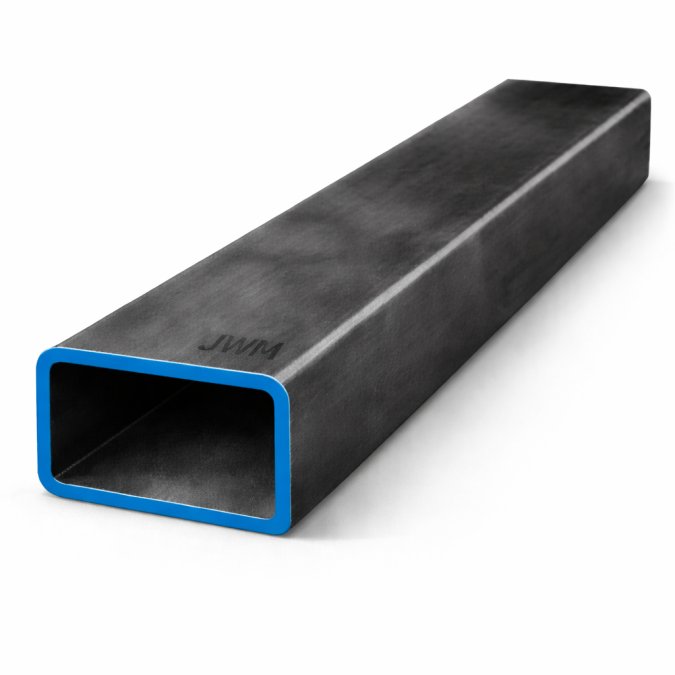
¾ x 1-1/2 x 14ga rectangle steel tubing is a thin-wall, rectangular hollow section with a 1.5-inch by 0.75-inch outside profile and a 14-gauge nominal wall. It is produced from mild steel to A500 or A513 grade, ships in a raw mill finish, and is used where a light, stiff, easily welded frame member is needed.
Nominal Wall Thickness and Outside Diameter
The outside dimensions are 3/4 inch by 1-1/2 inch. Wall thickness for 14 gauge is 0.083 inch nominal, and mill tolerances mean the actual wall can run slightly under or over that figure.
14 Gauge Steel Tubing Weight Per Foot and Load Capacity
The 3/4 x 1-1/2 14ga size weighs 1.18 lb per linear foot. That number drives most practical decisions: finished frame weight, shipping cost, and whether you can lift the assembly alone.
Weight Per Linear Foot Calculations
Weight per foot scales linearly. A 10-foot stick of 3/4 x 1-1/2 14ga rectangle steel tubing weighs about 11.8 pounds; a 20-foot length runs about 23.6 pounds.
Size |
Wall |
Weight per Foot |
8 ft Length |
|---|---|---|---|
3/4 x 1-1/2 |
14ga |
1.18 lb |
9.4 lb |
3/4 x 1-1/2 |
16ga |
0.94 lb |
7.52 lb |
1 x 1-1/2 |
14ga |
1.32 lb |
10.6 lb |
1 x 1-1/2 |
11ga |
1.84 lb |
14.7 lb |
How Load Capacity Actually Works in a Thin-Wall Tube
Every beam problem, and a tube in a frame is a beam, comes down to four variables: span between supports, how the ends are held, where the load sits along the span, and the shape of the cross-section. Change any one and the answer changes, which is why no supplier can hand you a single 'capacity' number true for every build.
Two properties do most of the work:
- Section modulus (S) governs bending stress. It's a pure geometry number, how the material is distributed around the neutral axis. For a rectangular tube, the 1-1/2 inch dimension oriented vertically gives a much larger S than the same tube laid flat.
- Moment of inertia (I) governs deflection. Stiffness, how much the tube sags under load, is driven by I, not by yield strength. A tube that's strong enough can still sag unacceptably if I is too low for the span.
Span Rules of Thumb for 14ga Rectangular Tubing
These are starting points for preliminary layout, not engineering values. Verify any load-bearing member against the current AISC Steel Construction Manual or have a licensed engineer check it.
- Under 24 inches, light load (bench top, shelf, panel): 14ga in this profile is comfortable. Deflection is negligible and the tube won't feel springy.
- 24 to 48 inches, moderate load (cart frame, equipment rack): keep the 1-1/2 inch face vertical, gusset the corners, and add a mid-span cross member if the load is concentrated.
- 48 to 72 inches, any real load: expect visible sag unless you add intermediate support, step up to 11ga, or switch to a deeper profile.
- Over 72 inches: treat this as a truss or a deeper-section problem, not a single-tube problem.
Why Deflection Usually Governs, Not Yield
Mild steel yields somewhere in the tens of thousands of psi, and a 14ga tube rarely gets close to that in a typical cart or rack. What fails first is serviceability: the shelf sags, the gate drags, the trailer deck flexes underfoot. Designers size thin-wall members for deflection limits, not yield, because a member that's 'strong enough' but springy is still a bad member.
How to Weld 14ga Steel Tubing Without Burn-Through
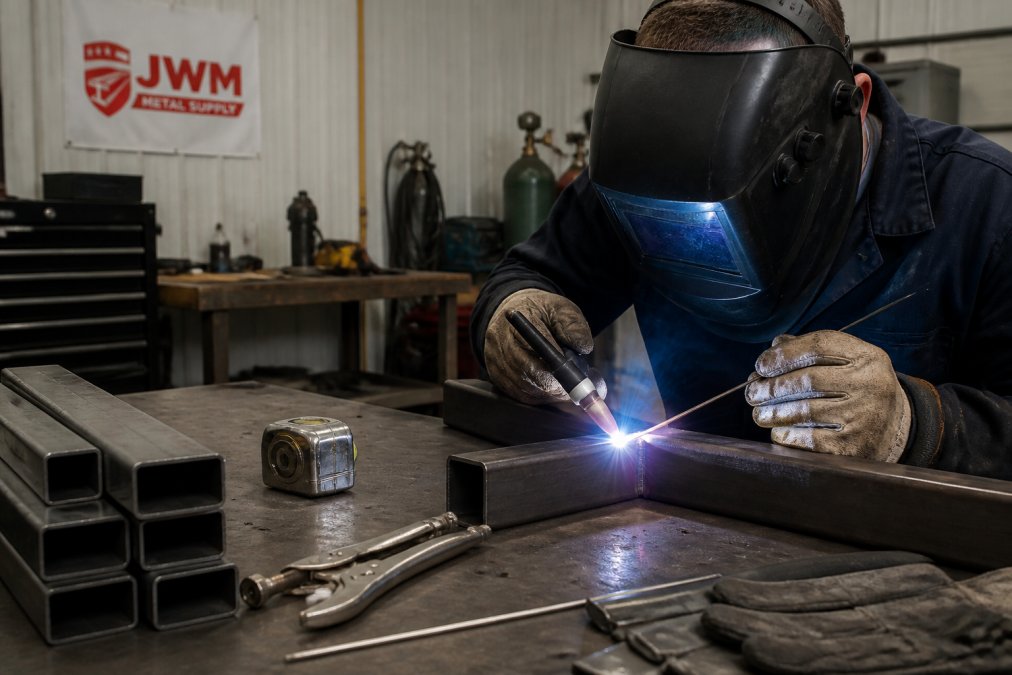
Welding 14ga steel tubing without burn-through comes down to heat control: use the lowest amperage that still fuses, move faster than on thicker stock, and let the joint cool between passes. At 0.083 inch, the wall is forgiving for a beginner on TIG or MIG, but it punishes anyone who lingers in one spot.
Fabrication Best Practices for Thin-Wall Tubing
Fit-up is everything on thin-wall work. Gaps force you to fill, and filling thin material is how you burn through. Cut square, clamp tight, and tack in alternating corners so heat doesn't pull the frame out of square.
A few habits that separate clean work from scrap:
- Cut with a fine-tooth blade or an abrasive chop saw, then deburr both ends
- Tack all four corners before running any full bead
- Alternate sides as you weld to balance heat input
- Let each joint cool before the next pass
- Check square after tacking, not after welding
Mild Steel Rectangular Tubing Applications
Mild steel rectangular tubing shows up anywhere a light frame needs to be strong, cheap, and easy to modify. The 3/4 x 1-1/2 profile in 14ga is a favorite for trailer frames, utility carts, shelving, and equipment racks.
Trailer Frames, Carts, and Racks
Trailer frames are the classic use case. A small utility trailer frame built from 14ga rectangular tubing stays light enough to tow behind a car while carrying a real load, provided spans are kept short and corners are gusseted. The rectangular profile also makes it easy to bolt on decking, fenders, and lighting brackets.
3/4" x 1-1/2" 14ga Rectangle Steel →
14ga vs 16ga vs 11ga: Strength and Gauge Conversion
The choice between 14ga, 16ga, and 11ga comes down to how much stiffness you need versus how much weight and weld difficulty you can tolerate. For the 3/4 x 1-1/2 profile, 14ga is the middle option: heavier than 16ga by about a quarter-pound per foot, lighter than 11ga by more than half a pound.
Gauge |
Wall Thickness |
Weight per Foot (3/4 x 1-1/2) |
Typical Use |
|---|---|---|---|
16ga |
0.065 in |
0.94 lb |
Light racks, decorative frames |
14ga |
0.083 in |
1.18 lb |
Trailer frames, carts, general fabrication |
11ga |
0.120 in |
1.84 lb |
Heavy-duty frames, load-bearing members |
Custom Cut, Pricing, and Sourcing for Small Orders
JWM Metal Supply cuts 3/4" x 1-1/2" 14ga rectangle steel tubing to your exact length with no minimum order quantity. Material certifications are available for load-bearing applications that need documented grade and origin. These precise cuts ensure that your framing components integrate seamlessly into large metal structures designed for agricultural efficiency.
Why Small-Quantity Sourcing Is the Hardest Part
A few patterns that work for individuals:
- Ask for 'remnants' or 'drops.' Every fabricator and service center accumulates short cut-offs. They're often sold by the pound at a fraction of new-stock pricing and are perfect for test joints and small brackets.
- Check local welding and fabrication shops. Many will sell a stick off their rack or cut a length for a walk-in, especially if you're buying consumables at the same time.
- Look for metal suppliers that publish per-piece pricing online. If a supplier lists a per-foot or per-length figure and accepts small orders, you've found the right channel for a one-off build.
- Buy one length first. Cut a test joint, weld it, and confirm the size and gauge before committing to a full project list. It's the cheapest way to avoid ordering 60 feet of the wrong profile.
What to Specify When You Order
A cut-to-length order goes smoothly when you provide four things up front:
- Exact length, in inches. State the finished dimension and note whether it's a critical fit or a rough cut.
- Quantity. Number of pieces, not total feet, unless the supplier quotes by the foot.
- Profile orientation.
- End use.
Length Tolerance, Finish, and Edge Condition
Three things to know before the order ships:
- Length tolerance. Cut lengths are held to a practical tolerance.
- Finish condition. Raw mill finish may show light mill scale or surface rust, which is normal and cleans off with a flap disc. If the tube is going straight to paint, plan on a prep pass.
- Edge condition. Cut edges can be sharp, so deburr before handling.
Shipping and Handling for Long Stock
Steel tubing ships in lengths that exceed most parcel carriers' limits, so long pieces typically move by freight or local delivery. A few practical notes:
- Bundle short pieces. If your project needs several pieces under a few feet, ordering them as one bundle is usually cheaper than ordering full sticks and cutting on site.
- Plan for the drop-off. Freight deliveries arrive on a truck with a liftgate or a forklift, and the driver won't carry material into your garage. Have a clear path and a place to stage the bundle.
- Inspect on arrival. Check for bends, dents, and cut-length accuracy before signing. Freight damage is easiest to resolve at the moment of delivery.
Corrosion Resistance and Surface Finish Options
Raw mild steel tubing has no meaningful corrosion resistance on its own. Left unpainted and exposed to moisture, 14ga rectangle steel tubing will develop surface rust, and that rust will eventually pit the wall. The material isn't defective; it's simply bare steel doing what bare steel does.
For outdoor work, the practical options are:
- Paint. Clean to bare metal, apply a primer rated for steel, then a topcoat. This is the most common and most economical choice.
- Powder coat. Durable and attractive, but it requires a shop with the equipment and it hides nothing, so prep has to be perfect.
- Galvanizing. Hot-dip galvanizing gives long-term protection for trailers and outdoor frames. It's a service, not a product, so plan for the lead time.
Conclusion
The hard part of buying steel tubing isn't the material, it's knowing which gauge and profile your project needs and getting it cut to length without paying for a full mill run. JWM Metal Supply cuts every order to your exact specifications with no minimum, ships American-made A500 or A513 tubing in 1 to 5 business days, and provides material certifications when your application calls for documented grade and origin.
Frequently Asked Questions
What is the actual wall thickness of 14ga steel tubing?
14 gauge steel tubing has a nominal wall thickness of 0.083 inches (2.11 mm). That is the standard gauge conversion used across the metalworking industry for mild steel. For a 1-1/2 x 3/4 x 14ga rectangle steel tubing profile, that wall thickness runs around the full perimeter of the rectangular cross-section. Always confirm the gauge with your supplier before welding or load-bearing use, since mill tolerances can vary slightly.
How much does 1-1/2 x 3/4 x 14ga rectangle steel tubing weigh per foot?
This profile weighs approximately 1.18 lb per linear foot. Weight per foot matters for two reasons: it drives your shipping cost, and it tells you how much steel you are actually buying. A 20-foot length of 14ga steel tubing at this weight comes in around 23.6 lb. Heavier gauges like 11ga weigh more per foot because of the thicker nominal wall thickness.
Can you weld 14ga rectangle steel tubing easily?
Yes, but 14ga is thin enough that burn-through is a real risk. TIG welding at low amperage (around 60-80 amps) gives the cleanest results on mild steel rectangular tubing. MIG works too if you keep the wire speed and voltage dialed in and use short, controlled beads. Clean the mill finish and any light surface rust off the joint first, fit the pieces tight, and tack before running a full pass.
What are the common applications for mild steel rectangular tubing?
Mild steel rectangular tubing shows up in trailer frames, utility carts, equipment racks, gates, handrails, and custom automotive frame repairs. The 3/4 x 1-1/2 profile is popular for lighter-duty structural work where a square tube would be overkill or where the rectangular cross-section fits a specific mounting surface. DIY enthusiasts and small fabrication shops use it for one-off builds because it cuts and welds with basic tools.