

Last Updated: October 1, 2026
2x4 Steel Tubing at a Glance: Sizes, Gauges, and Pricing
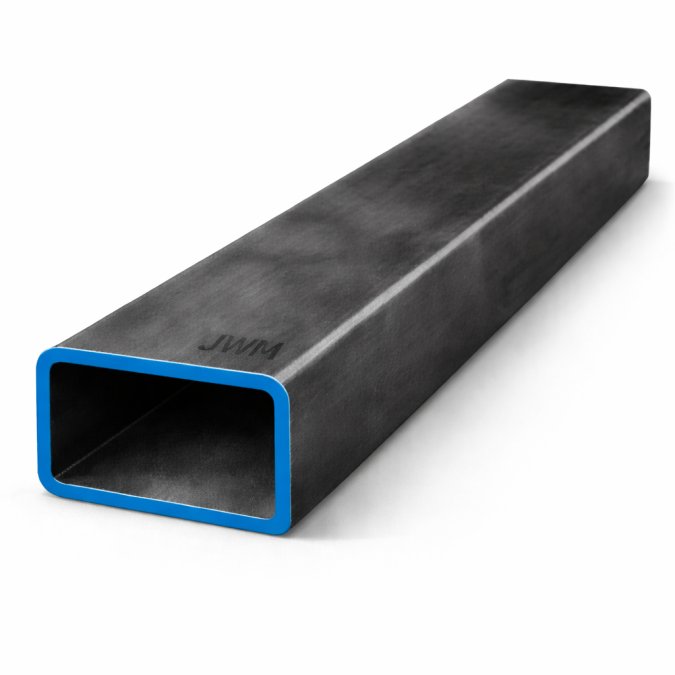
2x4 steel tubing is a rectangular hollow structural section with 2-inch by 4-inch outside dimensions, sold in wall thicknesses from 14 gauge down to 1/4 inch. JWM Metal Supply cuts every length to spec and ships nationwide with no minimum order.
Wall Thickness |
Weight Per Foot |
Price (per select length) |
|---|---|---|
14ga |
3.27 lb |
$26.19 |
11ga |
4.58 lb |
$26.19 |
3/16" |
6.87 lb |
$29.15 |
1/4" |
8.81 lb |
$29.51 |
Structural Steel Tubing Specifications You Need Before Ordering
Structural steel tubing specifications come down to four numbers: outside dimensions, wall thickness, material grade, and length. Get those right and the rest takes care of itself.
Carbon Steel Tubing Wall Thickness: 14ga to 1/4"
Carbon steel tubing wall thickness controls weight, load capacity, and weldability. The 2x4 profile comes in 14ga, 11ga, 3/16", and 1/4".
Here's the practical read on each:
- 14ga (3.27 lb/ft): Lightest option. Good for racks, shelving, gates, and non-structural frames where weight matters.
- 11ga (4.58 lb/ft): The middle ground most fabricators reach for. Noticeably stiffer than 14ga without a big weight penalty.
- 3/16" (6.87 lb/ft): Structural territory. Trailer frames, equipment skids, and anything taking repeated impact.
- 1/4" (8.81 lb/ft): The heaviest wall in the lineup. Use it when the load path demands it and weight is secondary.
How to Choose the Right Gauge for Load and Welding
Thin walls punish heat. At 14ga, a 1/8-inch stick electrode blows through before you've established a puddle, switch to TIG or wire feed with 0.030-inch wire and lower amperage.
Load Capacity, Span, and Bending: What 2x4 Tubing Can Handle
Load capacity depends on four variables: wall thickness, span length, end support condition, and how the load is applied. A 2x4 tube on a short span with fixed ends behaves nothing like the same tube on a long, unsupported span.
The Three Failure Modes You Are Actually Sizing Against
- Yielding. The steel is stressed past its yield point and takes a permanent bend. A500 Grade B has a published minimum yield strength of 46,000 psi; A513 is typically 50,000 to 60,000 psi. Yielding rarely governs on long spans.
- Deflection. The member sags without permanently bending. This governs most real-world horizontal members, a beam that hasn't yielded can still sag enough to crack a weld, bind a gate, or pool water on a deck.
- Local buckling. The compression flange or web cripples before the section reaches yield. This shows up on thin walls (14ga and 11ga) under concentrated point loads, which is why a thin-wall tube can fail at a load a thick-wall tube of the same outside dimensions shrugs off.
Orientation Is the Single Biggest Lever
The 4-inch dimension does the structural work. Orienting the tube so the 4-inch face is vertical rather than flat is the largest capacity gain available without changing gauge.
Span and Load: How the Numbers Move
Three relationships hold up in practice:
- Span dominates. Deflection under a uniform load scales with span raised to the fourth power. Halving the span reduces deflection sixteen-fold; doubling it increases deflection sixteen-fold. A gauge that feels overbuilt at four feet feels springy at ten.
- End conditions matter almost as much. A beam with both ends fixed against rotation deflects roughly one-fifth as much as the same beam simply supported. Welding your tube into a rigid frame is not the same as resting it on two sawhorses.
- Load type matters. A uniform load (a rack of parts spread along the length) deflects differently than a concentrated midspan load (a hoist point). A midspan point load on a simply supported beam deflects more than the same total weight spread uniformly.
A Reference Table for Common DIY Spans
The table below is a planning aid, not an engineering document. It assumes A500 Grade B, a simply supported beam, a uniform load, the tube oriented on edge (4-inch dimension vertical), and a deflection limit of L/360, the common building-code limit for members supporting plaster or brittle finishes, and a reasonable target for gates, racks, and benches. Values are rounded and conservative.
Wall |
Weight/ft |
Practical span for light loads (under 50 lb/ft) |
Practical span for moderate loads (50-150 lb/ft) |
Notes |
|---|---|---|---|---|
14ga |
3.27 lb |
up to about 4 ft |
up to about 3 ft |
Light racks, shelving, gate frames |
11ga |
4.58 lb |
up to about 6 ft |
up to about 4 ft |
The general-purpose choice |
3/16" |
6.87 lb |
up to about 8 ft |
up to about 6 ft |
Trailer frames, skids |
1/4" |
8.81 lb |
up to about 10 ft |
up to about 7 ft |
Heavy structural, impact loads |
When to Stop Guessing and Call an Engineer
Get stamped numbers from a qualified structural engineer when any of the following is true:
- The member carries a load that could injure someone if it fails, overhead lifting, trailer frames, vehicle-mounted equipment, mezzanine supports.
- The span exceeds the table above, or the load is concentrated rather than distributed.
- The assembly sees fatigue (repeated loading), impact, or vibration.
- A permit, inspector, or insurer is involved, they want calculations, not rules of thumb.
Custom Cut Steel Tubing: Lengths, Tolerances, and Delivery
Custom cut steel tubing means the supplier cuts your order to the length you specify rather than shipping a standard 20- or 24-foot mill length. JWM Metal Supply cuts every order to exact length and ships in 1-5 business days.
2" x 4" 14ga Rectangle Steel Tubing →
What to include on your order:
- Finished length for each piece, in inches
- Quantity per length
- Wall thickness and grade (14ga, 11ga, 3/16", or 1/4", A500 or A513)
- Any tolerance requirement if the pieces have to match each other
DIY Steel Fabrication Projects That Call for 2x4 Tubing
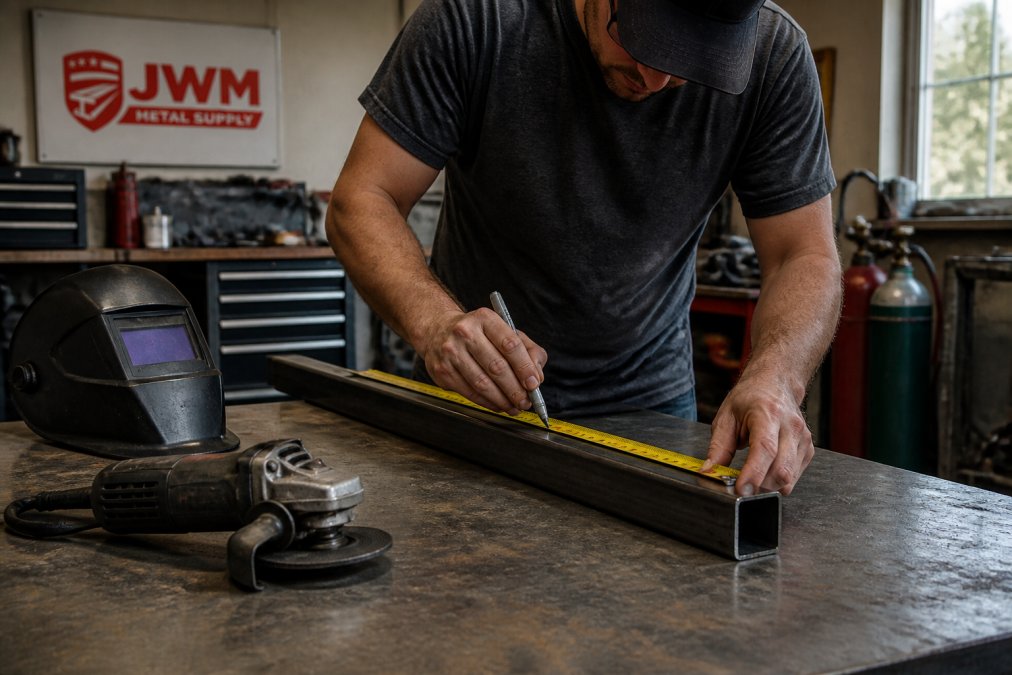
DIY steel fabrication projects cluster around a handful of shapes: frames, racks, gates, and trailers. The 2x4 profile fits all four because its 4-inch face resists bending in one direction while the 2-inch face keeps the assembly narrow. The more useful question is not "what can I build with 2x4?" but "when is 2x4 the right choice, and when should I reach for something else?"
2x4 vs. Square Tubing vs. Angle Iron: A Decision Framework
Most first-time buyers default to square tubing because it's familiar, or angle iron because it's cheap. Neither is wrong, but each shape solves a different problem.
Shape |
Best for |
Trade-off |
|---|---|---|
Members that bend in one direction, trailer frames, gate frames, bench rails, equipment skids |
Directional: strong on edge, weak flat. You must orient it correctly. |
|
Square tubing (e.g., 2x2) |
Members loaded in multiple directions, columns, and joints where you want a uniform profile |
Less bending stiffness per pound in the primary direction than a rectangular section of the same weight. |
Angle iron |
Brackets, gussets, edge reinforcement, and light frames where bending is not the governing load |
Open section: much lower torsional stiffness, and it twists under offset loads. |
Projects That Fit 2x4 Well
- Workbench and welding table frames. Use 11ga for a bench that stays put; step up to 3/16" if you will be hammering on it. Orient the 4-inch face vertical on the long rails.
- Trailer frames and utility cart chassis. 3/16" or 1/4" here. This is structural work, and the 4-inch face vertical orientation is doing the load-carrying.
- Driveway gates and fence panels. 14ga or 11ga keeps the swing weight manageable. Watch deflection on wide single-leaf gates, a 12-foot leaf on 14ga will sag at the latch unless you add a diagonal brace or step up a gauge.
- Equipment skids and dunnage racks. 11ga handles most shop loads. Add cross members to shorten the effective span rather than stepping up the gauge.
- Tractor and implement repairs. 3/16" is the usual starting point for field repairs, where impact and vibration are the governing loads.
Projects Where 2x4 Is the Wrong Pick
- Long unsupported spans with light walls. A 14ga 2x4 on a 12-foot span will deflect visibly under its own weight plus a modest load. Either shorten the span with intermediate supports or step up the gauge.
- Columns and posts. A column loaded axially is better served by square tubing, which gives the same stiffness in both directions and simplifies connection detailing.
- Twisting members. If the load is applied off-axis and will twist the member, an open section like angle iron or a closed square section will behave more predictably than a rectangular tube loaded the wrong way.
- Anything where you cannot control orientation. If the tube will be installed flat because of how it fits the assembly, you have given up the main advantage of the 2x4 profile.
A Note on Gauge Selection Across a Single Build
A common mistake on first builds is buying one gauge for everything. Match the gauge to the job and you'll spend less steel and less time. A trailer frame and a gate frame in the same project can reasonably use different wall thicknesses, the trailer needs 3/16" or 1/4", the gate is fine at 14ga or 11ga. Ordering cut-to-length pieces in each gauge costs less than overbuilding the light parts or underbuilding the heavy ones.
Welding, Drilling, and Finishing 2x4 Steel Tubing
Welding 2x4 steel tubing is straightforward once you match the process to the wall thickness. ERW carbon steel in A500 or A513 welds with standard mild steel filler, no preheat required in normal shop conditions.
Process by thickness:
Wall Thickness |
Recommended Process |
Notes |
|---|---|---|
14ga |
TIG or MIG, 0.030" wire |
Low amperage; watch for burn-through |
11ga |
MIG, 0.035" wire |
Most forgiving for beginners |
3/16" |
MIG or stick, 1/8" electrode |
Bevel critical joints |
1/4" |
Stick or MIG, multi-pass |
Bevel and run a root pass |
Conclusion
The hard part of buying 2x4 steel tubing isn't the tubing. It's getting the gauge, grade, and cut length right the first time, and finding a supplier who will sell you four pieces without treating you like a nuisance.
Frequently Asked Questions
How much does 2x4 steel tubing cost?
Pricing depends on wall thickness and cut length. JWM Metal Supply lists 2" x 4" 14ga and 11ga rectangle tubing at $26.19, 3/16" wall at $29.15, and 1/4" wall at $29.51. Heavier walls use more steel per foot, so they cost more. There are no minimum order requirements and shipping is free, which keeps small one-off orders affordable for hobbyists and contractors alike.
What are the common wall thicknesses available for 2x4 steel tubing?
JWM Metal Supply stocks four wall thicknesses in 2" x 4" rectangle tubing: 14ga at 3.27 lb per foot, 11ga at 4.58 lb per foot, 3/16" at 6.87 lb per foot, and 1/4" at 8.81 lb per foot. All are A500 or A513 carbon steel with a raw mill finish. Thicker walls carry more load and weld more easily; thinner walls keep weight and cost down.
Is 2x4 steel tubing suitable for heavy-duty structural framing?
Yes, when you match the wall thickness to the load. The 3/16" and 1/4" options at 6.87 and 8.81 lb per foot give the stiffness and yield strength structural framing needs, while 14ga and 11ga suit lighter frames, racks, and gates. Check span, load, and local building requirements before finalizing your gauge, and ask for material certifications on load-bearing work.
How does JWM Metal Supply ensure quality for custom-cut steel orders?
Every order is precision cut to your exact length from American-made carbon steel, and material certifications are available on request so you can verify grade and origin. Tubing ships in 1-3 business days with no minimum order. If a cut or dimension does not match your order, contact the team and they will make it right.