

Last Updated: October 1, 2026
2x2 Steel Angle: Specs, Thickness Options, and Pricing at a Glance
A 2x2 steel angle is an L-shaped piece of mild carbon steel with two equal 2-inch legs, used for structural support, framing, brackets, and repair work. At JWM Metal Supply, every 2x2 steel angle is American-made, cut to your exact length, and ships free with no minimum order. This guide covers thickness options, weight per foot, applications, and how to pick the right size for your project.
Thickness |
Weight Class |
Best For |
Weldability |
|---|---|---|---|
1/8" (0.120") |
Lightest |
Racks, brackets, light frames |
Excellent |
3/16" (0.188") |
Mid-range |
Trailer frames, equipment supports |
Excellent |
1/4" (0.250") |
Heaviest |
Load-bearing structures, heavy bracing |
Excellent |
Quick Comparison: 1/8", 3/16", and 1/4" Thickness
The 1/8" 2x2 steel angle handles light fabrication: shelving, brackets, and general repair work. Step up to 3/16" when the piece carries real weight, like a trailer frame or implement support. The 1/4" version is the choice for structural framing and reinforcement where rigidity matters most. All three are mild carbon steel with raw mill finish, ready to weld, drill, and cut with standard shop tools.

What 2x2 Steel Angle Is and How It's Made
Steel angle is produced by passing heated steel through rollers that form the L-shaped cross-section, a process called hot rolling. That profile gives the piece far more rigidity than flat bar of the same weight, which is why angle iron shows up in structural framing everywhere from trailer beds to barn repairs.
Hot Rolled vs Cold Rolled: What You Actually Need to Know
Hot rolled angle is formed above the steel's recrystallization temperature, which leaves a slightly rougher mill finish and looser dimensional tolerance. Cold rolled angle is processed at room temperature for a smoother surface and tighter tolerance, but it costs more and offers no strength advantage for most fabrication work.
Structural Steel Angle Applications: Frames, Brackets, Supports, and More
Structural steel angle applications cover nearly every corner of metal fabrication: trailer frames, equipment racks, gate reinforcement, shelving uprights, and repair brackets. The L-profile resists bending in two directions at once, so a single piece often replaces two flat bars.
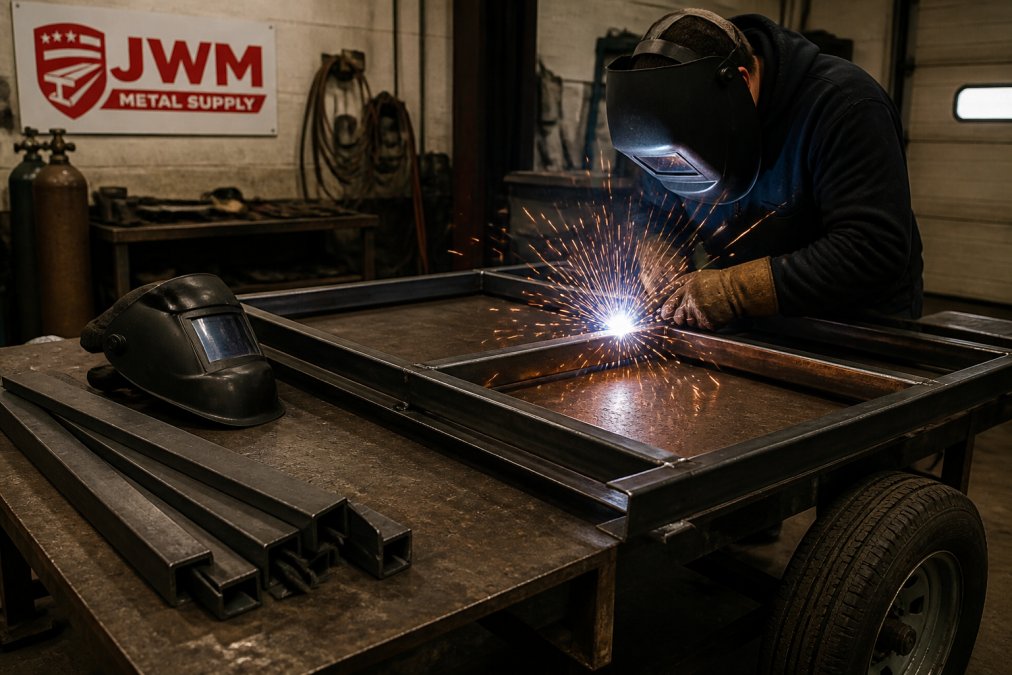
Common uses include:
- Trailer and utility bed framing
- Equipment and pallet rack supports
- Gate and fence reinforcement
- Workbench and shelving frames
- Agricultural implement repair
- Automotive frame bracing
Steel Angle Weight Per Foot: How to Calculate Load and Shipping Weight
Steel angle weight per foot depends on leg size and thickness. For 2x2 angle, the published weights per foot are approximately:
Thickness |
Weight Per Foot |
Weight of a 10 ft Piece |
Weight of a 20 ft Piece |
|---|---|---|---|
1/8" (0.120") |
~2.0 lb |
~20 lb |
~40 lb |
3/16" (0.188") |
~3.0 lb |
~30 lb |
~60 lb |
1/4" (0.250") |
~3.9 lb |
~39 lb |
~78 lb |
Here's the practical formula fabricators use:
Weight = weight per foot × length in feet
Why Weight Per Foot Is Not a Load Rating
A common mistake is to read weight per foot as a strength number. It isn't. Weight per foot tells you how much steel is in the section, which correlates with strength but doesn't determine it. What actually governs whether a 2x2 angle holds is:
- Span, the unsupported distance between supports
- Support spacing, how often the piece is braced or anchored
- Load direction, bending against a leg is far stronger than bending across the open corner
- Joint design, a welded or bolted connection transfers load differently than a free end
- Bracing, a piece braced against twisting carries much more than one left free
Shipping Weight and Handling
Because every 2x2 steel angle order from JWM Metal Supply ships free with no minimum, the practical question isn't freight cost, it's whether you can unload what arrives. A 20-foot bundle of 1/4" angle weighs close to 80 lb per piece. Plan for a second set of hands, a cart, or a forklift if you're ordering multiple long pieces.
Custom Cut Steel Angle: Why Length Matters More Than You Think
Custom cut steel angle arrives at the exact length your project needs, which cuts waste, saves freight weight, and removes a step from your workflow. Ordering full mill lengths means you pay to ship metal you'll cut off and scrap anyway.
Weldability, Machinability, and Surface Finish Options
Mild carbon steel angle welds cleanly with MIG, TIG, or stick processes, and it drills, taps, and saws with standard shop tooling. That combination is why angle iron is the default for fabrication work: it forgives minor technique errors and holds a strong joint.
Angle Iron - 2" x 2" x 1/8"(0.120") →
For finishing, you have options:
- Paint or primer: the most common choice for indoor and outdoor frames
- Powder coating: durable, but requires a coater
- Galvanizing: best for outdoor and wet environments
- Oil or wax: temporary protection during storage
How to Choose the Right Thickness for Your Project
Match thickness to load and span, not to habit. Most product pages stop at "1/8" for light, 1/4" for heavy" and leave you guessing. Here's the project-level guidance that actually helps you pick.
A Practical Selection Table
Project |
Typical Thickness |
Why |
|---|---|---|
Shelf brackets, small jigs, light repair |
1/8" (0.120") |
Short spans, low load, easy to drill and weld |
Workbench frames, shelving uprights, gate frames |
1/8" to 3/16" |
Moderate load, often braced at multiple points |
Trailer frames, utility bed framing, equipment supports |
3/16" (0.188") |
Carries dynamic load and vibration; needs more section |
Structural reinforcement, heavy bracing, load-bearing frames |
1/4" (0.250") |
Maximum rigidity for the profile; resists deflection over longer spans |
Span Rules of Thumb
These are starting points, not engineering certifications. For anything that carries people, vehicles, or overhead load, have a qualified engineer review the design.
- Under 2 ft span, light load: 1/8" is usually fine.
- 2 to 4 ft span, moderate load: step up to 3/16".
- 4 to 6 ft span, moderate to heavy load: 3/16" with mid-span bracing, or 1/4" unsupported.
- Over 6 ft span: 1/4" plus bracing, or redesign to shorten the span. Long unsupported runs are where angle iron fails.
Load Direction Matters as Much as Thickness
An L-profile is strongest when the load bends it against a leg and weakest when it twists the open corner. Two habits make any thickness perform better:
- Orient the leg vertically under a downward load so the tall leg resists bending.
- Brace against twist with a gusset, a second angle, or a welded plate at the corner.
When to Size Up vs. Size Down
- Size up for anything load-bearing, anything outdoors that will see vibration, and anything you can't easily inspect later.
- Size down for jigs, one-off brackets, and shop fixtures where weight and workability matter more than capacity.
If you're between two sizes on a load-bearing project, go heavier. The extra weight per foot is a small price next to rebuilding a frame that deflected or failed.
Sketch the frame before you order. Mark each span, each support point, and the direction of the load. That sketch tells you more about the right thickness than any rule of thumb, and it lets JWM Metal Supply cut each piece to the exact length your drawing calls for.
Corrosion Prevention and Finishing for 2x2 Angle Iron
Carbon steel angle will rust when exposed to moisture, so finishing isn't optional for outdoor work. The good news: prevention is straightforward and cheap compared to replacing a rusted frame.
- Store steel off the ground and under cover
- Prime cut ends, since exposed edges rust first
- Touch up welds after grinding
- Recoat any scratched areas promptly
Frequently Asked Questions
What is the price of 20 feet of 2x2 angle iron?
At JWM Metal Supply, 2x2 angle iron is priced per piece based on thickness and cut length. The 2" x 2" x 1/4" option starts at $20.47, while the 1/8" and 3/16" options start at $26.24. Because every order is custom cut to your exact length, the total for 20 feet depends on how you split that length across pieces. There are no minimum order requirements, and shipping is free.
How much does 20 feet of 2x2 angle iron weigh?
Weight depends on wall thickness. For 2x2 angle, the approximate weights per foot are: 1/8" (0.120") is ~2.0 lb, 3/16" (0.188") is ~3.0 lb, and 1/4" (0.250") is ~3.9 lb. That puts 20 feet at approximately 40 lbs, 60 lbs, and 78 lbs respectively. Always confirm exact weight with the material certification if load calculations matter for your project.
What are the common uses for 2x2 steel angle iron?
Structural steel angle applications include trailer frames, equipment racks, shelving, bracing, gate frames, agricultural implement repairs, and general fabrication. The equal-leg L profile resists bending better than flat bar of the same weight, which is why it shows up in load-bearing brackets and reinforcement work. It also welds and drills easily with standard shop tools, making it a favorite for both DIY builders and professional fabricators.
How does JWM Metal Supply ensure precision in custom-cut steel?
Every 2x2 steel angle order is cut to your specified length using saw or plasma equipment, then checked against your dimensions before packing. Material certifications are available on request so you can verify grade and origin. If a cut arrives outside your stated tolerance, contact the team and they will make it right. Orders typically ship in 1 to 3 business days, and shipping is free nationwide with no minimum order.
Choosing the right 2x2 steel angle comes down to matching thickness to your load, cutting to exact length, and protecting the steel once it's in place. JWM Metal Supply makes that simple with American-made mild carbon steel, precision cut-to-length service, no minimum order, and free shipping nationwide. Every order is ready to ship in 1-3 business days, with material certifications available for load-bearing work. Shop now and get the exact 2x2 steel angle your project needs, delivered free.