

Last Updated: September 28, 2026
What 2x2 Square Tubing Actually Is
2x2 square tubing is a hollow structural section with a 2-inch by 2-inch outside profile, sold in several wall thicknesses and used for frames, trailers, gates, and fabrication work. At JWM Metal Supply, we cut it to your exact length and ship it nationwide, which matters because most suppliers force you into full 20-foot or 24-foot mill lengths.
The 2-inch square profile hits a sweet spot. It's small enough to handle in a garage, large enough to weld without burning through thin walls, and square enough that joints self-align. That last point is why fabricators reach for square tubing instead of round: a square profile gives you flat faces for clamping, drilling, and bolting without a jig.
Most of what we sell is A500 Grade B or A513 carbon steel, both electric resistance welded (ERW) and both made in the USA. Which spec you get depends on the product, so check the individual listing rather than assuming.
A500 Grade B vs A513: What the Spec Sheet Means
A500 Grade B is a structural tubing specification. It sets minimum yield strength and tensile strength requirements, and it's the spec engineers reference when tubing carries load. A513 is a mechanical tubing specification, written around dimensional consistency and surface quality for parts that get machined or formed rather than loaded structurally.
Here's the practical difference. If your project has a stamped drawing, a permit, or an engineer's signature, the drawing will name a spec. Order to that spec. If you're building a workbench or a cart in your garage, either material welds and cuts the same way, and the wall thickness matters far more than the grade.
What most guides miss: the grade on the cert sheet doesn't tell you the tubing is straight, square, or cut clean. Those are fabrication and handling issues, not metallurgy. Mill test reports (MTRs) confirm chemistry and mechanical properties. They don't confirm your cut length is accurate to the sixteenth.
2x2 Square Tubing Wall Thickness Guide: Gauges and Inside Dimensions
Wall thickness is the single most consequential decision you'll make, and it's the one buyers get wrong most often. The outside dimension stays 2 inches no matter what. Everything else changes.
Gauge / Fraction |
Wall Thickness |
Nominal Inside Dimension (estimated) |
Typical Ordering Note |
|---|---|---|---|
0.065" |
~1.870" x 1.870" |
Lightest common wall; easiest to cut and form |
|
14 gauge |
0.083" |
~1.834" x 1.834" |
Middle ground for general fabrication |
11 gauge |
0.120" |
~1.750" x 1.750" |
Heavier wall; more material at the joint |
3/16" |
0.188" |
~1.625" x 1.625" |
Heavy wall for demanding builds |
1/4" |
0.250" |
~1.500" x 1.500" |
Heaviest wall in the lineup |
JWM Metal Supply offers 2x2 square tubing in 16 gauge (0.065"), 14 gauge (0.083"), 11 gauge (0.120"), and 3/16" (0.188"), 1/4” (0.250), each cut to your selected length.

Estimating Inside Dimensions Without a Guaranteed Number
A useful shorthand: nominal inside dimension is roughly the outside dimension minus twice the nominal wall thickness. For 11 gauge, that's 2.000" minus 0.240", or about 1.750".
Treat that as an estimate, not a usable clearance. Corner radii, weld flash inside the seam, and mill dimensional tolerance all eat into the true opening. If a mating part has to slide inside the tube, order a sample length first and measure it. The published tolerance on our tubing is ±1/8", which is generous enough that a tight-tolerance slip fit can fail on paper and work in practice, or the reverse.
How Strong Is 2x2 Square Tubing? What Decides Load Capacity
There is no single strength number for 2x2 square tubing, and any page that hands you one without asking about your span, supports, and connections is selling you a guess. Capacity depends on wall thickness, unbraced span, how the ends are supported, where the load sits, how the joints are made, and whether the member is braced against twisting.
What we can do is show you the mechanism, so you understand which lever you're actually pulling when you move from 16 gauge to 11 gauge, or from a 4-foot span to an 8-foot span.

The Four Variables That Do Most of the Work
Wall thickness. A tube resists bending through its material, and the material sits as far from the neutral axis as the geometry allows. Because the outside dimension is fixed at 2 inches, adding wall thickness moves material inward, toward the center of the section, where it contributes less to stiffness than material at the outer fiber. That's why the jump from 0.065" to 0.250" is real but not proportional, and why a heavier wall is often chosen for weldability and dent resistance as much as for bending strength.
Unbraced span. Deflection under a given load rises with roughly the cube of the span. Going from a 4-foot span to an 8-foot span doesn't double the sag, it multiplies it several times over. This is the single most powerful variable in the list, and it's the one most DIY builders underestimate.
End conditions. A member welded into a closed frame behaves differently from one resting on two sawhorses. Fixed ends reduce mid-span deflection compared to simple supports, but only if the connections are actually stiff enough to develop that restraint. A weld that looks solid but sits on a thin-wall tube may flex more than the tube itself.
Connection design. A strong tube with an undersized weld, a single bolt in bearing, or a hinge that wasn't accounted for fails at the connection, not the member. In small fabrication, connections are where most unexpected failures originate.
Why We Won't Publish a Generic Load Chart
A load chart is only valid inside the assumptions it was built on: a specific span, a specific support condition, a specific load placement, a specific safety factor. Change one assumption and the number is wrong. Change two and it's dangerous. The same 2x2 tube that behaves fine as a workbench leg can be badly under-matched as a beam spanning a driveway gate opening, and the chart can't tell the difference.
For anything structural, load-bearing, or safety-critical, work from your project specifications or have a qualified engineer review the design. That's not a disclaimer, it's the actual answer. A trailer frame, a gate spanning a driveway, and a workbench leg are three different engineering problems that happen to use the same material.
A Practical Way to Reason About Your Own Build
You don't need a chart to make a better first guess. You need to answer four questions in order:
- What is the longest unsupported distance? That's your span, and it drives everything else. If you can add a support or a gusset to shorten it, do that before you add wall thickness.
- Where does the load sit? A load at mid-span bends the member far more than the same load near a support. If your heaviest load can be moved toward an end, move it.
- How are the ends restrained? Welded into a frame, bolted through a plate, or sitting loose on a surface are three different conditions. Be honest about which one you have.
- What's the consequence of deflection? A workbench that sags a quarter inch is an annoyance. A gate that sags stops latching. A trailer frame that sags is a safety problem. The consequence should drive how much margin you build in.
If you can answer those four questions, an engineer can give you a defensible answer quickly, and you'll be ordering the right wall thickness the first time instead of the third.
Welding Square Steel Tubing: Fit-Up, Distortion, and Joint Prep
Square tubing welds cleanly, and the square profile is a real advantage here: flat faces mean square joints, and square joints mean less clamping. The failure mode isn't the weld itself, it's distortion. Heat pulls the material, and thin walls pull faster.
A few things that matter more than machine settings:
- Cut square. A cut that's off by a degree shows up as a gap on the far side of the joint. Clean, accurate cuts are the foundation of good fit-up.
- Tack before you run. Tack all four corners, check for square, then weld. Chasing square after a full pass means cutting.
- Balance your heat. Alternate sides and stagger your passes. Welding one full side before moving to the opposite side is how frames twist.
- Match filler to base. For A500 Grade B and A513 carbon steel, a standard carbon steel filler is the normal choice. Confirm against your specific project requirements.
We don't publish amperage settings, because the right number depends on your machine, your wire or rod, your position, and your technique. Start from your filler manufacturer's recommendations and adjust on scrap.
Cutting, Finishing, and Corrosion Protection
Raw, uncoated carbon steel will rust. That's not a defect, it's the nature of the material, and it's why finish planning belongs at the start of a project rather than the end.
2" x 2" 16ga (0.065") Carbon Steel →
Cutting. Square tubing cuts with an abrasive chop saw, a band saw, a portable band saw, or a grinder with a cut-off wheel. Band saws give the squarest cuts with the least cleanup. Whatever you use, deburr the inside and outside edges before welding or assembly.
Surface prep. Mill finish and mill scale come off with a flap disc or a grinder before paint. Skip this and your coating will fail at the scale line, not at the edge.
Corrosion protection. For indoor work, a primer and topcoat handle most situations. For outdoor exposure, hot-dip galvanizing is the standard choice for carbon steel, and it protects the inside of the tube as well as the outside. For field-applied protection, a zinc-rich primer followed by a topcoat is a common approach. Powder coating works well on prepared, dry steel.
One caveat on galvanizing: it has to happen before assembly if you want full coverage, and welding after galvanizing burns the coating off and produces fumes you don't want to breathe. Plan the sequence.
Custom Cut Steel Tubing: How Ordering to Length Works
Custom cut steel tubing solves the problem that has frustrated small buyers for years: you need 6 feet, and the supplier only sells 24-foot mill lengths.
At JWM Metal Supply, every piece of 2x2 square tubing is cut in-house to the length you select, inspected, and shipped. There's no minimum order quantity, so a hobbyist building one cart gets the same cut-to-length service as a shop ordering for production. Orders ship in 1 to 5 business days, with most moving faster.
What to specify when you order:
- Outside dimension and wall thickness. "2x2, 11 gauge" is a complete specification. "2-inch tube" is not.
- Exact length per piece. List each length separately if they differ.
- Quantity per length. Ten pieces at 48 inches is different from one piece at 480 inches.
- Tolerance expectations. Published tolerance is ±1/8". If your project needs tighter, say so before ordering.
- Certification needs. If you need MTRs, request them at order time, not after delivery.
DIY Metal Project Ideas That Use 2x2 Tubing
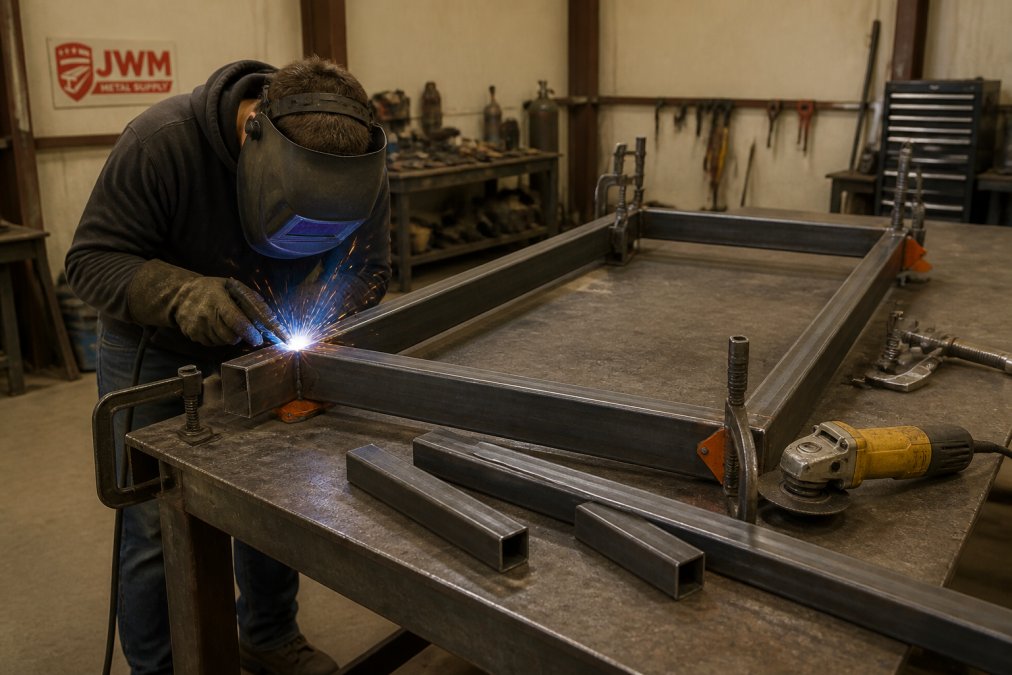
Prioritizing structural integrity during the initial fabrication phase ensures that your workbench remains stable under heavy loads, a principle that underscores why square tube frame durability remains the gold standard for long-term industrial furniture.
The 2-inch square profile is the default choice for a long list of home and shop projects, mostly because it's rigid in both directions and easy to join at 90 degrees. Flat faces clamp, drill, and bolt without a jig, and square corners self-align in a way round tube never does.
Common builds include:
- Workbenches and carts. A welded frame with a top and shelf, sized to your space.
- Gates and fencing. Square tubing gives you flat faces for hinge and latch mounting.
- Trailer repairs and light trailer frames. A frequent use, and one where wall thickness selection deserves engineering input.
- Furniture frames. Tables, benches, and shelving with a clean, industrial look.
- Equipment repair and farm projects. Implement frames, racks, and guards.
- Automotive projects. Brackets, supports, and structural repair work.
Wall thickness selection for any of these depends on span, load, and connection design. We can't tell you that 11 gauge is "enough" for a trailer frame, because that answer depends on the frame. What we can do is help you plan the material list, because the sourcing step is where most first-time builders lose a weekend.
The Real Problem With DIY Projects: Sourcing Small Quantities
Ask anyone who has built a workbench or a utility cart and they'll tell you the same story. The project needs six pieces at 36 inches and two at 60 inches. The local supplier sells 20-foot and 24-foot mill lengths, and now you're cutting a 24-foot stick down in a parking lot with a portable band saw, or paying for a delivery you didn't want.
That's the gap most project guides skip. Here's how to think about it before you order.
Option 1: Buy mill lengths locally. Best when you have a truck, a way to cut safely, and a project that will consume most of the stick.
How to Build a Cut List That Doesn't Get You a Phone Call
The single biggest cause of order problems is a vague cut list. "A bunch of 3-foot pieces" gets you a guess. A numbered list gets you the right material the first time.
Write your list like this:
- Outside dimension and wall thickness. "2x2, 11 gauge" is a complete specification. "2-inch tube" is not.
- Exact length per piece. List each length separately if they differ.
- Quantity per length. Ten pieces at 48 inches is different from one piece at 480 inches.
- Tolerance expectations. Published tolerance is ±1/8". If your project needs tighter, say so before ordering.
- Certification needs. If you need MTRs, request them at order time, not after delivery.
A Note on Planning the Build Around the Material
Experienced builders design around the cut list, not the other way around. If your design calls for a 47-1/2 inch member and the supplier cuts to the nearest inch, either adjust the design or specify the half inch. If a mating part has to slide inside the tube, order a sample length first and measure the actual inside dimension, because the nominal estimate (outside dimension minus twice the nominal wall thickness) doesn't account for corner radii, internal weld flash, or mill tolerance.
How to Choose the Right 2x2 Square Tubing for Your Project
Start with the drawing or the requirement, not the material. If you have a spec, order to it. If you don't, work backward from the loads and the span.
A practical decision path:
- Is this structural or safety-critical? Trailer frames, overhead supports, and anything people stand under or drive on. Get engineering input, then order to that spec.
- Is this a fixture or a utility build? Workbenches, carts, racks, and shop furniture. Pick a wall thickness that gives you enough material for solid welds and enough stiffness for the span.
- Does something need to fit inside or over the tube? Check inside dimensions against your mating part before ordering, and consider a sample cut.
- Will it live outdoors? Plan for galvanizing or a coating system from the start.
- Do you need documentation? Request MTRs at order time.
Frequently Asked Questions
What are the common wall thicknesses available for 2x2 square tubing?
JWM Metal Supply offers 2x2 square tubing in 16 gauge (0.065"), 14 gauge (0.083"), 11 gauge (0.120"), and 3/16" (0.188"). Each wall thickness changes the tubing's weight, stiffness, and weld behavior, so the right pick depends on your span, load, and connections rather than a single default. Thicker walls resist bending better but cost more and weigh more per foot.
How do I calculate the inside dimension of 2x2 square tubing?
You can estimate the nominal inside dimension by subtracting twice the nominal wall thickness from the 2" outside dimension. For example, 16 gauge (0.065") gives roughly 1.870" inside, and 3/16" (0.188") gives roughly 1.625". Treat these as estimates only: corner radii, actual wall thickness, and manufacturing tolerances mean the usable inside dimension is not guaranteed. Check the individual product specifications before designing a tight fit.
What is the difference between A500 Grade B and A513 carbon steel tubing?
A500 Grade B and A513 are two different tubing specifications that can both apply to 2x2 square steel tubing. Which one you receive depends on the specific product, and not every size or wall thickness is stocked in both. If your project requires a particular specification, confirm it on the product page or request the mill test reports (MTRs) before ordering, especially for anything load-bearing.
Can I order a single length of 2x2 square tubing for a small project?
Yes. JWM Metal Supply has no minimum order quantity, so a one-off garage project gets the same precision cut as a production run. Tubing is cut in-house to your exact length with a ±1/8" tolerance, inspected before shipping, and typically ships in 1 to 5 business days. Mill test reports are available on request if you need documentation for your build.
Choosing tubing gets complicated fast when you're balancing wall thickness, span, connection design, and finish, and most suppliers make it harder by selling only full mill lengths. JWM Metal Supply cuts 2x2 square tubing to the exact length you specify, in 16 gauge through 1/4", with no minimum order and free shipping. Material certifications are available on request, and orders are ready to ship in 1 to 5 business days. Get started with JWM Metal Supply and order the length you actually need.