

Table of Contents
- What Certified Steel Means for Your Construction Project
- How ASTM Steel Standards for Construction Protect Your Investment
- The Role of Mill Test Report Requirements in Quality Assurance
- Risk Mitigation: Why Non-Certified Steel Leads to Catastrophic Failure
- Legal and Liability Implications of Certified vs. Uncertified Materials
- Cost-Benefit Analysis: The True Value of Certified Steel
- Verification Checklist: How to Confirm Your Steel Is Certified
- Frequently Asked Questions
Last Updated: October 7, 2026
What Certified Steel Means for Your Construction Project
Certified steel comes with documentation that traces every batch back to the mill where it was produced, including mill test reports showing the material's actual tensile strength, yield strength, and chemical composition.
At JWM Metal Supply, we provide ASTM A36 certified steel with material certifications available for every order. This matters whether you're building a structural support, fabricating equipment, or reinforcing an existing structure. The certification removes ambiguity from your material sourcing.

How ASTM Steel Standards for Construction Protect Your Investment
ASTM International sets the standards that define what "steel" actually means in construction, specifying minimum tensile strength, yield strength, chemical composition limits, and testing procedures. When a specification calls for ASTM A36, it's not describing a brand, it's describing a material that meets a defined set of physical properties.

These standards exist because structural failure is catastrophic. A beam that yields under load doesn't just cost money to replace; it can injure or kill people.
Why ASTM A36 is the Industry Standard
ASTM A36 is the most common structural steel in construction because it balances strength, weldability, and cost.
More importantly, A36 welds reliably using standard techniques without preheating or post-weld heat treatment, and you can drill, machine, and fabricate it with equipment most shops already have.
The ASTM A36 specification defines exact chemical composition limits and testing procedures. When you buy certified A36, the mill has tested the actual material and documented that it meets those limits.
Code Compliance and Building Inspector Requirements
Building codes reference ASTM standards directly. The International Building Code (IBC) requires structural steel to meet ASTM standards. Your local building inspector will ask for mill test reports and certification documentation. Without them, the inspector can reject your work, even if the steel is physically identical to certified material.
Code compliance isn't optional theater, it's the legal framework that defines safe construction. If you can't produce documentation, the inspector can't sign off.
The Role of Mill Test Report Requirements in Quality Assurance
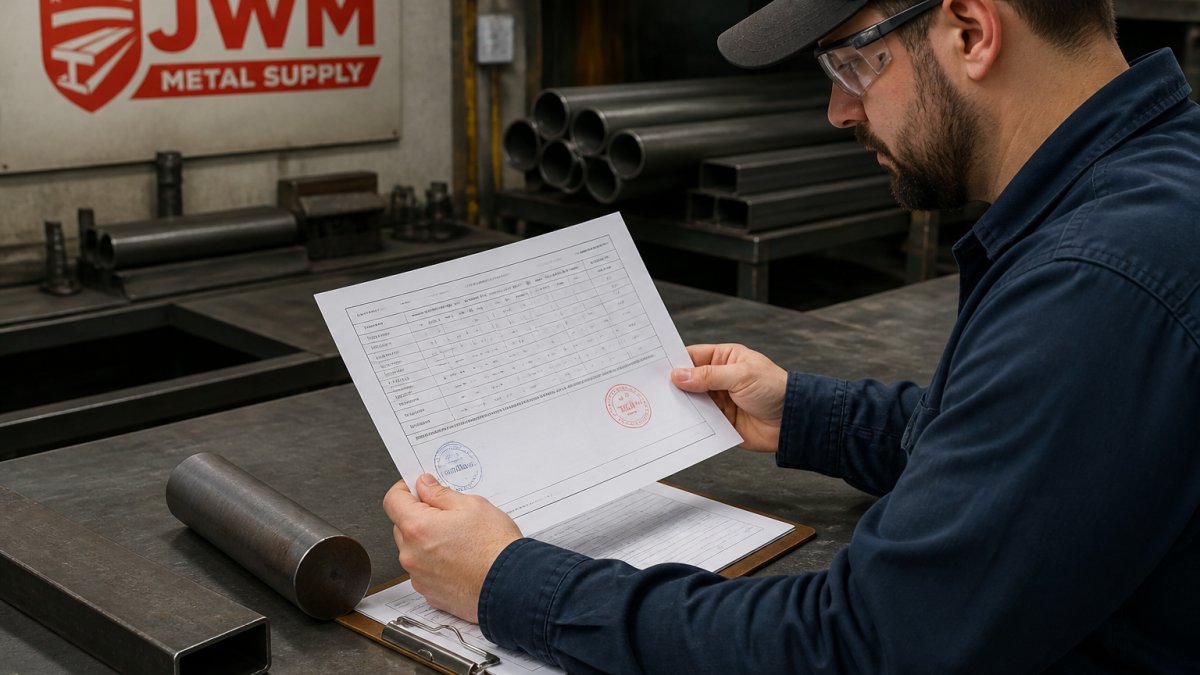
A mill test report is a document from the steel mill that proves the material meets specification, including the heat number (which identifies the specific batch), chemical composition analysis, tensile test results, and sometimes additional testing like impact testing or hardness measurements.
The report shows what the material actually is, not what someone claims it is. That distinction matters enormously.
What a Mill Test Report Proves
A mill test report proves three things: identity, properties, and traceability. It identifies which specific batch of steel you received, documents the measured tensile strength, yield strength, and chemical composition, and traces that batch back to the mill where it was produced and tested.
When you have a mill test report, you have evidence. If someone questions whether your steel meets specification, or if there's ever a failure investigation, the report provides a clear record of what the material was certified to be.
Traceability: From Mill to Your Project Site
Traceability means you can follow the material from the mill through your fabrication and onto the job site. Every certified piece carries a heat number that matches the mill test report, transforming "this looks like steel" into "this steel meets ASTM A36 and here's the proof."
Traceability prevents mix-ups and substitutions, creates accountability at every step, and dramatically reduces the risk of catastrophic failure because you know exactly what you have.
Risk Mitigation: Why Non-Certified Steel Leads to Catastrophic Failure
Structural failure isn't a minor problem. A beam that fails under load can collapse a building, trap people, or kill, that's why standards exist.
Using certified steel with mill test reports eliminates that category of risk: you know the material meets specification, will behave as designed, and comes with documentation if anything goes wrong.
The cost difference between certified and uncertified steel is minimal. The risk difference is enormous.
Legal and Liability Implications of Certified vs. Uncertified Materials
Most articles on certified steel stop at "it keeps you safe." The sharper question for anyone signing a specification or managing a project is: what does certification actually do to your legal position when something goes wrong? The answer is that it converts an unprovable claim into a documented one.
The Standard of Care Problem
Construction liability is built on the standard of care, what a reasonably prudent professional in the same role would have done under the same circumstances.
If the answer is "we bought steel and assumed it was fine," you have no defense.
Certified steel with a mill test report flips that. You can show the specification you issued, the heat number you received, the chemistry and mechanical properties the mill measured, and the chain that connects them.
How Code Compliance Becomes a Legal Shield
The International Building Code (IBC) requires structural steel to conform to recognized ASTM standards and requires documentation of that conformance. Chapter 17 establishes special inspection and structural observation requirements for many structural steel projects, and those inspections depend on submittals, mill test reports, certifications, and traceability records, being available before and during construction.

Following the code is not a guarantee of immunity. It is, however, the clearest evidence that you met the standard of care.
1/4" Thick × 5" Wide A36 Steel Flat Plate – Select Length (5"–30") →
Where Liability Actually Shifts
Liability in a steel failure typically spreads across the mill, distributor, fabricator, erector, inspector, and engineer of record. Certification makes that allocation possible. Without heat-number traceability, the parties cannot even agree on which batch of steel is in question, and the dispute defaults to whoever has the weakest documentation.
That is the practical reason certified steel matters to owners and general contractors: it protects the paper trail that determines who pays when the structure is questioned.
What to Keep in the Project Record
For liability purposes, the useful file is short and specific:
- The specification section that named the ASTM grade and any supplementary requirements.
- The mill test report for every heat number delivered to the site.
- The receiving records that tie delivered material to those heat numbers.
- The special inspection reports and any nonconformance documentation.
- Any substitution requests and the engineer's written response.
That file is what a lawyer, an insurer, or a building official will ask for. It is also the file that certified suppliers make easy to assemble and uncertified suppliers make impossible.
Cost-Benefit Analysis: The True Value of Certified Steel
Most treatments of this topic wave at "certification costs a little more and saves a lot." That is true but useless for anyone building a budget. The real business case for certified steel sits in four cost categories that are easy to overlook and expensive to absorb.
1. The Material Line Item Is the Smallest Number
The direct premium for certified material is typically modest, often a small percentage of the piece price, and frequently absorbed entirely when the supplier already stocks certified inventory.
What matters is what the premium buys: a documented material that passes submittal review the first time. Uncertified material that fails review doesn't save money, it converts a material cost into a schedule cost, and schedule costs are an order of magnitude larger.
2. Schedule Risk Is the Dominant Cost
A rejected submittal or failed special inspection doesn't just delay the steel, it delays everything sequenced behind it: erection crews, decking, concrete, MEP rough-in, and the owner's occupancy date.
Certified steel with mill test reports available at order time removes the most common cause of submittal rejection. That is the single largest line in the business case, and it is the one competitors almost never quantify.
3. Insurance and Bonding Treatment
Insurers and sureties underwrite documented risk. A project with a clean traceability record, heat numbers matched to mill test reports, special inspections completed, no substitution disputes, presents a materially different risk profile than one with gaps.
Bonding capacity works the same way. A contractor who can produce documentation on demand is a better underwriting risk than one who cannot.
4. Rework, Replacement, and Dispute Costs
When uncertified material is discovered after installation, the cost isn't the steel, it's demolition, re-fabrication, re-inspection, and re-scheduling. Those costs land on whoever specified or supplied the material, and often spark a dispute costing more in legal fees than the original material ever did.
Certified steel does not eliminate the possibility of a problem. It eliminates the category of problem where nobody can prove what the material was.
A Simple Way to Frame the Decision
Where the Premium Disappears Entirely
On many projects the premium is zero in practice, because the supplier already stocks certified material as standard inventory. When certified ASTM A36 is the default product rather than a special order, the buyer pays the same price and receives the documentation as part of the transaction, as at JWM Metal Supply, where mill test reports are included with every order, not sold as an upgrade.
Verification Checklist: How to Confirm Your Steel Is Certified
When you order steel, verify certification before the material arrives. Here's what to check:
- Request mill test reports in advance. Ask your supplier for copies before shipment, don't wait until delivery.
- Verify the heat number matches. The heat number on the material should match the one on the mill test report. If they don't match, you have the wrong material.
- Check the specification. The report should state ASTM A36 (or whatever spec you ordered). If it says something else, it's not what you ordered.
- Confirm tensile and yield strength. The report should show minimum yield of 36,000 PSI and tensile between 58,000-80,000 PSI for A36.
- Inspect the material visually. Certified steel should be clean, free of obvious defects, and consistent in appearance. Significant rust, pitting, or damage indicates handling problems.
- Keep documentation on site. Have the mill test report where work is happening, available for the building inspector, not in an office file.
When you order from JWM Metal Supply, material certifications are available for every order. We cut material to your exact specifications and provide the documentation you need to pass inspection and protect your project.
Using certified steel for construction is the baseline for professional work.
Get started with JWM Metal Supply and order certified ASTM A36 steel cut to your exact project specifications.
Frequently Asked Questions
What does it mean for steel to be certified?
Certified steel has been tested and verified to meet specific ASTM standards and comes with documentation (material certifications) proving its material properties. This certification confirms the steel's chemical composition, tensile strength, and load-bearing capacity. Certified steel is traceable from the mill to your project, ensuring you know exactly what you're using and that it meets code requirements. Non-certified steel lacks this verification, creating risk for structural failure and liability issues.
Why are mill test report requirements important for construction projects?
Material certifications document the actual properties of the steel you receive, including yield strength, tensile strength, and chemical composition. These certifications prove your material meets ASTM standards and building codes. For load-bearing applications, inspectors often require material certifications as evidence of compliance. Without them, you have no proof the steel is safe for structural use, and you assume all liability if failure occurs.
What happens if I use non-certified steel in a construction project?
Non-certified steel may not meet required strength specifications, creating risk of catastrophic failure under load. You lose traceability of the material's origin and properties. Building inspectors may reject the work, requiring costly removal and replacement. If the structure fails, you face personal liability, legal action, and potential injury claims. Insurance may not cover damage from non-compliant materials.
How do I verify that my steel is certified before ordering?
Ask your supplier for ASTM certification and material certifications before purchase. Confirm the steel grade (A36 is common for construction) matches your project requirements. Verify the supplier is transparent about material traceability and can provide documentation. Check that the supplier's certifications are current and legitimate. JWM Metal Supply provides material certifications for all orders, ensuring you have proof of compliance before your project begins.