

Table of Contents
- Steel Angle Iron vs Square Tubing for Frames: The Short Answer
- Angle Iron vs Square Tubing Strength: Section Properties and How They Behave
- Steel Angle Load Capacity: What 1" x 1" Angle Actually Carries
- Square Tubing Dimensions and Wall Thickness: Reading the Specs
- How to Weld Square Tubing Frames (and Angle Iron Joints)
- Choosing by Application: Trailers, Racks, Farm Equipment, and Shop Builds
- Conclusion: Match the Shape to the Load Path
- Frequently Asked Questions
Last Updated: October 16, 2026
Steel Angle Iron vs Square Tubing for Frames: The Short Answer
When comparing steel angle iron versus square tubing for frames, neither shape wins outright.

This guide from JWM Metal Supply walks through section properties, load capacity, wall thickness, and joint behavior so you can match the material to the job.
Angle iron is a hot-rolled carbon steel L-shape sold by leg size and thickness. Square tubing is a hollow structural section sold by outside dimension and wall gauge.
The core difference is geometry.
Angle Iron vs Square Tubing Strength: Section Properties and How They Behave
Strength comparisons only mean something when members are matched for size and thickness. A 1" x 1" x 3/16" angle and a 2" x 2" x 14 gauge tube are not a fair fight.

Section properties describe how a shape distributes material around its axes. Two numbers matter most: moment of inertia (bending stiffness) and section modulus (bending stress).
Bending Stiffness and Deflection Under Load
Deflection is where square tubing pulls ahead. A closed tube places material on both sides of the neutral axis, so its moment of inertia climbs quickly as outside dimension grows. An angle concentrates material on one side, leaving the other leg doing far less work.
For a given weight of steel, a square tube usually deflects less than an angle of similar mass, a difference that shows up fast on any real span without mid-support.
Torsion, Buckling, and Failure Modes
Torsion is the angle iron's weak point. An open L-section twists easily because nothing closes the shape against rotational movement. A square tube resists torsion through its closed cell, which is why trailer frames and equipment racks lean on tubing.
Buckling differs too. Long, slender angle legs can buckle locally under compression, especially with off-center loads. Square tubing buckles in its walls, but the enclosed shape delays that failure.
Steel Angle Load Capacity: What 1" x 1" Angle Actually Carries
Steel angle load capacity depends on span, support conditions, and load position, so no single number covers every case. A worked example makes the comparison concrete.
Section Properties: The Numbers Behind the Behavior
For a 1" x 1" x 3/16" angle, the moment of inertia about its strong axis is roughly 0.044 in^4 and the section modulus is roughly 0.088 in^3, the numbers that govern deflection and bending stress.
A 1" x 1" x 14 gauge square tube (0.083" wall) has a moment of inertia of roughly 0.021 in^4, lower than the angle's strong axis.

A 2" x 2" x 14 gauge square tube has a moment of inertia of roughly 0.348 in^4, nearly eight times the 1" angle's strong axis and over thirty times its weak axis.
Worked Example: 1" Angle vs 2" Tube at 4 Feet
Assume a simply supported beam with a 4-foot span, a 200-pound midspan load, and A36 steel (yield 36,000 psi, modulus of elasticity 29,000,000 psi).
For the 1" x 1" x 3/16" angle loaded along its strong axis:
- Maximum bending moment: (200 lb x 48 in) / 4 = 2,400 lb-in
- Bending stress: 2,400 / 0.088 = 27,273 psi, about 76% of yield
- Maximum deflection: (200 x 48^3) / (48 x 29,000,000 x 0.044) = 0.173 inches
For the 2" x 2" x 14 gauge tube:
- Bending stress: 2,400 / 0.348 = 6,897 psi, about 19% of yield
- Maximum deflection: (200 x 48^3) / (48 x 29,000,000 x 0.348) = 0.022 inches
The angle survives but uses most of its capacity and deflects nearly eight times as much. The tube has reserve capacity and stays stiff, the practical difference between an open and closed section at the same span.
What Changes the Answer
Three variables decide whether 1" angle is enough:
- Span: Deflection scales with the cube of span. Double the span and deflection increases eight times under the same load. A 1" angle that works at 2 feet may fail serviceability at 4 feet.
- Bracing: A leg tied to a solid surface stops the twist that kills angle frames. Without bracing, the weak axis governs and capacity drops sharply.
- Load direction: Loads pushing into the heel behave far better than loads hanging off a leg tip. An eccentric load on a leg tip adds torsion the section isn't shaped to resist.
For heavier racks, trailer beds, and equipment frames, step up to 1" x 1" x 1/4" angle iron or move to tubing. Our 1" x 1" x 3/16" angle iron and 1" x 1" x 1/4" angle iron ship cut to your exact length.
Angle Iron - 1" x 1" x 3/16"(0.188") - Select Length →
Square Tubing Dimensions and Wall Thickness: Reading the Specs
Square tubing dimensions are written as outside size plus wall thickness, and both change how the member performs. A 2" x 2" tube is the same outside size whether the wall is 14 gauge or 3/16", but the load capacity is not.
Wall thickness does the heavy lifting. Steel tubing carries load in its walls, so a thicker wall raises bending strength and local buckling resistance. Outside dimension controls stiffness; wall thickness controls how much stress the tube survives before yielding.
| Spec | 2" x 2" 14ga (0.083") | 2" x 2" 11ga (0.120") | 2" x 2" 3/16" (0.188") |
|---|---|---|---|
| Wall thickness | 0.083" | 0.120" | 0.188" |
| Best for | Light gates, furniture | General frames, racks | Trailers, heavy equipment |
| Weldability | Good | Good | Good |
| Weight | Lightest | Moderate | Heaviest |
A common mistake is buying by outside size alone. Our 2" x 2" 14 gauge square tube suits light frames, while the 2" x 2" 3/16" square tube is built for trailer and equipment work.
How to Weld Square Tubing Frames (and Angle Iron Joints)
Welding square tubing frames starts with fit-up, not heat. Clean, square cuts and tight gaps produce stronger joints than any rod choice.
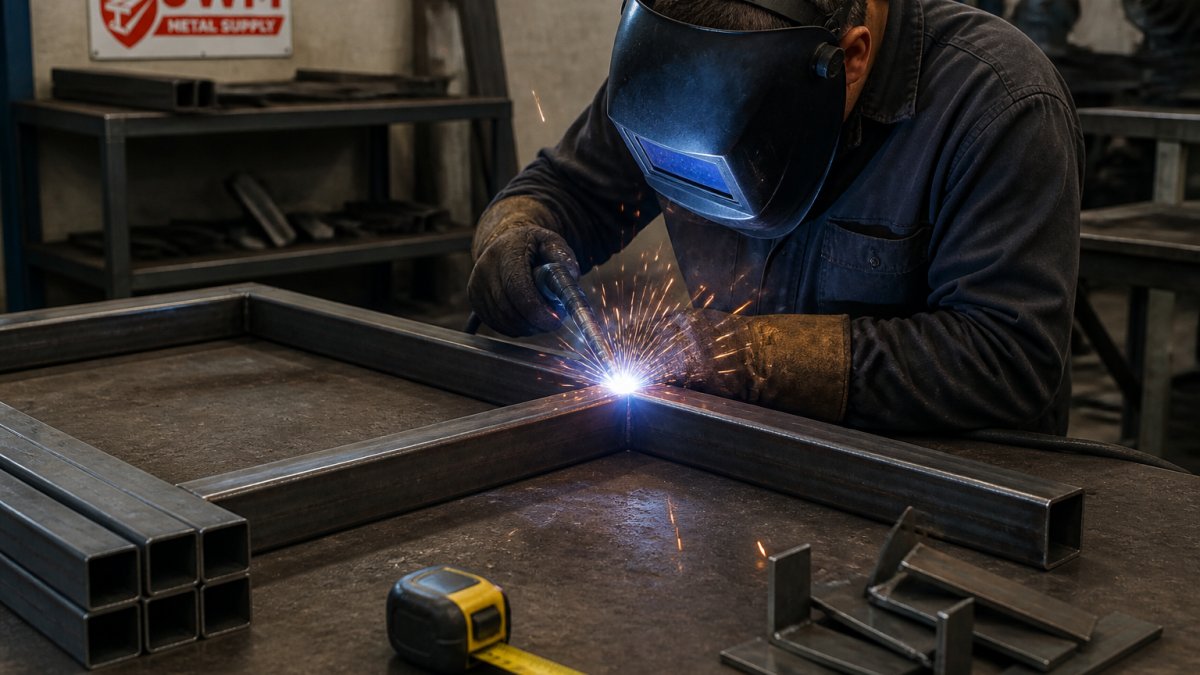
But the joint is where the frame works or fails. A frame is a load path, and the connections decide how that path behaves.
Corner Joints: Where Frames Fail First
A square tube butt joint at a corner concentrates stress at the weld toe. On thin walls, the heat-affected zone can be the weakest part of the member. Beveling thicker walls (3/16" and up) before welding gets full penetration and moves the failure point away from the weld.
Angle iron corners behave differently. Because the legs meet at 90 degrees, you can weld along both legs, distributing force across two planes instead of one, which is why angle frames often tolerate sloppier welds. But weld only one leg and you've created an eccentric load path, adding twisting you didn't design for.
Bracing and Racking: The Load Case Nobody Plans For
A rectangular frame with four welded corners and no diagonal bracing will rack, it will parallelogram under a sideways push. Square tubing resists this better than angle thanks to its torsional stiffness, but neither shape eliminates racking on its own.
Add a diagonal brace or gusset at each corner if the frame sees lateral load. Trailer crossmembers and the deck often provide that bracing; a freestanding rack needs it added deliberately.
Welding Sequence for Either Shape
- Cut members square and deburr every edge.
- Clamp the frame flat on a level table before tacking.
- Tack all corners, then check diagonals for square.
- Weld in short passes, alternating corners, to limit heat distortion.
- Let joints cool, then re-check the frame before final welding.
Corrosion Protection Inside Closed Tubing
Square tubing has a hidden cost: the inside is sealed off from paint, galvanizing, and inspection, so moisture entering through an unsealed weld or open end can rust it from the inside out. Drill a weep hole at the low point of each closed section and seal the ends after welding. Angle iron has no interior surface to protect, which is one reason it holds up well in damp shops.
Attaching Panels, Brackets, and Hardware
Angle iron's flat legs make it easy to bolt on panels, brackets, and hardware, drill through one leg and use the other as a mounting surface. Square tubing requires through-bolts or welded tabs, and through-bolting can crush the wall if you overtighten. Use a sleeve or welded tab when the connection carries load.
Choosing by Application: Trailers, Racks, Farm Equipment, and Shop Builds
Match the shape to the load path and the choice usually makes itself. Frames carrying twisting loads, rolling equipment, or road vibration belong in square tubing; mostly static, bolted, or budget builds belong in angle.
| Application | Recommended Shape | Why |
|---|---|---|
| Trailer frames | Square tubing | Resists torsion and road vibration |
| Storage racks | Angle iron | Cheap, easy to drill and bolt |
| Farm equipment repair | Square tubing | Handles impact and multi-directional load |
| Shop tables and carts | Either | Angle for economy, tubing for stiffness |
| Gates and fencing | Square tubing | Clean look, stiff under wind load |
| Brackets and bracing | Angle iron | Simple to cut, weld, and fasten |
For trailers and anything that moves, we recommend tubing every time. The closed section shrugs off the twisting that opens up angle frames.
Farm equipment is the middle ground: implements see impact loads from odd angles, and a closed tube spreads that force around its whole section instead of concentrating it in one leg.
Conclusion: Match the Shape to the Load Path
The shapes aren't the problem, picking one by habit instead of by load path is. Tubing wins wherever torsion, vibration, or multi-directional bending shows up; angle iron wins on cost, drilling, and simple static frames.
Get started with JWM Metal Supply and order steel cut to your frame's real dimensions, backed by material certifications for the load-bearing work that matters.
Frequently Asked Questions
Is square tubing stronger than angle iron for a frame?
For a closed frame loaded in more than one direction, square tubing usually wins. Its closed cross-section resists bending and twisting in both axes, while steel angle iron only develops full stiffness along one leg and twists easily when loaded off-axis. That said, a larger, thicker angle can outperform a thin tube. Compare actual section properties at the same steel thickness and steel grade before deciding.
How much weight can steel angle support?
There is no single number. Steel angle load capacity depends on leg size, steel thickness, span, how the load is applied, and whether the member is braced. A short, well-supported 1" x 1" x 3/16" angle handles far more than the same piece spanning several feet unsupported. For anything load-bearing, work from the span and deflection limit, not a generic rating.
Is steel square tubing measured by inside or outside dimensions?
Square tubing dimensions are quoted by the outside dimension, so a 2" x 2" tube measures 2" across the outside regardless of wall thickness. The inside dimension changes with gauge: 2" x 2" 14ga (0.083") leaves roughly 1.870" inside, 11ga (0.120") leaves about 1.750", and 3/16" (0.188") leaves about 1.625". Order by outside size plus wall thickness.
When should you use angle iron instead of square tubing?
Angle iron suits brackets, corner bracing, edge supports, and frames where you need a flat face to bolt or weld to. It is easy to cut, drill, and weld with standard shop tools, and the open L-shape lets you clamp joints quickly. Square tubing is the better pick when you want maximum rigidity per pound and a clean, closed look on trailers, gates, and equipment frames.