

Last Updated: October 14, 2026
What Industrial Metal Supply Buyers Need to Know in 2026
Industrial metal supply is the business of stocking, cutting, and delivering raw metal products, including carbon steel, to fabricators, contractors, and hobbyists in the forms and lengths their projects require.
The gap between a good and bad industrial metal supply experience rarely comes down to price per pound. It comes down to whether the material matches the job.
Below, we break down what to have ready before you order, how to read a quote, and which questions separate a real distributor from a drop-shipper with a website.
How to Order Steel Online Without Getting Burned
Ordering steel online works well when you supply four things up front: material type, grade, dimensions, and quantity. Suppliers who cut to order, like JWM Metal Supply, can only guarantee a fit when those four inputs are correct on the order form.
Information to Have Ready Before You Order
- Material type: carbon steel
- Grade or specification: for example, A36 or A500 Grade B
- Exact dimensions: thickness, width, and length in inches
Write the application down even if the supplier does not ask. A bracket that holds a mailbox and one that holds a 400-pound gate need different steel, and the person reading your order cannot guess which you meant.
Red Flags in an Online Steel Quote
Watch for quotes that list a length but no tolerance, a grade but no mill certification option, or a price with no shipping terms. Those three omissions cause most order disputes. A quote that says "approximately 24 inches" is not a specification; it is a hope.
Steel Material Specifications: Grades, Standards, and Certifications
Steel material specifications define the chemistry, strength, and dimensional tolerances a piece of steel must meet, and they are written by standards bodies like ASTM International.
Two grades cover most carbon steel orders:
- A36: a general-purpose structural carbon steel, easy to weld, machine, and form. It is the default for brackets, plates, repairs, and general fabrication.
- A500 Grade B: a structural tubing specification with controlled yield strength, used for frames, columns, and load-bearing tube assemblies.
Material certifications are mill test reports that trace a batch of steel back to its heat number and chemical composition. If your project is load-bearing, inspected, or customer-facing, ask for them. JWM Metal Supply makes material certifications available so you can hand the paperwork to an inspector or engineer.
A36 vs. A500 Grade B: Which Grade for Which Job
Grade |
Typical Form |
Best For |
Weldability |
|---|---|---|---|
A36 |
Plate, flat bar, angle |
Brackets, repairs, mounting plates |
Excellent |
A500 Grade B |
Square and rectangle tubing |
Frames, trailers, structural supports |
Excellent |
If you are building a trailer frame or anything that carries weight in tube form, order A500 Grade B tubing. If you are patching a mower deck or making a mounting plate, A36 is the practical choice. Buying A500 for a non-structural job wastes money; buying A36 for a structural tube application is a design error.
Cut-to-Size Steel: What You Can Order and How Tolerance Works
Cut-to-size steel means the supplier cuts your material to the length you specify rather than shipping a standard 20-foot mill length.
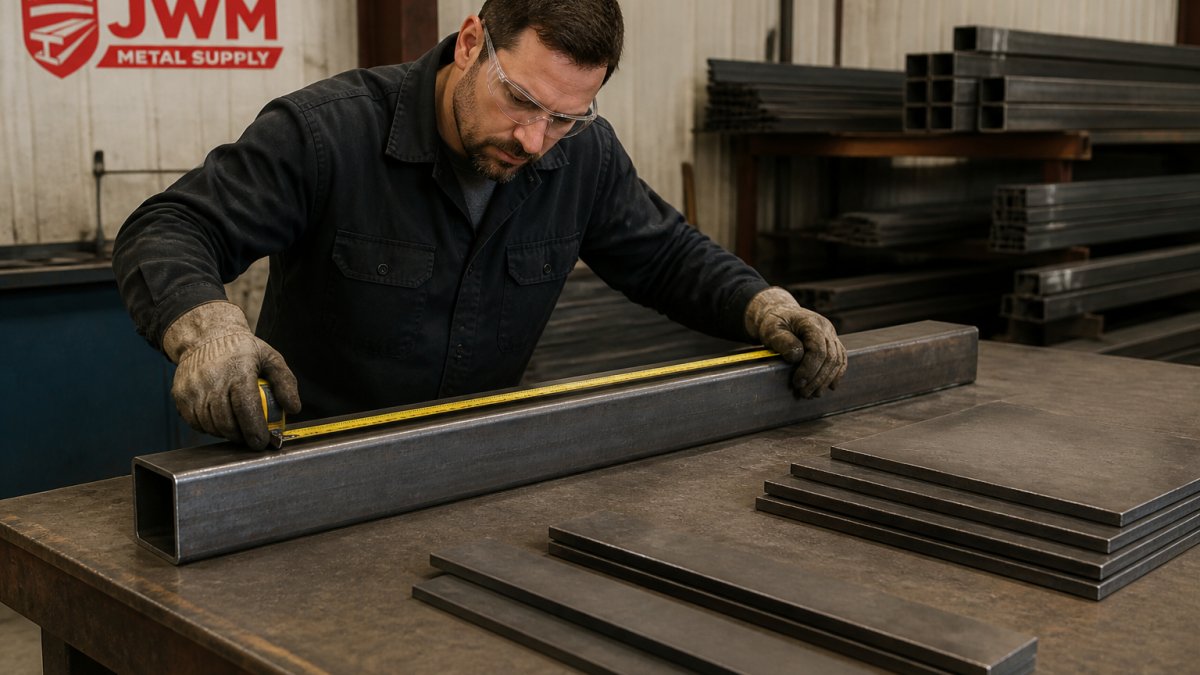
Tolerance is the acceptable range around your requested dimension. A saw cut on tubing typically holds about ±1/8", while plasma cutting on plate can hold ±1/16" on a straight cut. That difference matters when parts stack or bolt together.
What you can order cut to size:
- Square and rectangle steel tubing in selectable lengths
- Steel plate cut to a rectangle or custom size
- Flat bar cut to a specified length
What Industrial Metal Supply Actually Costs: A Pricing Breakdown
Industrial metal supply pricing is driven by four factors: material type, form, cut complexity, and quantity. Weight is the base unit, so thicker and wider stock costs more per piece even when the length is identical. Understanding how those factors interact separates a quote you can budget against from a number you have to guess at.

Here is how the pieces we stock price out:
15" x 27" Steel Rectangle Plate -- 1/4" Thick-A36 Hot Rolled →
Product |
Specification |
Price |
|---|---|---|
1/4" thick, A36 hot rolled |
$100.79 |
|
1/4" x 5" A36 steel flat plate |
Select length 5"-30" |
From $37.27 |
3" x 4" rectangle steel tubing |
11ga (0.125") wall, A500 Grade B |
From $27.94 |
1-1/2" x 1-1/2" square steel tubing |
14ga (0.083") wall |
From $26.19 |
How a Quote Is Actually Built
A distributor prices a line item by starting with the mill weight of the piece, applying the current market price per hundredweight for that grade and form, then layering processing and freight on top. That is why two pieces with the same footprint can quote differently: a 1/4" plate and a 14ga tube of the same length do not weigh the same.

- Mill form. Plate, flat bar, angle, and tubing each carry a different base price per pound because they come off different mill lines. Tubing is formed and welded, so its base price reflects an extra manufacturing step.
- Grade. A36 and A500 Grade B are both carbon steel, but A500 has a controlled yield strength that requires tighter chemistry control at the mill, which shows up in the per-pound price.
- Cut setups. A single straight saw cut is one setup. A piece that needs a miter, a notch, or two perpendicular cuts is three or more setups, and each setup adds labor time to the line.
Three Cost Factors Buyers Miss
- Cut charges scale with setups, not inches. A 6-inch cut and a 36-inch cut on the same saw take nearly the same time; a second cut doubles the labor. Ask how many setups your order needs, not how many inches of cut.
- Certification requests add handling time. Mill certs must be pulled and matched to your heat number, a manual step. Worth the wait on structural work, unnecessary on a decorative bracket.
- Shipping weight has a ceiling. Free or flat-rate shipping usually has a weight cap, so splitting a large order across two shipments can cost more than one consolidated freight load.
Ask for a quote that breaks out material, processing, and freight as separate lines. A single all-in number hides which factor is driving the cost, and you cannot negotiate a line you cannot see.
The honest answer on total cost: a slightly higher piece price from a supplier who cuts accurately and ships on time is cheaper than a low price that arrives 3/16" off and forces a reorder, which costs you the piece twice plus the labor spent fitting the wrong part.
Choosing the Right Shape: Plate, Tubing, Angle Iron, and Flat Bar
Shape selection follows the load. Plate spreads force across a surface, tubing resists bending in every direction, angle iron carries load along an edge, and flat bar handles linear reinforcement and brackets.
- Plate: mounting surfaces, base plates, gussets, repair patches
- Tubing: frames, trailers, racks, structural supports
- Angle iron: corner bracing, shelf supports, edge reinforcement
- Flat bar: brackets, hinges, trim, linear reinforcement
A common mistake is choosing tubing for a job that needs plate. Tube walls are thin relative to their outside dimension, so a bolt hole through a tube wall can crush it.
How to Evaluate a Metal Distributor Before You Commit
Evaluate a metal distributor on four things: cut accuracy, stock consistency, shipping reliability, and whether they take your small order seriously. Every distributor claims all four, so build the evaluation around what you can verify rather than what you are told.
A Verification Checklist, Not a Sales Pitch
- Cut tolerance, in writing. Ask what tolerance they hold and whether it appears on the quote. A supplier who states ±1/8" on a saw cut and ±1/16" on a straight plasma cut has a real process; one who says "we cut accurate" has a slogan.
- Material certifications and how fast they arrive. Mill test reports trace a batch back to its heat number and chemical composition. Ask whether certs are available, whether they cost extra, and how many business days they take.
- Minimum order quantity. A stated minimum tells you who the distributor is built to serve. No minimum means small orders are part of the model, not an exception someone has to approve.
- Actual ship time, not best-case. Ask for typical ship time on a standard order and on a cut-to-size order. Those often differ, and the cut-to-size number is the one that affects your schedule.
- Material origin and supply chain. Domestic steel comes with a traceable supply chain and paperwork that holds up in an inspection. Ask where the stock originates and whether that origin is documented on the cert.
- Stock consistency across orders. The real test is whether the second order matches the first. Ask whether they stock the same grades and forms continuously or buy spot; a spot buyer may not have your grade next month.
- How they handle a bad cut. Every shop eventually ships a piece at the edge of tolerance. Ask what happens then: reorder at their cost, credit, or nothing. The answer tells you more than any capability claim.
What the Answers Reveal
A distributor who can answer all seven without checking with someone else runs a real operation. One who deflects on tolerance, certs, or origin is either a reseller or a shop that has not thought about it, and either way you carry the risk.
The three questions that separate a real distributor from a reseller: stated cut tolerance, available mill certifications, and a documented domestic material source. If a supplier cannot answer all three, keep looking.
JWM Metal Supply cuts American-made carbon steel in our Kansas facility, ships in 1-5 business days, and sets no minimum order, so a single bracket and a fifty-piece production run get the same treatment.
Conclusion: Match the Supplier to the Project
The hardest part of buying steel is not finding a supplier; it is finding one whose tolerances, stock, and lead times match what your project needs. A hobbyist building one gate and a shop running weekly production have different definitions of "good enough."
JWM Metal Supply serves both. We cut American-made carbon steel to your exact length, offer material certifications for load-bearing work, hold no minimum order quantity, and ship in 1-5 business days.
Frequently Asked Questions
What should I look for in an industrial metal supplier?
Check four things: whether they publish real material grades (A36, A500 Grade B) rather than vague descriptions, whether they offer cut-to-size steel with a stated tolerance, whether material certifications are available on request, and whether shipping terms are clear. A supplier that lists exact wall thicknesses, cut tolerances, and country of origin gives you enough information to verify the order matches your project. Vague listings usually mean vague material.
Can I order custom-cut steel without a minimum order?
Yes, some suppliers cut to length with no minimum order quantity. That matters for hobbyists and one-off repairs where buying a full mill length wastes money. When ordering, specify the exact length, the shape, and the wall thickness or plate thickness you need. Expect a cutting tolerance, often around plus or minus 1/8 inch on saw-cut tubing, so plan your weld gaps accordingly.
What information should I provide when ordering cut-to-size steel?
Give the shape and profile, the outside dimensions, the wall thickness or plate thickness, the material grade, and the exact length. For example: 3 x 4 inch rectangle tubing, 11 gauge wall, A500 Grade B, cut to 48 inches. Add the application if it is load-bearing so the supplier can flag a grade mismatch. Include your zip code early so shipping and delivery timing are accurate on the first quote.
What should I check when steel arrives?
Measure the cut lengths against your order before you start cutting or welding, since custom-cut material is often non-returnable. Check the wall thickness or plate thickness with calipers, confirm the grade on the mill certificate if you requested one, and inspect for damage in transit. Light surface rust, mill scale, or oil on hot rolled steel is normal and does not affect structural integrity. Report any size or damage issue immediately.