

Last Updated: October 5, 2026
Prepare Your Carbon Steel Tubing for Welding
To weld carbon steel tubing effectively, preparation starts before you strike an arc. The foundation of a strong weld lies in proper preparation. Clean material and correct fit-up prevent defects that are expensive to fix later.
It's the difference between a weld that holds and one that fails under stress.
Clean the Base Metal
Your base metal must be clean. Rust, mill scale, paint, and oil all interfere with the welding process. They create weak bonds and porosity in the weld pool.
Use a wire brush or grinding wheel to remove surface contaminants. Work the entire joint area, not just where the arc will land. Pay special attention to the inside of the tube if you're welding both sides.
For carbon steel, this step takes minutes but saves hours of rework. A clean surface lets the filler metal flow properly and bond with the base metal.
Check Fit-Up and Joint Alignment
Gaps between pieces affect weld quality. A gap larger than 1/16 inch forces you to adjust your machine settings. Too much gap and the weld can't bridge properly.
Check alignment before clamping. Misaligned pieces create stress points in the finished weld. Use a straightedge or level to confirm the tubes are flush.
Clamp your work securely. Movement during welding breaks the arc and creates defects. For tubing, use clamps that distribute pressure evenly to avoid denting the material.
Choose Your Welding Process for Carbon Steel Tubing
Three main processes work for carbon steel tubing: MIG, TIG, and stick welding. Each has strengths depending on wall thickness, joint position, and your skill level.
The right process depends on your specific application. Thin-wall tubing needs a different approach than heavy-wall material.
MIG Welding Carbon Steel Tubing
MIG welding is fast and forgiving. It works well for carbon steel tubing from 1/16 inch to 1/4 inch wall thickness.
MIG produces a clean weld with minimal spatter when settings are correct. It's ideal for flat and horizontal positions. Overhead work is harder because gravity pulls the molten pool downward.
For tubing work, use a MIG Welding Gun 15 ft Cable for Millermatic 200-252 that matches your machine. The right torch size and cable length make the job easier and more precise.

Start with 0.035 inch wire for most carbon steel tubing work. Adjust amperage based on wall thickness and joint design.
TIG Welding Carbon Steel Tubing
TIG welding gives you the most control. You hold the torch in one hand and feed filler metal with the other.
TIG is slower than MIG but produces superior weld quality. The shielding gas protects the weld pool completely when you use the right coverage. For carbon steel, argon gas works well.
TIG is the best choice for critical applications where weld strength and appearance matter equally. Structural work, pressure vessels, and load-bearing frames benefit from TIG's precision.
The learning curve is steeper than MIG. Your non-dominant hand must feed filler metal smoothly while your dominant hand maintains torch angle and arc length. Practice on scrap material first.
Stick Welding for Thicker Wall Tubing
Stick welding works for heavier wall thickness, typically 3/16 inch and above. It's versatile and works in windy conditions better than MIG or TIG.
Stick uses a consumable electrode coated with flux. The flux creates a shielding gas and slag that protects the weld pool. No separate gas bottle is required, which appeals to field work and outdoor fabrication.
The electrode must be replaced frequently, which interrupts your work rhythm. Slag removal takes extra time. For production work, MIG or TIG is usually faster.
Stick welding demands good technique. Maintain consistent arc length and travel speed. Too fast and the weld is weak. Too slow and you add too much heat.
How to Weld Square Tubing with Proper Technique
Square tubing presents unique challenges because corners concentrate heat. The weld pool behaves differently at a corner than on a flat surface.
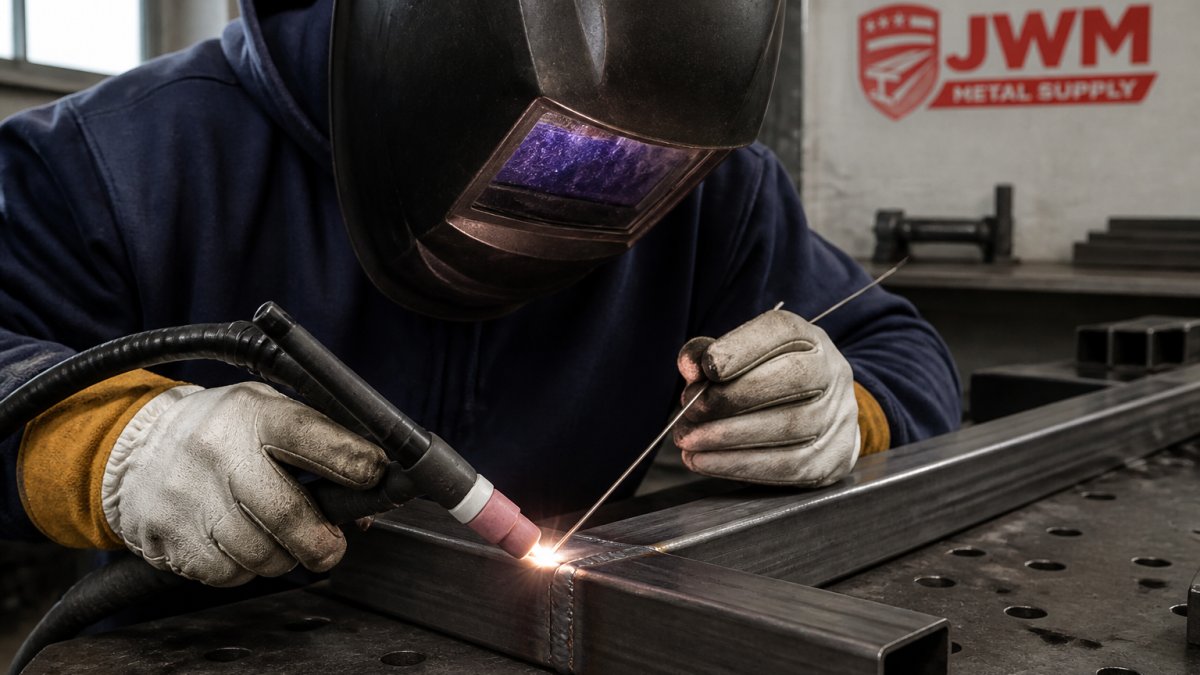
Proper torch movement and positioning prevent burn-through and ensure penetration at the corner.
90-Degree Joint Positioning
Position your square tubing so the joint is flat or slightly downhill. Flat position is easiest and produces the best weld. Gravity helps the filler metal flow into the joint.
For a corner joint, the torch approaches from a 45-degree angle. This allows you to see the weld pool and control heat input to both pieces equally.
Start the arc at the inside corner. Let the weld pool form before moving. A small, controlled pool prevents spatter and gives you better visibility.
Keep the torch tip about 1/8 inch from the base metal. This distance maintains proper shielding gas coverage and arc stability.
Torch Movement and Cup Walking
Cup walking is a technique where the ceramic cup of the TIG torch rolls along the corner. This method maintains consistent arc length and heat input.
Position the cup against the inside corner. Apply slight downward pressure. As you move forward, the cup rolls along the edge. The arc stays centered on the joint.
For MIG welding, use a slight weave pattern. Move the torch from one side of the joint to the other in a small "C" shape.
Travel speed matters. Move too fast and you miss the corner. Too slow and the base metal overheats, causing warping or burn-through in thin sections.
Welding Thin-Wall Steel Tubing: Preventing Burn-Through
Thin-wall tubing, typically 1/16 inch to 3/32 inch, requires lower heat input. The base metal melts quickly. Excessive heat creates holes instead of welds.
Preventing burn-through is your main challenge. Proper machine settings and technique control the weld pool size.
Machine Settings for Thin Wall Thickness
For MIG welding thin-wall carbon steel tubing, start with low amperage. A setting of 80-120 amps works for 1/16 inch wall thickness. Increase amperage gradually as wall thickness increases.
Wire feed speed controls how much filler metal enters the pool. Start at 200-250 inches per minute for 0.035 inch wire on thin material.
Voltage affects arc length and weld appearance. Set voltage to produce a smooth, stable arc. Too low and the arc sputters. Too high and the pool becomes too large.
MIG Welding Gun 15 ft Cable for Millermatic 200-252 XLM-25 →
For TIG welding thin-wall tubing, use a small electrode. A 1/16 inch tungsten electrode gives you better control than larger sizes.
Heat Input Control and Interpass Temperature
Heat input is the total energy delivered to the base metal. For thin-wall tubing, keep heat input low. High heat causes warping and burn-through.
Calculate heat input using this simple formula: amperage × voltage ÷ travel speed. Lower numbers mean less heat.
Let the weld cool between passes if you're making multiple passes. Use a temperature stick or infrared thermometer to check.
Cooling too slowly allows grain growth in the heat-affected zone. Cooling too fast can cause cracking in some steel grades. Carbon steel is forgiving, but don't overheat it.
Set Your Machine Parameters and Shielding Gas
Getting machine settings right is half the battle. Wrong settings create spatter, porosity, and weak welds.
Start with conservative settings and adjust based on results.
Amperage, Voltage, and Wire Feed Speed
When you weld carbon steel tubing with MIG, amperage controls penetration. Higher amperage melts the base metal deeper. For 1/8 inch wall thickness, start at 150-180 amps.
Voltage affects arc length and weld width. A range of 18-24 volts works for most carbon steel MIG welding. Higher voltage creates a wider, flatter bead.
Wire feed speed determines how much filler metal the gun pushes. A speed of 300-400 inches per minute works for 0.035 inch wire on medium-thickness tubing.
For TIG welding, amperage and electrode size work together. A 1/8 inch electrode at 120-150 amps works for 1/8 inch wall thickness. Filler metal diameter should match electrode size.
Shielding Gas Selection and Coverage
Shielding gas protects the weld pool from atmospheric contamination. For carbon steel, argon is the standard choice. It's inert and provides good coverage.
For MIG welding, a mixture of argon and CO2 works well. A typical mix is 75% argon and 25% CO2. This blend improves penetration and reduces spatter compared to pure argon.
Gas flow rate matters. Too little gas and the weld oxidizes, creating a dull appearance and weak properties. Too much gas creates turbulence that sucks air into the shielding envelope.
Set gas flow to 15-20 cubic feet per hour for MIG welding. For TIG welding, use 12-15 cubic feet per hour. These rates provide complete coverage without waste.
Inspect Your Weld and Identify Common Defects
A good weld looks uniform and smooth. The bead should have consistent width and height. Color should be light gray or silver, never dark or oxidized.
Inspection catches problems before they cause failures.
Visual Inspection for Weld Quality
Look for surface cracks. A crack appears as a dark line running along or across the bead. Any crack means the weld failed. You must remove it and re-weld.
Check for porosity. Small round holes or pits in the weld surface indicate gas pockets trapped during solidification. Porosity weakens the weld and can cause failure under stress.
Examine the weld profile. The bead should blend smoothly into the base metal at the edges. A sharp angle or undercut (groove worn into the base metal) reduces strength.
Look at the weld pool penetration. For single-pass welds, you should see fusion at the root (the bottom of the joint).
Troubleshooting Common Welding Problems
Spatter (small metal balls stuck to the base metal) usually means voltage is too high or wire feed speed is too fast. Reduce voltage first.
Porosity often comes from dirty base metal or inadequate shielding gas flow. Clean the material thoroughly before welding. Check gas flow and confirm the gas cylinder isn't empty.
Cracks in the weld indicate too much heat or too much restraint. For carbon steel, this is rare but possible with thick sections. Preheat the material before welding if cracking occurs.
Undercut (a groove along the edge of the weld) results from too much amperage or too fast travel speed. Reduce amperage or slow down your travel speed.
Safety, Ventilation, and Post-Weld Care
Welding produces fumes and intense light. Proper safety equipment protects you from burns, eye damage, and respiratory harm.
Always wear a welding helmet with an auto-darkening lens. The VEVOR Auto-Darkening Welding Helmet with true color technology lets you see your work clearly while protecting your eyes.

Wear flame-resistant clothing. The VEVOR Flame-Resistant Welding Jacket in 7 oz FR cotton protects your torso from sparks and spatter.

Protect your hands with welding gloves. The Premium Reinforced Palm MIG Welding Gloves with split cowhide leather provide heat and abrasion resistance.
Ensure adequate ventilation. Welding fumes contain manganese, chromium, and other metals (the CDC). Work outdoors when possible.
Allow welds to cool naturally. Don't quench them in water unless the procedure specifically requires it. Rapid cooling can cause cracking in some applications.
Welding carbon steel tubing is a skill that improves with practice.
JWM Metal Supply provides precision-cut carbon steel tubing ready to weld. Get your tubing cut and shipped in 1-3 business days. Shop Now and start your project with confidence.
Frequently Asked Questions
What's the best welding process for carbon steel tubing?
MIG welding works best for most carbon steel tubing projects due to its speed and ease of use. TIG welding provides superior control and cleaner welds for thinner walls and precise work. Stick welding suits thicker-wall tubing and outdoor conditions where shielding gas coverage is difficult. Your choice depends on tube wall thickness, joint type, and your skill level.
How do you prevent burn-through when welding thin-wall steel tubing?
Reduce amperage and voltage to the lowest settings that still produce a stable arc. Use shorter arc length and travel slower to control heat input. Practice on scrap tubing first to dial in the right parameters for your specific wall thickness.
How should you prepare carbon steel tubing before welding?
Clean the joint area with a wire brush or grinder to remove rust, mill scale, and oil. Proper fit-up is critical. Clamp or tack the pieces in place to maintain alignment during welding.
What shielding gas should you use for carbon steel tubing?
Pure argon or argon-CO2 blends (75/25 or 80/20) are standard for MIG welding carbon steel tubing. Argon alone provides better arc control and is preferred for thin walls. Adding 15-25% CO2 improves penetration and travel speed for thicker sections. For TIG welding, pure argon delivers the best results. Always verify your gas supply and regulator are properly set to maintain consistent coverage throughout the weld.