

Last Updated: September 29, 2026
What Is A36 Steel Plate?
A36 steel plate is a hot rolled carbon steel structural product with a 36,000 psi minimum yield strength, specified under ASTM A36 and used across construction, fabrication, and repair work. At JWM Metal Supply, we cut A36 carbon steel plate to order in our Kansas shop and ship it nationwide.
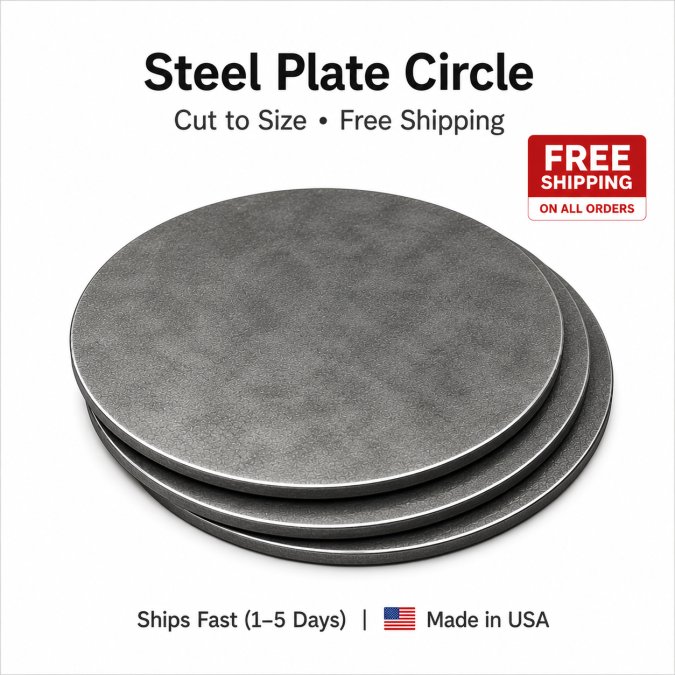
Steel plate circle -- 1/4" Thick-A36 Hot Rolled
It's the baseline structural steel in the United States. When a drawing calls for "mild steel plate" without a grade, A36 is usually what's meant.
A36 steel plate is a low carbon steel with a maximum carbon content of 0.26%, which keeps it ductile, easy to weld, and forgiving under load.
What Does ASTM A36 Mean?
ASTM A36 is the standard specification covering carbon structural steel shapes, plates, and bars. It's the most widely referenced structural steel standard in the country.
The "36" refers to minimum yield strength in ksi. That single number drives most design decisions. The spec also sets a tensile strength range of 58,000 to 80,000 psi and a minimum 20% elongation in 8 inches, which is where the ductility comes from.
A few practical points about the standard:
- It covers various plate thicknesses, though most shop work happens well below that
- Material is identified by UNS number K02600
- ASME SA36 is the boiler and pressure vessel code equivalent, essentially the same chemistry and properties
- Mill test reports are how you verify a heat actually meets the spec
Anyone can stamp "A36" on a shipping label. A material test report ties the plate to a specific heat number and chemistry.
Is A36 Steel Hot Rolled?
A36 steel is almost always supplied hot rolled. The mill heats a slab above its recrystallization temperature and rolls it to finished thickness, leaving a dark, scaled surface.
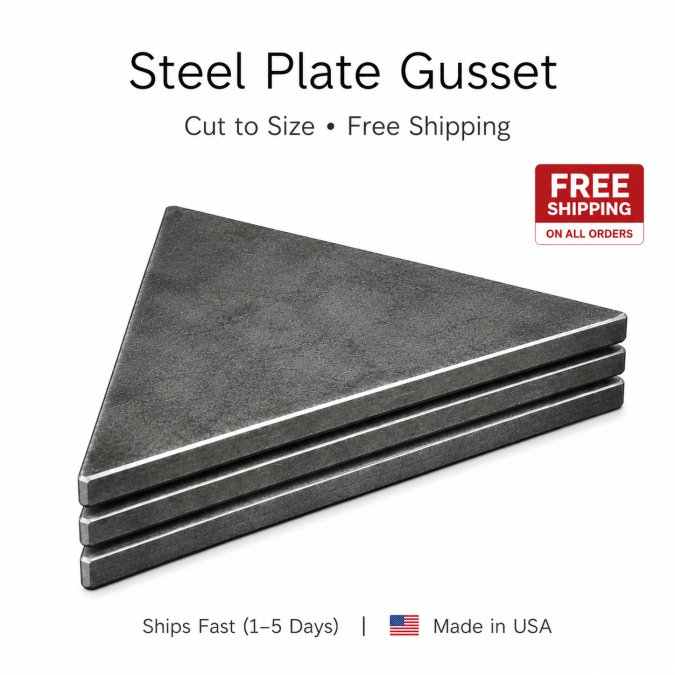
1/4" Thick gusset plate.
Hot rolling refines the grain structure and leaves the material in a normalized-ish state that machines and welds predictably. Cold rolling gives tighter tolerances and a smoother finish but introduces work hardening and limits practical thickness.
The practical consequence is dimensional tolerance. Hot rolled A36 steel plate thickness varies within the mill's allowance, and the surface carries mill scale. Neither is a defect. Both are things you plan around when you're laying out a weld or measuring for a fit.
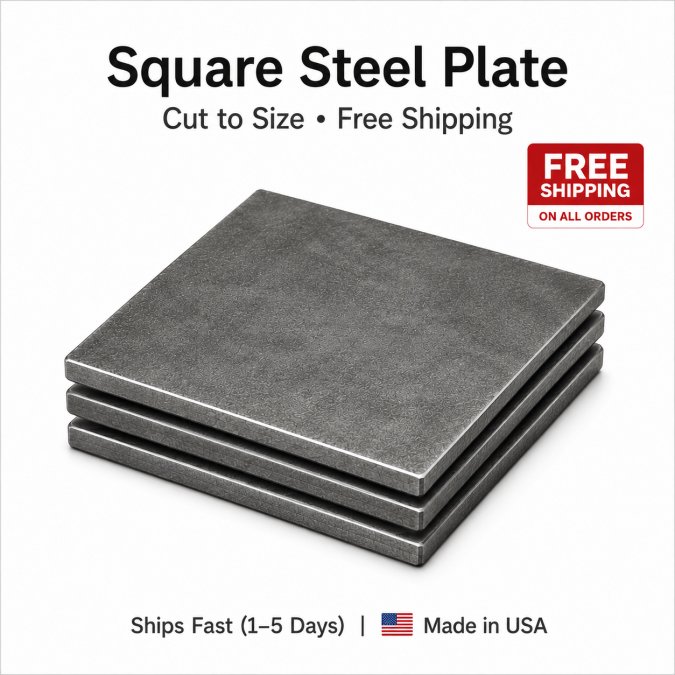
A36 Steel Plate, 1/4" thick.
Common Uses for A36 Steel Plate
A36 steel plate shows up anywhere a fabricator needs strong, weldable, affordable flat material.
Structural and construction work. Base plates, gussets, connection plates, and column shims, the default when the load path is defined and corrosion isn't the concern.
Trailer and equipment repair. Frame reinforcement, crossmembers, and patch plates. The 1/4" thickness is the workhorse, rigid enough for structural repairs, still manageable with common shop tools.
Farm and agricultural equipment. Implement repairs, hitch plates, and custom brackets take a beating and get welded in the field.
Industrial machinery and mounting. Motor mounts, pump bases, and machine leveling plates.
DIY and hobby fabrication. Workbenches, welding tables, brackets, and custom projects where the material needs to be predictable and available in small quantities.
A36 Steel Plate Thicknesses and Sizes
A36 steel plate thickness is measured in inches or fractions. Common shop thicknesses include 1/4", which is a frequently ordered size for general fabrication.
Plate is typically sold by thickness and cut to a specified width and length. Standard stock sizes exist, but most buyers need a specific size.
That's where cut-to-size ordering changes the math. If your project needs a 15" x 27" piece, buying a full sheet and cutting it down wastes material, shipping weight, and time. Ordering A36 steel plate cut to size means you pay for what you use.
Available A36 steel plate sizes depend on the supplier and thickness. At JWM Metal Supply, our 15" x 27" Steel Rectangle Plate in 1/4" A36 hot rolled is a stocked size, and we cut custom lengths and sizes as long as the piece is shippable.
A36 Steel Plate Shapes: Circles, Squares, and Rectangles
Most A36 steel plate is sold as rectangles, but shape matters. A36 steel rectangles cover most fabrication work: brackets, plates, and reinforcements. A36 steel squares suit mounting plates and machine bases with a symmetrical footprint. A36 steel circles are used for flanges, round base plates, and rotating equipment components.
Cutting a circle from a rectangular plate leaves scrap. If your design calls for a round part, ordering a pre-cut circle usually beats cutting one yourself.
Shape |
Typical Use |
Ordering Note |
|---|---|---|
Rectangle |
Brackets, base plates, patches |
Most economical, least waste |
Square |
Mounting plates, machine bases |
Often cut from rectangle stock |
Circle |
Flanges, round base plates |
Pre-cut saves scrap and layout time |
Carbon Steel Plate Weight Calculation: How Much Does A36 Steel Plate Weigh?
A36 steel plate weight is calculated from the density of steel, approximately 0.284 pounds per cubic inch.
The standard formula for plate weight is:
Weight (lbs) = Length (in) × Width (in) × Thickness (in) × 0.284
Nothing about A36 changes the density, so a 1/4" plate of A36 and a 1/4" plate of any other carbon steel grade weigh the same.
Why does this matter before you order? Because weight drives shipping cost, and shipping cost drives whether a small order makes sense.
Quick Weight Examples for Common Plate Sizes
Here's how the formula plays out on real 1/4" A36 plate sizes:
Plate Size |
Thickness |
Weight (approx.) |
|---|---|---|
15" × 27" |
1/4" |
28.7 lbs |
12" × 12" |
1/4" |
10.2 lbs |
12" × 24" |
1/4" |
20.4 lbs |
6" × 12" |
1/4" |
5.1 lbs |
Notice the pattern: a 1/4" plate weighs about 10.2 pounds per square foot. Once you know that number, you can estimate any size in your head.
Cutting A36 Steel Plate
A36 cuts cleanly with nearly every common process, one reason it dominates general fabrication.
The method depends on thickness, precision, and volume. Plasma cutting is efficient for various materials and handles curves well. Abrasive saws and band saws work for straight cuts on smaller pieces. Angle grinders and cutting wheels handle field work and trimming.
For shop production, CNC plasma cutting gives consistent sizing and clean edges on plate up to the thickness it's rated for. The trade-off is a heat-affected zone along the cut edge, which is normal and generally doesn't affect structural performance in A36.
One thing to plan for: cut edges are sharp. Deburring before handling isn't optional if anyone else will touch the plate.
Welding A36 Steel Best Practices
Welding A36 steel is straightforward, a large part of why the grade is so common. With a maximum carbon content of 0.26%, it sits comfortably in the weldable range for low carbon steel.
The best practices are less about exotic technique and more about discipline:
- Clean the joint first. Mill scale, oil, and surface rust introduce porosity and inclusions. Grind to bright metal where it matters.
- Match filler to the base metal. ER70S-6 or E7018 are standard choices for A36 and produce sound welds in most positions.
- Control heat input. A36 tolerates a wide range, but excessive heat on thin plate causes distortion and burn-through.
- Preheat thick sections in cold conditions. Cold plate pulls heat out of the weld fast. A modest preheat helps on heavier sections.
- Watch restraint. Highly restrained joints in any steel can crack. Sequence your welds to let the plate move.
For A36 steel plate used in welding, the material is forgiving. Most failures trace back to joint prep and fit-up, not the plate.
Drilling and Machining A36 Steel
A36 machines well with standard shop equipment, though it isn't a free-machining grade. The low carbon content means it forms a gummy chip rather than the short, brittle chips from resulfurized steels.
Practical guidance for drilling and machining:
- Use sharp bits and the right speed. High-speed steel or carbide tooling at moderate surface speed. Too fast burns the edge, too slow work-hardens the surface.
- Use cutting fluid. A36 will drill dry, but fluid extends tool life noticeably.
- Watch for work hardening. Light passes and consistent feed beat heavy pressure on a dull tool.
- Expect mill scale to dull tooling. Scale is abrasive. Removing it before machining saves edges.
The trade-off between machinability and weldability is real. Grades engineered to machine easily often do so because of added sulfur, which can promote porosity in welds. A36 sits on the weldable side of that trade-off, the right default for structural and repair work.
Mill Scale and Surface Condition
Mill scale is the dark, flaky oxide layer that forms on hot rolled steel as it cools. It's a normal characteristic of A36 hot rolled steel plate, not a defect.
What you should expect on delivery:
- Mill scale, which may be uneven across the plate
- Light surface rust, especially after transit or storage in humid conditions
- Oily or dirty surfaces from handling and cutting
- Minor surface imperfections that don't affect structural integrity
None of these change the plate's strength, but they change how you prep it. Mill scale must come off anywhere you're welding, and before painting or coating.
For corrosion protection, A36 has no inherent atmospheric corrosion resistance, that's what A588 weathering steel is for. In practice, A36 plate gets protected with primer, paint, galvanizing, or powder coating, and the prep work determines how long the coating lasts.
A36 Steel Plate vs Other Carbon Steels
A36 is a general-purpose structural steel, not a specialty grade. Knowing where it stops being the right answer saves money and rework.
A36 vs A572. A572 is a high-strength low-alloy steel available in grades 42, 50, 55, and 60. Grade 50 delivers 50,000 psi minimum yield versus A36's 36,000 psi, roughly a 39% increase. That gap matters when the design is weight-sensitive: a beam, bracket, or gusset sized in A572-50 can often be thinner than the same part in A36 for the same load, reducing material weight and freight. The trade-offs are real. A572-50 costs more per pound, is stocked in fewer sizes, and its alloy content (typically vanadium, columbium, or nitrogen) makes it slightly less forgiving to weld than A36 in cold or highly restrained conditions. If weight isn't the constraint, A36 is cheaper and easier to source.
A36 vs A992. A992 is a wide-flange beam specification, not a plate grade. It gives consistent yield and tensile properties for structural shapes, with a 50 ksi minimum yield and a 65 ksi maximum tensile. It is not a substitute for plate.
A36 vs A588. A588 is weathering steel with added copper, chromium, and nickel for atmospheric corrosion resistance. It costs more and is specified when exposed steel is part of the design intent, bridge girders, outdoor sculptures, unpainted architectural elements. A36 has no comparable atmospheric corrosion resistance and needs a coating system in exposed service. Beyond surface protection, structural integrity depends on the mechanical limits involved when lifting steel beams safely into position.
Grade |
Min. Yield |
Min. Tensile |
Best For |
Trade-off |
|---|---|---|---|---|
A36 |
36 ksi |
58 ksi |
General fabrication, repair, brackets |
No corrosion resistance |
A572-50 |
50 ksi |
65 ksi |
Weight-sensitive structures |
Higher cost, less stock, tighter weld controls |
A992 |
50 ksi |
65 ksi |
Structural wide-flange beams |
Not a plate grade |
A588 |
50 ksi |
70 ksi |
Exposed weathering steel |
Premium price, limited sizes |
A few practical rules of thumb:
- If the drawing says A36, use A36. Substituting a higher-strength grade changes the stiffness of the assembly even when strength is adequate, because stiffness tracks the modulus of elasticity, essentially the same (~29,000 ksi) across all these carbon steels. A572-50 is not a drop-in for deflection-controlled parts.
- If weight is the problem, price A572-50. On a long span or lift-limited install, the thinner section can pay for the higher per-pound cost.
- If the part is a repair or a bracket, A36 is almost always the right call. It welds easily, machines predictably, and is the most widely stocked plate grade in the country.
For most repair, bracket, and general fabrication work, A36 is the correct and most economical choice. The comparison only matters when the design is weight-sensitive, exposed to weather, or governed by a specification that names a different grade.
Choosing the Right Plate Thickness
Plate thickness should come from the load, not from what's on the shelf. In real shop practice, thickness decisions come down to a handful of variables: what the plate has to carry, how far it spans unsupported, how much deflection is acceptable, and how it will be attached.
Start with the load path. If the plate is structural and the load path is engineered, use the specified thickness. The drawing thickness already accounts for the load, span, safety factor, and connection detail.
Then check the span. Deflection scales with the cube of the span, so doubling the unsupported distance increases deflection roughly eight times for the same thickness and load. A 1/4" plate that feels rigid at 12" between supports can feel springy at 24". If you're spanning farther, step up in thickness or add support.
Match the parent section on repairs. If you're reinforcing or patching, match or exceed the parent material thickness. Going thinner defeats the purpose, and going much thicker creates a stiffness mismatch that concentrates stress at the weld toe.
Think about weld distortion before you commit. Thinner plate distorts more under the same heat input. A 3/16" plate welded on one side of a long seam will pull noticeably; a 1/4" plate of the same length will move less. If the part has to stay flat, thicker plate or balanced weld sequencing is the answer.
Consider how the plate will be fastened. A 1/4" plate takes a tapped thread reasonably well in most applications. Thinner plate needs a nut, a weld nut, or a through-bolt because there isn't enough material for reliable threads.
A quick decision framework:
- Load-bearing, engineered: use the drawing thickness
- Repair or reinforcement: match the parent section
- General brackets and plates: 1/4" is the safe default
- Light covers and shims: 3/16" or thinner
- Heavy machine bases: step up and check deflection
A common pattern in shop practice is to size the plate for stiffness first and strength second. Yield strength rarely governs a plate already thick enough to resist deflection.
When in doubt, order a size that matches the job rather than the closest stock size. A36 steel plate cut to size lets you specify the thickness the design calls for instead of what the supplier happens to have on the rack.
Custom Cut Steel Plate Services: Ordering A36 Steel Plate Cut to Size
Custom cut steel plate services solve the problem standard stock sizes create: waste. Ordering a plate cut to your exact dimensions means less material to trim, less weight to ship, and less time on the saw.
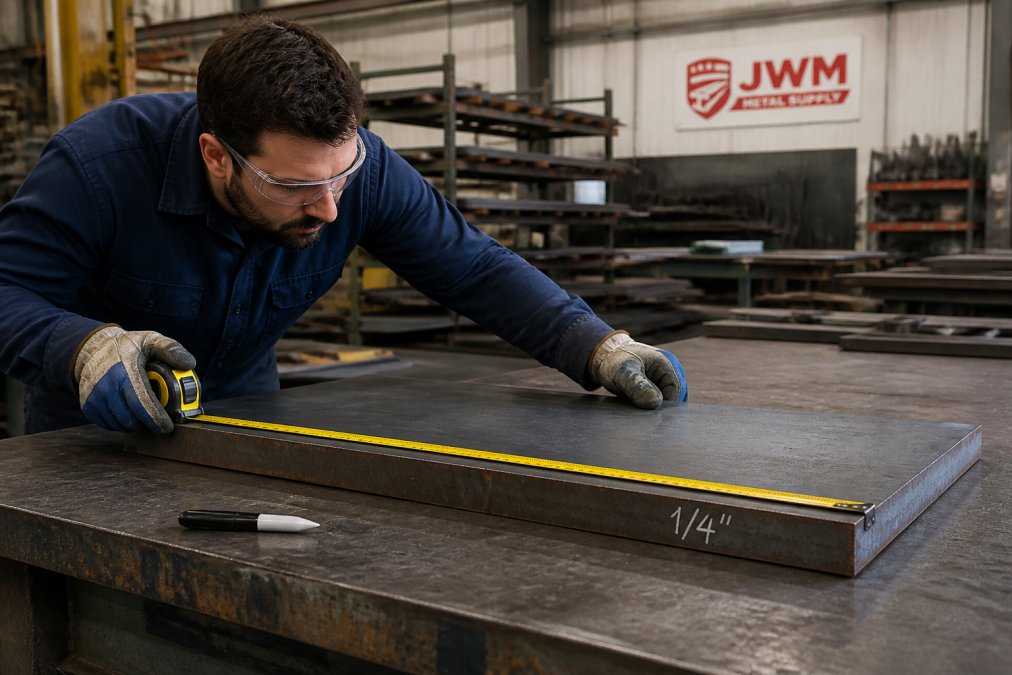
What to check before you buy A36 steel plate online:
- Is the size cut to order, or pulled from stock? Cut-to-order means you get your dimensions, not the closest standard size.
- What's the tolerance? A stated tolerance like ±1/16" tells you what to expect on the fit.
- Is there a minimum order? Some suppliers won't cut a single small plate. Others will.
- Are material certifications available? For load-bearing work, this is the difference between a documented plate and an unknown one.
- What's the actual lead time? Ask for the ship date, not a range.
- What are the total costs? Cutting, handling, and shipping should be clear before you commit.
JWM Metal Supply cuts A36 steel plate to exact length with no minimum order quantity, ships free, and makes material certifications available.
Frequently Asked Questions
Is A36 steel the same as mild steel?
A36 steel is a type of mild steel, but not all mild steel is A36. Mild steel is a broad category of low carbon steel with roughly 0.05% to 0.25% carbon. A36 is a specific grade defined by ASTM International with guaranteed minimum yield strength of 36,000 psi and tensile strength of 58,000 to 80,000 psi. When you buy A36 steel plate, you get documented mechanical properties that generic mild steel may not carry.
How do you calculate the weight of A36 steel plate?
Use the formula: weight (lbs) = length (in) x width (in) x thickness (in) x 0.2836. The 0.2836 factor is the density of steel in pounds per cubic inch. For example, a 12 in x 12 in x 1/4 in A36 steel plate weighs about 10.2 lbs (12 x 12 x 0.25 x 0.2836). This carbon steel plate weight calculation works for any flat plate size and is the same formula fabricators use to estimate shipping and load limits.
Is A36 steel easy to weld?
Yes. A36 is one of the most weldable structural steels available. Its low carbon content, typically 0.25% to 0.29% max, means it resists cracking and accepts common processes like MIG, TIG, stick, and flux-core without preheat. For best results, clean mill scale from the weld zone, use ER70S-6 filler wire, and match your amperage to the plate thickness.
What is the difference between A36 and other carbon steels?
A36 is a general-purpose structural steel with 36,000 psi minimum yield strength. A36 costs less, welds more easily, and is stocked in more shapes and thicknesses. For most repair, bracket, and fabrication work, A36 steel plate delivers the best balance of strength, weldability, and price.
Buying steel plate online comes down to trust: that the grade is what the label says, the dimensions match the order, and the material shows up when promised. JWM Metal Supply cuts every A36 steel plate to your specifications in our Kansas shop, backs it with material certifications on request, and ships free with no minimum order. Shop Now and get American-made A36 steel plate cut to size, ready to ship in 1-5 business days.