

Last Updated: October 23, 2026
Quick Summary
To calculate plate deflection for shelving, use δ = 5wL⁴ / (384EI) for a simply supported plate under uniform load, where L is span, E is 29,000,000 psi, and I is the moment of inertia. Compare the result to an L/360 limit, then check bending stress against yield.
- The L⁴ term means doubling span increases deflection sixteen times.
- For a 12-inch wide, 0.25-inch thick plate, I equals 0.0156 in⁴.
- A 36-inch span with a 300-pound load deflects about 0.40 inches, failing L/360.
- A36 steel has a yield strength of 36,000 psi.
- Add a center support to cut deflection to one-sixteenth of the original.
What Steel Plate Deflection Means for a Shelf
Plate deflection is the amount a steel shelf bends downward under load, measured at its weakest point. Every loaded shelf flexes. The question is whether it flexes enough to sag, spring back wrong, or fail.
Here is the part most shelf builders get wrong: a shelf that looks fine empty can droop visibly once loaded. The math below tells you how much before you cut steel.
Simply Supported vs. Fixed Edge Conditions
A simply supported plate rests on its edges and can rotate freely. Think of a shelf sitting in angle iron brackets. It deflects more, but the math is simpler.
A clamped plate has edges welded or bolted rigidly. Clamped edges resist rotation, so the same plate deflects less.
Most garage shelves land somewhere in between. We size for simply supported because it is the conservative case.
Elastic vs. Plastic Deformation
Elastic deformation springs back when you remove the load. Plastic deformation does not. Once a shelf bends past its yield strength, it stays bent, and that bend weakens it permanently.
Keep your working load well under the point where bending stress approaches yield strength. That margin is your safety factor, covered below.
The Steel Shelf Deflection Formula Explained
The steel shelf deflection formula for a simply supported plate under a uniform load is:
δ = 5wL⁴ / (384EI)
Where:
- δ = maximum deflection at midspan
- w = load per unit length
- L = span length between supports
- E = Young's Modulus for steel, about 29,000,000 psi
- I = moment of inertia of the shelf cross-section
The L⁴ term is the one that hurts. Double the span and deflection goes up sixteen times. That single exponent explains more shelf sag than any other variable.
Uniformly Distributed Load vs. Point Load
A uniformly distributed load spreads evenly across the shelf, like books or boxes. Use the formula above.
A point load concentrates in one spot, like a heavy vise or a single engine block. Point loads cause higher local deflection and stress concentration. For a point load at midspan, the formula becomes:
δ = PL³ / (48EI)
If you are unsure which applies, assume point load. It is the harsher case.
What You Need Before You Calculate
Gather these four values before you touch a calculator:
- Span length (L) in inches, measured between support centers
- Shelf width in inches, for load per unit length
- Plate thickness in inches
- Total load in pounds, including the shelf's own weight
You also need two material properties for steel: Young's Modulus (29,000,000 psi) and Poisson's ratio (about 0.3). Both are standard for carbon steel.
A 1/4" A36 plate is a common starting point for garage shelving. Our 15" x 27" A36 hot rolled plate is a good size for a short-span shelf bay, and A36 is weldable and easy to drill for brackets.

Step-by-Step: Calculating Deflection on a Steel Shelf
Here is the process we walk customers through, start to finish.
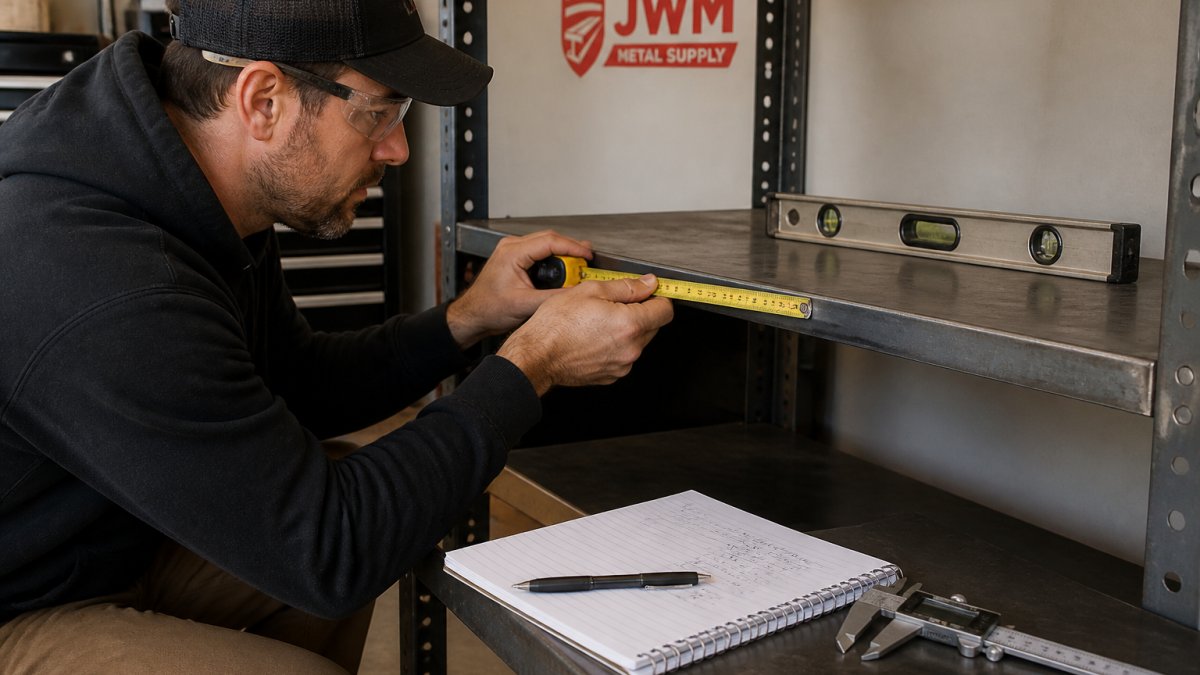
Step 1: Measure the clear span. Measure bracket center to bracket center, not edge to edge.
Step 3: Convert to load per unit length (w). Divide total load by shelf length in inches.
Step 5: Plug into the formula. δ = 5wL⁴ / (384EI).
Step 6: Compare to your limit. A common deflection limit is span divided by 360, or L/360.
Shelf Load Capacity Calculation and Safety Factor
Shelf load capacity calculation starts with bending stress, not deflection. A shelf can pass the deflection check and still fail on stress, and the reverse is also true. You need both numbers before you trust the design.
The Stress Calculation, Step by Step
Bending stress for a simply supported shelf is σ = Mc/I, where M is the maximum bending moment and c is half the plate thickness. For a uniform load, M = wL²/8.
Using the same 36-inch span, 12-inch-wide, 1/4-inch plate from the deflection walkthrough, with a 300-pound total load (w = 8.33 lb/in):
- Maximum moment: M = wL²/8 = (8.33 × 36²) / 8 = (8.33 × 1,296) / 8 ≈ 1,350 lb-in.
- Section modulus: c = 0.125 in, I = 0.0156 in⁴, so I/c = 0.0156 / 0.125 = 0.125 in³.
- Bending stress: σ = M / (I/c) = 1,350 / 0.125 = 10,800 psi.
Compare that to the yield strength of A36 steel, which is 36,000 psi. The stress is about 30 percent of yield, so the plate is not close to permanent bending at that load. The deflection check, however, failed.

When Stress Controls Instead
On a short, heavily loaded span the order flips. A 12-inch span carrying the same 300 pounds produces a much smaller moment, but a concentrated point load or a narrow shelf can push stress toward yield before deflection looks alarming. Run both checks every time; do not assume one governs.
Choosing a Safety Factor
A safety factor is the ratio of yield strength to your working stress. A factor of 2.0 means you design for half of yield, or 18,000 psi for A36.
Application |
Suggested Safety Factor |
Working stress limit for A36 |
Notes |
|---|---|---|---|
Light storage, home garage |
2.0 |
18,000 psi |
Books, tools, boxes |
Workshop bench shelf |
2.5 |
14,400 psi |
Vises, parts, vibration |
Overhead or walk-under shelf |
3.0+ |
12,000 psi or less |
Anything above head height |
Overhead shelves deserve more margin because a failure is a hazard, not an inconvenience. Vibration and repeated loading also argue for a higher factor, since cyclic stress can initiate cracks at welds or bolt holes over time.
Deflection Limit vs. Stress Limit: Which One Wins
A simple decision rule keeps you from overthinking it:
- Long span, light load: deflection almost always controls. Shorten the span or add a support before adding thickness.
- Short span, heavy load: stress often controls. Check the section modulus and consider a stiffer cross-section.
- Both fail: the design is undersized; change geometry, not just material.
How to Spot Failure Before It Happens
Numbers are the primary tool, but visual inspection catches what a calculator misses. Watch for these indicators:
- Permanent set after unloading. If the shelf does not return to flat when you remove the load, you have crossed into plastic deformation. That bend weakens the plate permanently and the shelf should be replaced or reinforced.
- Visible bow at midspan under load. A straightedge or a level laid across the shelf shows the gap. Compare it to your L/360 limit; if the gap grows over time under the same load, the plate is yielding.
- Springiness or bounce. A shelf that feels lively under a hand press is deflecting more than it should, even if it has not bent permanently.
- Weld or bolt-hole cracking. Cracks at connections signal stress concentration and cyclic fatigue. Stop using the shelf and inspect the joints.
- Local dimpling under a point load. A concentrated load can dent a thin plate well before the overall span deflects. That dent is plastic deformation at the contact point.
When to Use a Shelf Deflection Calculator
A shelf deflection calculator earns its keep when the geometry gets complicated: multiple supports, mixed loads, or a shelf with cutouts.
For a simple rectangular shelf on two supports, the hand formula is faster and you learn more doing it. For anything with three or more supports, a stiffener, or a non-uniform load, use a calculator or a spreadsheet you build once and reuse.
Be careful with online calculators that ask only for span and load. They often assume a beam, not a plate, and they skip the stress check entirely.
How to Reduce Shelf Sag in Practice
Reducing sag comes down to four levers, ranked by how much they help:
- Shorten the span. The L⁴ term makes this the biggest win. Add a center support and deflection drops to one-sixteenth of the original.
- Add a stiffener. A welded rib or a folded lip boosts the moment of inertia without adding much weight.
- Increase thickness. Deflection scales with 1/d³, so going from 1/4" to 3/8" cuts deflection substantially.
- Fix the edges. Welding or bolting the shelf edges to a frame moves you toward clamped behavior and cuts deflection further.
In practice, a center support plus a welded lip solves most garage shelf sag without changing plate size. Our 1/4" x 6" A36 flat plate can be used for stiffener ribs for this job.

Common Mistakes to Avoid
The errors below show up in nearly every shelf build we hear about.
- Measuring edge to edge instead of center to center. Your span is longer than you think, and L⁴ punishes the error.
- Forgetting the plate's own weight. A 1/4" plate adds real load, especially on wide shelves.
- Using beam formulas for wide plates. A 24" wide shelf is a plate, not a beam, and beam math understates deflection.
- Ignoring support conditions. Assuming clamped edges when the shelf just rests in a bracket gives you a false sense of safety.
- Skipping the stress check. Deflection passing does not mean the shelf is strong enough.
- Loading one corner. Off-center loads deflect more than the formulas predict for centered loads.
Shelf sag is a calculation problem, not a mystery. Measure your span, run the formula, check both deflection and stress, and size your plate with a real safety factor. When you are ready to cut, JWM Metal Supply stocks American-made A36 plate cut to your exact dimensions, with no minimum order and material certifications available on request.
Frequently Asked Questions
How do you calculate deflection in a steel shelf?
Use the simply supported plate formula for a uniformly distributed load: maximum deflection equals 5 times the load per unit area times the span length to the fourth power, divided by 384 times Young's Modulus times the moment of inertia. For A36 steel, Young's Modulus is about 29,000 ksi. Measure your span, thickness, and expected load first, then run the numbers. Keep the result under an appropriate deflection limit for a shelf that stays visually flat under load.
How much can a steel shelf deflect under load?
A common rule for shelving involves a deflection limit. For example, a 36-inch span would have a specific deflection limit at full load. Stiffer limits like span divided by 360 are used where the shelf sits under precision equipment or glass. Deflection beyond the elastic range means the plate has yielded, and it will not spring back when unloaded.
Does shelf depth or span affect steel plate deflection?
Span affects deflection the most. Deflection rises with the fourth power of span length, so doubling the span increases sag roughly sixteen times for the same load and thickness. Depth matters too: a wider plate carries more total load, but the unsupported span between supports is what drives bending. Shortening the span with a center support is the fastest way to cut deflection.
How can you reduce deflection in a steel shelf?
Add a center support or stiffener to shorten the span, increase plate thickness, or switch edge conditions from simply supported to clamped by welding or bolting the edges down. You can also reduce the load per square foot or add a front and back lip to raise the moment of inertia. Combining a shorter span with a thicker plate usually beats either change alone.
