

Last Updated: October 21, 2026
Why Buying a Full Stick of Steel Tubing Wastes Money
Most suppliers sell steel tubing in 20-foot or 24-foot full sticks. If your project needs three feet, you are paying for seventeen feet of material that goes into the scrap pile.
At JWM Metal Supply, we cut every order to the length you actually specify. No full sticks, no minimum quantity, no leftover steel sitting in your garage.
A full stick makes sense for a production shop running the same part all week.
Steel Tubing Cut to Size: What to Expect From a Supplier
Steel tubing cut to size means the supplier cuts each piece to your specified length before shipping, so you receive project-ready material instead of a full mill length.
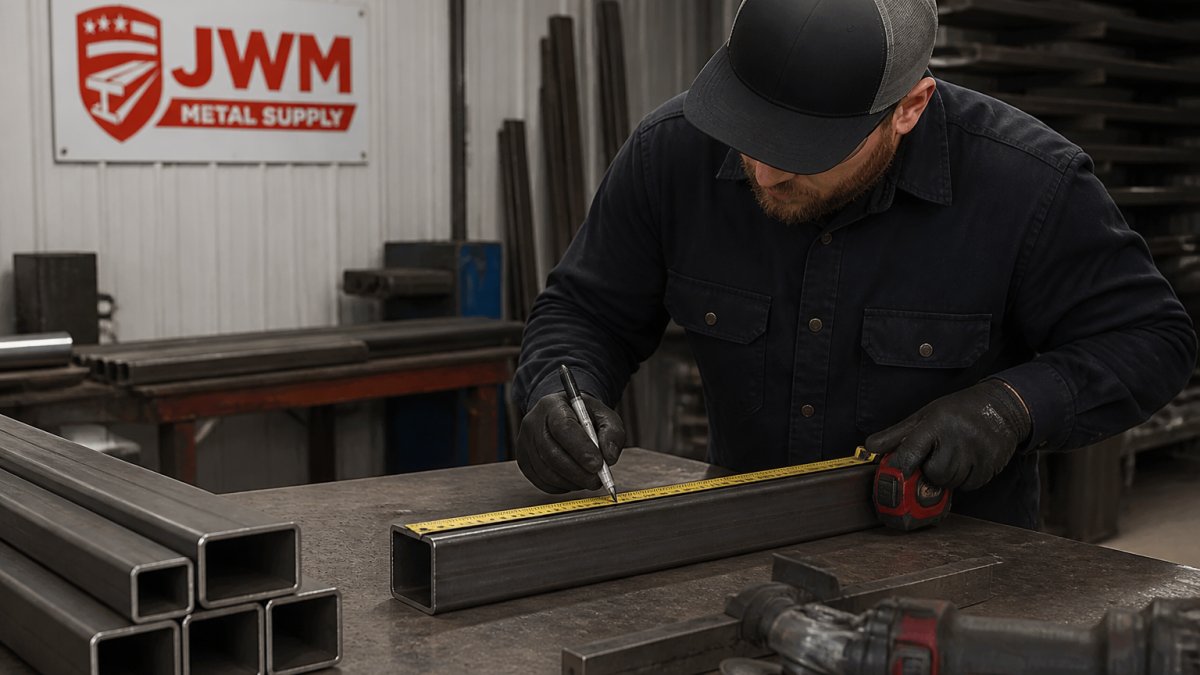
Three things matter when you order cut-to-length tubing: the tolerance, the finish, and the return policy. JWM Metal Supply cuts to a ±1/8" tolerance on shop equipment.
Raw steel may arrive with mill scale, light surface rust, oil, or residue. That is normal for unfinished material and does not affect structural performance.
How to Request a Cut-to-Length Order
Requesting a cut-to-length order is mostly a specification exercise. The supplier can only cut what you clearly describe, so the quality of your cut list decides how close the delivered pieces come to your drawing. Work through these steps in order.
- Pick the shape and outside dimension. Decide between square, rectangular, and round tubing, then lock the outside dimension from your drawing. Do not order by "about an inch", order the exact outside dimension the design calls for.
- State the wall thickness in decimal, not just gauge. Gauges vary between standards, so write both: for example, 16ga (0.065") or 14ga (0.083"). If the drawing only shows a gauge, convert it to decimal before you order.
- Name the material grade. Common carbon steel tube grades include A500 Grade B and A513. The grade affects strength, weldability, and how the tube behaves under load, so put it on the cut list rather than leaving it to the supplier's default.
- Measure each piece and add your tolerance allowance. Measure from the drawing, not from a tape measure on site. If a piece must fit between two fixed points, decide whether you want the nominal length or a slightly under-length piece that gives you room to fit.
- Write the cut list in inches, one line per piece. A clean list looks like this: 1 x 1 square tubing, 16ga (0.065"), A500 Grade B, four pieces at 18", two pieces at 36". Group identical pieces on one line and keep the total piece count visible.
- Confirm the total piece count and the cut charge before checkout. Cutting is often priced per cut or per piece, so the piece count drives the final number. Ask whether the cut charge is included in the listed price or added at checkout.
- Ask for the tolerance and return policy in writing. Custom cuts are usually non-returnable, so confirm the tolerance and the return terms before you pay, not after the pieces arrive.
Suppliers quote faster when the list is unambiguous. A cut list that mixes gauges, omits the grade, or lists lengths in feet and inches invites a clarifying email that delays the order.
What the Cut Tolerance Means for Your Fit
A ±1/8" tolerance is fine for most frames, brackets, and repairs, but it matters when a piece has to sit between two fixed points. If the gap is tight, order the piece slightly under-length and take up the difference with a weld gap or a shim rather than ordering to the exact nominal length and hoping the cut lands on the high side.
Steel Tubing by the Foot: Pricing and Minimums Compared
Buying steel tubing by the foot removes the full-stick requirement entirely. You pay for the length you order, and the minimum order is often a single piece.
Here is how the common purchase channels compare on the factors that actually affect your total:
Purchase Channel |
Minimum Order |
Cut to Length |
Typical Trade-off |
|---|---|---|---|
Online cut-to-length supplier |
One piece |
Yes, to ±1/8" |
Small cutting tolerance to plan around |
Local metal retailer |
Varies by store |
Sometimes, in-store only |
Trip required, limited short-length stock |
Full-stick distributor |
One full stick |
No |
Pay for unused material |
Scrap yard or surplus dealer |
One piece |
No, sold as found |
Condition varies, grade often unmarked |
JWM Metal Supply prices per piece with no minimum order quantity. A 1/2" x 1/2" x 16ga square tube starts at $30.12, and a 3/4" x 3/4" x 16ga piece starts at $23.87.

The trade-off with any cut-to-length order is the tolerance. If your application needs machined ends, budget for a finishing pass after delivery.
Steel Tubing Drop Pieces and Offcuts: Where to Find Them
Steel tubing drop pieces are the short remainders left over after a shop cuts a larger order. They are sold cheaply or by weight, and they suit small brackets, repairs, and one-off projects where exact grade matters less than price.
Finding them takes legwork. Local fabrication shops, welding suppliers, and scrap yards are the usual sources. Call ahead and ask what short lengths they have in square or rectangular tubing, and confirm the wall thickness before you drive over.
How to Call a Shop About Drop Pieces
Most shops do not list drop pieces anywhere. The inventory changes every week, and the person who knows what is on the rack is usually on the floor, not at a front desk.
Use a script like this:
- "Do you have any short cutoffs in square or rectangular tubing under four feet?"
- "What outside dimensions and wall thicknesses are on the rack right now?"
- "Is the grade marked, or is it mixed?"
- "How do you sell it, by the piece, by the pound, or by the bundle?"
- "Can I come by this week to look through it?"
Ask about the selling unit before you drive over. Some shops sell drop pieces by the piece, some by weight, and some only as a mixed bundle. Knowing the unit tells you whether a small load is worth the trip.
How to Evaluate a Drop Piece Before You Buy
Drop pieces rarely come with a material cert, and grade is often unmarked. That does not make them unusable, but it changes what you can safely do with them. Run through these checks before the material goes into a project.
- Corrosion. Look for pitting, flaking, and deep rust, not just surface discoloration. Light surface rust cleans up; pitting does not.
- Damage. Check for dents, kinks, crushed ends, and bends that will not straighten. A kinked tube loses stiffness at the kink no matter how you orient it.
- Dimensional accuracy. Measure the outside dimension and wall thickness with calipers. Drop pieces are sometimes mislabeled, and a tube that measures undersize will not match the rest of your stock.
- Straightness. Sight down the length against a straightedge. A piece that is visibly bowed is hard to use in a frame.
- Markings. Look for stenciled grade, mill marks, or heat numbers. If none are present, treat the grade as unknown.
- Weldability. Unknown grade means unknown weldability. Test a scrap end before you commit a finished part to it.
For a decorative bracket, unknown grade is fine. For anything load-bearing, buy new cut-to-length stock with documentation instead. The savings on a drop piece disappear if the part fails or has to be remade.
Square Steel Tubing-1/2" x 1/2" x 16ga (0.065")-Select Length →
Where Drop Pieces Fit in Your Sourcing Plan
Treat drop pieces as a supplement, not a plan. Buy the pieces that carry load or need a known grade as new cut-to-length stock, and use drop pieces for brackets, spacers, jigs, and repairs where the grade does not drive the design. That split keeps the cost down without putting unverified material into the parts that matter.
How to Buy Steel Tubing Online Without Overpaying
Buying steel tubing online comes down to three checks: the total landed cost, the specification match, and the shipping terms.
Start with the total, not the unit price. Add the cut charge, shipping, and any certification fee. A lower per-piece price with paid freight often loses to a slightly higher price with free shipping.
JWM Metal Supply ships free with no minimum order, and orders are ready to ship in 1-3 business days.
Checking Specs Before You Check Out
Verify these five items before you pay:
- Outside dimensions match your drawing
- Wall thickness is stated in gauge and decimal
- Material grade is named (A500 Grade B or A513)
- Cutting tolerance is published
- Return policy for custom cuts is clear
A common mistake is ordering by gauge alone. Gauges vary in decimal thickness between standards, so confirm the decimal wall thickness in the listing. Our 1" x 1" square tubing comes in 16ga (0.065"), 14ga (0.083"), and 11ga (0.120") walls, and each one behaves differently under load.

American Society for Testing and Materials standards for steel tube
Total Cost Comparison: Cutting, Shipping, and Minimum Orders
The cheapest steel tubing is the order with the lowest total cost, not the lowest unit price.
Waste is the hidden one. A full stick you only partly use carries the cost of the unused remainder plus storage.
Freight is the second swing factor.
U.S. General Services Administration guidance on commercial item purchasing
Our recommendation: price the exact pieces you need, delivered, from two or three sources, and compare the final number.
Conclusion
The hard part of buying short lengths of steel tubing is not finding a supplier.
JWM Metal Supply cuts American-made carbon steel tubing to your specifications, ships free with no minimum order, and gets orders out in 1-3 business days. Material certifications are available when your project needs documented grade.
Shop Now and order the lengths your project actually requires.
Frequently Asked Questions
Can I order a single piece of steel tubing online?
Yes. Many suppliers sell steel tubing by the piece with no minimum order, so a single cut length ships just like a larger order. JWM Metal Supply sells square steel tubing in select lengths starting at $23.87 for 3/4" x 3/4" x 16ga, with no minimum order quantity. You pick the outside dimensions, wall thickness, and length from the product page, and the piece is cut to your specification before shipping. Confirm the cutting tolerance before ordering, since custom-cut steel is typically non-returnable.
Do metal suppliers sell steel tubing drop pieces or offcuts?
Some do, but availability is unpredictable because drop pieces depend on what other customers ordered. Local fabrication shops, scrap yards, and surplus dealers are the most common sources for steel tubing drop pieces. Inspect any offcut for bends, heavy rust, or wall thinning before you buy, and measure the actual wall thickness rather than trusting the label. If you need a specific grade or a consistent length for a load-bearing project, ordering steel tubing cut to size is more reliable than hunting for offcuts.
What is the difference between a full stick and a cut-to-length steel tube?
A full stick is the standard mill length a supplier stocks, commonly 20 or 24 feet, and you buy the whole thing whether your project needs it or not. A cut-to-length tube is trimmed to the exact length you specify, so you pay for the material you will actually use. For a one-off repair or a small frame, cut-to-length avoids storing leftover steel and paying for scrap. Expect a cutting tolerance of about ±1/8" on custom cuts, and note that cut pieces are usually non-returnable.
How do I choose the right size and wall thickness for steel tubing?
Start with the load the tube carries and the space it fits into. Outside dimensions set the footprint, while wall thickness drives strength: 16ga (about 0.065") suits light frames, brackets, and furniture, and 11ga (about 0.120") handles heavier structural work. Square tubing gives more rigidity than angle or channel for the same footprint. Match the material grade to the job, A500 Grade B is a common structural choice, and ask for material certifications if the part is load-bearing.